Église du Bon-Pasteur is a former Roman Catholic church in the 1st Arrondissement of Lyon, also known as Bon-Pasteur and, in German, Guter Hirte. The parish was requested in 1855 by Archbishop Louis-Jacques-Maurice de Bonald, and Jean-Baptiste-Irénée Callot was assigned to found it, with the patronage of Emperor Napoleon III and Empress Eugénie. The foundation stone was laid by Empress Eugénie in 1869.
The church building was designed by architect Clair Tisseur in a neo-Romanesque style and oriented north-south. It was completed in 1883 and inaugurated the same year with temporary wooden steps for access. Its southern main entrance remained inaccessible because a barracks was not demolished, leaving the entrance four meters above Rue Neyret; the tympanum sculptures can be seen from the street. Side entrances have served as access points since 1883. The church includes stained glass windows by Lucien Bégule and a pulpit by Jules Comparat. Its tower, located on the hill of La Croix-Rousse, is highly visible. The church was desacralized in 1984, later used as an exhibition space by art students from 1992 to 2008, and has since deteriorated, with vandalism and graffiti reported in the interior.
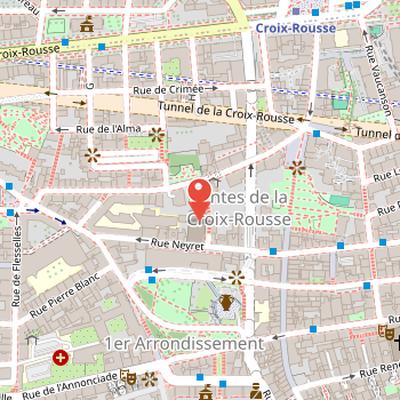
Nearby Objects
-
 Amphitheater of Lyon 130 m away
 -
 Sanctuary of the Three Gauls 130 m away
 -
 Montée de la Grande Côte 150 m away
 -
 Gare de Lyon-Croix-Rousse 250 m away
 -
 Place Sathonay 300 m away
Bon-Pasteur Church in Lyon
The Bon-Pasteur church, also referred to as Guter Hirte in German, is a former Roman Catholic church in the 1st Arrondissement of Lyon. The church is associated with the Kirchenbau Bon-Pasteur in Lyon. In 1984, it was desacralized, marking the end of its religious use.
Foundation of the Parish
In 1855, Archbishop Louis-Jacques-Maurice de Bonald requested the creation of a parish between St-Bruno and St-Polycarpe. That same year, Jean-Baptiste-Irénée Callot was assigned to found the parish. The project also involved the patronage of Emperor Napoleon III and Empress Eugenie. The foundation stone was laid by Empress Eugenie in 1869, marking an important step in the parish's early history.
Architecture and later use
The church building was designed by architect Clair Tisseur in a neo-Romanesque style and completed in 1883. It was oriented north-south and originally included a tower over the southern main entrance. Later, Tisseur's successor to Callot commissioned Joseph-Etienne Malaval to build a spire tower. The church tower is located on the hill of La Croix-Rousse and is highly visible.
Access to the building was shaped by its unusual entrance arrangement. The southern main entrance remained inaccessible because the barracks was not demolished, and it stands four meters above Rue Neyret. At the inauguration in 1883, temporary wooden steps were used, while the side entrances have served as access points since that time. The tympanum sculptures are visible from Rue Neyret.
The church was deconsecrated in 1984. From 1992 to 2008, it was used as an exhibition space by art students. Since 2008, the building has decayed, and its interior has been vandalized and covered with graffiti. The city of Lyon owns the church but has not taken any initiatives regarding it.
Interior Furnishings and Condition
The church interior included stained glass windows by Lucien Begule (1848-1935), as well as a pulpit and tympanum sculptures by Jules Comparat. These furnishings form part of the building's documented interior Ausstattung. In later documentation on several private websites, the church interior was described as being in a devastating condition.