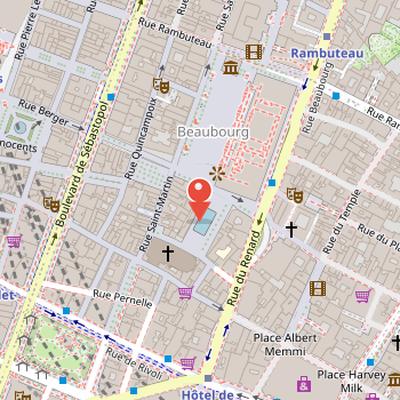
The Stravinsky Fountain is a public fountain and sculpture ensemble on Place Stravinsky, next to the Centre Pompidou in Paris, between the Centre Pompidou and the Church of Saint-Merri. Created in 1983 by sculptors Jean Tinguely and Niki de Saint Phalle, it represents the works of composer Igor Stravinsky through sixteen sculptural forms. The fountain combines black mechanical sculptures by Jean Tinguely with brightly colored sculptures by Niki de Saint Phalle. Its elements include representations of L'Oiseau de feu (The Firebird), La Clef de Sol (The Musical Key of G), La Spirale (The Spiral), L'Elephant (The Elephant), Le Renard (The Fox), Le Serpent (The Serpent), La Grenouille (The Frog), La Diagonale (The Diagonal), La Mort (Death), La Sirène (The Mermaid), Le Rossignol (The Nightingale), L'Amour (Love), La Vie (Life), Le Cœur (The Heart), Le Chapeau de Clown (The Clown's Hat), and Ragtime. The basin covers some rooms and offices of IRCAM (Institut de Recherche et Coordination Acoustique/Musique).
Nearby Objects
-
 Église Saint-Merry 60 m away
 -
 Saints Innocents Cemetery 300 m away
 -
 Musée d'Art et d'Histoire du Judaïsme 350 m away
 -
 Hôtel de Ville 350 m away
 -
 Théâtre de la Ville 350 m away
Design and Location
The Stravinsky Fountain is a whimsical public fountain ornamented with sixteen works of sculpture. It represents the works of composer Igor Stravinsky. Created in 1983 by sculptors Jean Tinguely and Niki de Saint Phalle, it is located on Place Stravinsky next to the Centre Pompidou in Paris.
Sculptural Composition and Location
The Stravinsky Fountain is located in Place Stravinsky, between the Centre Pompidou and the Church of Saint-Merri. It contains sixteen sculptural works inspired by the compositions of Igor Stravinsky. The fountain combines black mechanical sculptures by Jean Tinguely with brightly colored sculptures by Niki de Saint Phalle, creating a strong contrast in form and color.
The individual sculptures are associated with a range of titles drawn from Stravinsky-related themes and imagery. These include L'Oiseau de feu (The Firebird), La Clef de Sol (The Musical Key of G), La Spirale (The Spiral), L'Elephant (The Elephant), Le Renard (The Fox), Le Serpent (The Serpent), La Grenouille (The Frog), La Diagonale (The Diagonal), La Mort (Death), La Sirene (The Mermaid), Le Rossignol (The Nightingale), L'Amour (Love), La Vie (Life), Le Coeur (The Heart), Le Chapeau de Clown (The Clown's Hat), and Ragtime. Together, the works form a public sculptural ensemble organized around references to music, movement, and symbolic figures.
Design and Setting
The basin covers some rooms and offices of IRCAM, the Institut de Recherche et Coordination Acoustique/Musique, an organization devoted to promoting modern music and musicology connected with the Pompidou Center. IRCAM was founded by the composer and conductor Pierre Boulez, who suggested the work of Stravinsky as a theme for the fountain. Because offices and rooms of IRCAM are located below the basin, the fountain was designed to be lightweight, with shallow water, a stainless steel lining, and sculptures of plastics.
Planning and Creation
The Stravinsky Fountain was part of a sculptural program launched by the City of Paris in 1978. The program aimed to create seven contemporary fountains with sculpture in different squares across Paris, including new fountains at the Hotel de Ville and in the Palais Royal gardens. These works were the first public fountains built in Paris since the Palais de Chaillot fountains of 1937. The initiative was tied to the City of Paris redevelopment effort around Les Halles, which had been torn down in 1971. That redevelopment sought to re-animate the area with pedestrian streets, squares, and works of art.
In October 1981, Mayor Jacques Chirac announced a new fountain near the Centre Pompidou. Jean Tinguely and Niki de Saint Phalle were selected to design it, and Chirac required that the fountain have modern lines that would match the Centre Pompidou.
Funding and Support
The Stravinsky Fountain was financed through a combination of public and private support. The City of Paris contributed two million French francs to the project, and Jack Lang, then Minister of Culture, matched that amount. The financial agreement was signed on December 15, 1982. Additional funding came from private sponsors, including Societe Lyonnaise des eaux with 500,000 francs and Fondation Scaler with 150,000 francs. The Swiss government also contributed to the fountain's funding.
Commission, Design Changes, and Dedication
The history of the Stravinsky Fountain began as a commission for Jean Tinguely alone, but the project changed in May 1982 when Tinguely asked that brightly colored works by Niki de Saint Phalle be included. This proposal raised concerns at the Bureau of Monuments, which worried that the colored works would visually dominate the fountain. The Ministry of Culture and the Sous-Direction du Patrimoine intervened and persuaded Tinguely to limit Saint Phalle's contribution to four or five works. The project was then agreed to as a joint work by Tinguely and Saint Phalle.
Tinguely also made specific technical and environmental choices for the fountain. He preferred untreated water so that moss could grow in the basin, and he wanted very low power electric motors in order to reduce electrocution risks. The sculptures were placed on the bottom of the basin rather than attached.
The fountain was dedicated on March 16, 1983 by Mayor Chirac, Minister Jack Lang, and Madame Pompidou. During the ceremony, Chirac and Lang avoided looking at or speaking to each other. Under French law and practice, the French state legally maintains fountains, while artists and their descendants retain moral rights over their works.
After the dedication, Saint Phalle continued to take an interest in the fountain's appearance. In 1985 she requested modifications to the Rossignol sculpture to make it harmonize better with the rest of the work. Five years later, she asked for the Sirène sculpture to be replaced by Nana, but the substitution was never carried out because of cost.
Design Choices and Site Planning
Tinguely described the Stravinsky Fountain as an effort to combine charm, color, and the movement of water. He wanted the fountain to include the colors of Niki and to avoid what he saw as artificial color effects in the California style or electronically controlled water jets. He also imagined the sculptures as street performers, with a quality similar to a circus. In his references to Stravinsky, he pointed both to jazz recordings by Ernest Ansermet from the United States and to an homage to a circus elephant seen in a circus in Evian or Lausanne.
The first model, made for Pierre Boulez, was very small and used many colors. Tinguely said he did not want to install another black machine after Basel. For the site near the Centre Pompidou, he noted that Paris was a city of light and practically the center of the world, while the Centre Pompidou itself was a superb monstrosity and an enormous provocation. He therefore chose not to place something monumental beside it. Instead, he aimed for the opposite of the Pompidou Centre, thinking in terms of psychology, speed, movement, charm, games, jokes, and competition with street performers.
Color was important to the design, including the gold of the Firebird. He also wanted an alarm clock as an answer to daylight. Tinguely studied the site for an entire year in order to observe the sun and the wind, and he used those observations to determine the placement of the sculptures and the orientation of the fountains.
Design Process and Firebird
According to Tinguely, Niki de Saint Phalle began the fountain project by making a large number of models, including hats, elephants, serpents, and tricks. He also stated that the Firebird was a found object in her work. De Saint Phalle then redrew and repainted the Firebird until it was the exact size, adding holes to let wind pass in the square of the Beaubourg.
Critical Reception
Critical reaction to the Stravinsky Fountain emphasized the contrast between the contributions of Niki de Saint Phalle and Jean Tinguely. One account said that de Saint Phalle realized her phantasmagoric menagerie of symbols with knowing truculence, and that she took charge of the stage with color described as violent and brilliant as flowing water. Tinguely was presented as the creator of the ensemble, responsible for the mechanical components of the work. He was described as a sculptor in the dada tradition, whose visual humor played with absurdity and provocation. Another response said that he made a Parisian fountain picturesque and gave it the charm of an eighteenth century mechanical music box. A quoted remark described de Saint Phalle as very beautiful, Madame Claude Pompidou as very dignified, and the fountain itself as droll and gay. Children were also reported to have laughed at the opening, which was described as beautiful.