Hôtel de Ville, Paris, is the building that has housed the municipal institutions of the City of Paris since 1357. Its history can be traced back to earlier municipal jurisdictions, including the corporation des nautes, which obtained jurisdiction near the Grand Châtelet in 1250. This jurisdiction was later installed at “la vallée de la misère” on the quai de la Mégisserie, in a house called le bénitier, before being transferred at the start of the 14th century to the parloir aux bourgeois, located at the site of the current 11 rue Soufflot.
In 1357, Étienne Marcel acquired the Maison aux Piliers on behalf of the municipality, and it became the seat of the prévôté des marchands. The building later fell into ruin in the 16th century, prompting municipal officers to obtain permission from King François I in 1529 to replace it with a Renaissance palace designed by the Italian architect Boccador. Construction began in 1533 and was completed in 1628, with work interrupted by the Wars of Religion. The Hôtel de Ville has also been the scene of political unrest, including events during the Fronde in 1652.
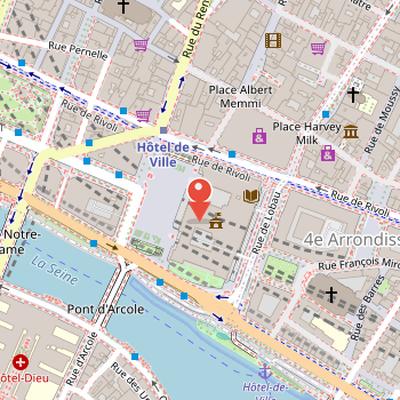
Nearby Objects
-
 Saint-Gervais-Saint-Protais Church 200 m away
 -
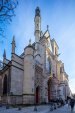 Église Saint-Merry 300 m away
 -
 Hôtel-Dieu de Paris 300 m away
 -
 Théâtre de la Ville 300 m away
 -
 Stravinsky Fountain 350 m away
Municipal Seat and Political Symbol
The Hotel de Ville has housed the municipal institutions of the City of Paris since 1357, making it one of the citys long-standing civic buildings. Beyond its administrative function, it has also become closely associated with public unrest. It is often described as a rallying point for rioters, insurgents, and revolutionaries in Paris, which has given the building a significant place in the citys political history. Its role has therefore extended beyond government administration to that of a visible symbol in moments of conflict and collective action.
From Medieval Municipal Seat to Renaissance Palace
The history of the Hotel de Ville site begins with the corporation des nautes, the ancestor of the municipality of Paris, which obtained jurisdiction near the Grand Chatelet in 1250. This jurisdiction was first installed at la vallee de la misere on the quai de la Megisserie, in a house called le benitier, before being transferred at the start of the 14th century to the parloir aux bourgeois, located on the site of the current 11 rue Soufflot. In 1357, Etienne Marcel acquired the Maison aux Piliers on behalf of the municipality. The building then became the seat of the prevote des marchands and remained the center of municipal institutions in Paris after that acquisition.
By the 16th century, the Maison aux Piliers had fallen into ruin. In 1529, municipal officers requested and obtained permission from King Francois I to replace it with a Renaissance palace. The new building was designed by the Italian architect Boccador, and construction began in 1533. The foundation stone was laid on 9 June 1533 by Pierre Violle, prevot des marchands of Paris. Construction was not completed until 1628, having been interrupted by the Wars of Religion. The southern part of the palace was built from 1533 to 1551 under Francois I and Henri II, while the northern part was built from 1605 to 1628 under Louis XIII and Louis XIV, led by prevot Robert Miron.
The construction work also involved the transport of timber, with Charles Leconte, master carpenter of the Hotel de Ville, first floating a timber raft on the Yonne and Seine. The raft arrived in Paris on 28 January 1533. Historical material associated with this period includes a plan of the old Hotel de Ville before reconstruction began in 1533, based on Braun and Hogenberg's plan circa 1530, as well as an image of the Hotel de Ville on the Atlas de Verniquet from the 1780s. Together, these facts show the long continuity of municipal administration at the site, from medieval jurisdiction to the Renaissance palace that became the Hotel de Ville.
Political Events and Reconstruction
The Hotel de Ville was the scene of several major political events in 1830. A fireworks display was held at Place de Greve in front of the city hall on July 29, 1830, for the publication of the Peace. On July 31, Charles X left Paris for Saint Cloud castle, while royal troops retreated to Bois de Boulogne. On the same day, the building hosted a provisional municipal commission formally tasked with supplying the capital, and the group known as the Gouvernement provisoire was installed there. This commission, composed of Casimir Perier, General Mouton, Pierre-Francois Audry de Puyraveau, Francois Mauguin, and Auguste de Schonen, offered the lieutenancy general of the kingdom to the Duke of Orleans on August 1, 1830, and also attempted to transform itself into an executive provisional government by appointing commissioners to ministerial departments. Most of these commissioners were confirmed by Louis-Philippe d'Orleans on August 2, and the ministry formed by the provisional municipal commission of Paris lasted for about one day.
From 1837 to 1848, the city hall underwent enlargement and partial reconstruction according to plans by Godde and Lesueur. The Renaissance facade was preserved during this work. Antoine Vivenel served as the general contractor managing the construction site. The enlargement altered the surrounding urban fabric, and several streets and buildings disappeared, including Rue des Juges-Pecheurs, Rue des Arcis, Rue du Degre, Rue de la Huchette, and Rue des Espiciers. Four painters, including Jean-Victor Schnetz, were also called to decorate the walls of the old Throne room in celebration of the Parisian revolutions.
The building continued to function as a center of public authority in later decades. It housed the Paris municipal council from 1834 and was used by the Second Empire regime to stage power starting in 1852 during the plebiscite in favor of Napoleon III. It was decorated with the colors of the Emperor for the proclamation of the imperial regime that same year and served as the seat of the Prefecture under the Second Empire. The building also hosted large celebrations, including the visit of Queen Victoria. Its access was cleared by Haussmann through the demolition of nine streets to create Avenue Victoria. The Hotel de Ville remained associated with the city of Paris during the Franco-Prussian War of 1870.
The Commune and the Rebuilding of the Hotel de Ville
The Hotel de Ville played a central role in the political upheavals of 1871. After the Corps legislatif pronounced the dechance of the emperor under crowd pressure at the Palais Bourbon, the government of the Defense nationale was constituted at the Hotel de ville. During the Commune de Paris, the building became the seat of the Conseil de la Commune and the Garde nationale led by Jean-Louis Pindy. It also served as a place of public proclamation, including the election results announced there on March 28, 1871, after the Conseil de la Commune had settled in the building.
The Hotel de Ville was repeatedly represented in contemporary images, including its courtyard Louis XIV with Gardes nationaux, the Throne Room, and the building in flames during the Semaine sanglante. On May 23 and 24, 1871, Communards set fire to the Hotel de Ville, its annex on Avenue Victoria, and part of the Palais de Justice in an effort to slow the progression of the Armee des Versaillais. The fire destroyed the archives and library at the Hotel de Ville, and two collections of Paris civil status records before 1860 were lost, one in the Hotel de Ville fire and another in the Palais de Justice fire. The remains cleared from the building were later exhibited in several Paris locations, including Parc Monceau, Jardins du Trocadero, Square Paul-Langevin, and Musee Carnavalet.
After the destruction, the building was rebuilt between 1874 and 1882 by Theodore Ballu and Edouard Deperthes. The new facade was styled in neo-Renaissance and inspired by the previous building. The rebuilt Hotel de Ville was also modernized with electricity, telephone, elevators, and central heating. In later history, it remained a significant public setting, including for the speech delivered by General de Gaulle on June 26, 1944.
Architectural Composition of the Facade
The facade of the Hotel de Ville is defined by its broad composition, which includes the main facade, the corner pavilions, and the campanile, with the overall surface area reaching 33,470 square meters. The main facade features a central avant-corps corresponding to the former Renaissance monument. At both ends, two pavilions are each flanked by a square turret in corbel. These turrets contain two doors giving access to the courtyards, closed by wrought iron grids bearing the arms of the City of Paris.
The central body and the two pavilions are widened on each side by a small recessed wing of six meters, each ending in an angle pavilion. The ground floor and first floor of each bay are opened by round-arched and rectangular windows surmounted by mezzanines, with the bays framed by pilasters and engaged columns. The next floor of the intermediate facade has an attic pierced with stone dormers containing rectangular windows.
On the pavilion level, the central bay has a round arch preceded by a balcony with balustrade, while the two lateral bays are decorated with niches containing statues. This level is surmounted by a Mansart roof crowned with an open gallery, whose corner pedestals support flame vases. The central pediment occupies three bays and carries a clock dial flanked by figures of Labour and Instruction. Two half-pediments connect the clock to the balustrade, where reclining figures of La Seine and La Marne are placed. Above the clock, a seated figure symbolizes the City of Paris and is crowned by a pediment carrying the City arms, supported by two reclining figures representing Prudence and Vigilance.
Behind the clock stands an octagonal belfry campanile, flanked by four crouching chimera. It is covered by a scaled dome topped by a lantern with a wrought iron balustrade. The roofs are crowned by 16th century repoussé copper knights holding oriflammes, and the large chimney stacks are finished with entablatures, consoles, acroterions decorated with rosettes, and cornices.
Interior Decoration and Symbolic Program
The facades of the Hotel de Ville are adorned with prominent figures from Paris, including artists, scholars, politicians, and industrialists. This emphasis on notable citizens echoes the former city hall expanded under Louis-Philippe, which featured standing statues of illustrious men of the capital, although most of those statues were destroyed during the Commune of Paris. In the forecourt, two bronze statues add to the symbolic program: Art by Laurent Marqueste and Science by Jules Blanchard.
The building also contains a highly decorated banquet hall, designed as a republican replica of the Hall of Mirrors of Versailles. Four painters, Jean-Joseph Weerts, Francois-Emile Ehrmann, Paul Milliet, and Ferdinand Humbert, created works for this space. Several provincial references are missing from the representations, including Franche-Comte, Limousin, and Bourbonnais. Alsace is absent because it was annexed by Germany in 1871 and recovered in 1919 by the Treaty of Versailles. Algeria is present as a veiled woman, reflecting its status as a French possession from 1830 until independence in 1962.
Other interiors continue this program of allegorical decoration. In the salon des Arts, Leon Bonnat painted Le Triomphe de l'Art in 1894, Gustave-Marie Greux, after a sketch by Georges Jules Bertrand, created Hymne de la Terre au Soleil in 1894, Tony Robert-Fleury painted L'Architecture in 1892, Pascal Dagnan-Bouveret painted La Peinture in 1890, and Georges Callot painted La Philosophie. In the salon des Sciences, Albert Besnard painted La Verite, entrainant les Sciences a sa suite around 1890. The grande salle a manger includes sculptural works by Antonin Idrac and Jules Coutan, Louis-Ernest Barrias, and Alexandre Falguiere: Le Toast, La Chasse from 1889, and La Peche from around 1880.
Public Visits
Visits of the Hotel de Ville are free after prior registration with the public relations department of the City of Paris. The visits include all reception salons, the grand staircase, and the Paris Council chamber. They are also open during the European Heritage Days.