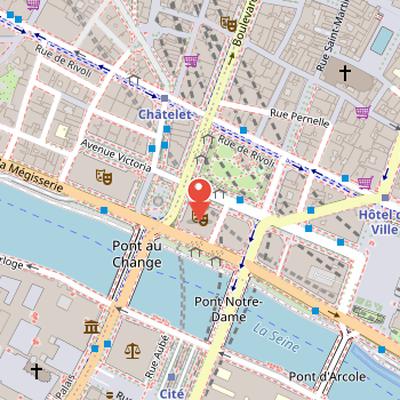
Théâtre de la Ville is a Parisian theatre located at 2, place du Châtelet. Designed by Gabriel Davioud during Haussmann’s restructuring of Paris, it was built between 1860 and 1862 on the site of several former streets and has the same plan as the Théâtre du Châtelet facing it. It originally housed the Théâtre-Lyrique troupe directed by Léon Carvalho and presented major operatic works by Charles Gounod, Georges Bizet, Hector Berlioz, and other composers. The building was destroyed by fire during the Commune events and rebuilt identically in 1874, with changes to the interior arrangements. Over time, it carried several names, including Théâtre-Lyrique, Théâtre des Nations, Théâtre Sarah-Bernhardt, and Théâtre de la Ville. From the early 1980s, it became a major venue for promoting contemporary dance and its young creators. It has also had a second hall, Théâtre des Abbesses, in northern Paris since 1996.
Nearby Objects
-
 Place du Châtelet 70 m away
 -
 Théâtre du Châtelet 140 m away
 -
 Palais de la Cité 200 m away
 -
 Île de la Cité 300 m away
 -
 Église Saint-Merry 300 m away
Names and roles of the theatre
Theatre de la Ville is a Parisian theatre located at 2, place du Chatelet. It became a major venue for promoting contemporary dance and its young creators from the early 1980s, giving it an important role in the citys cultural life. Since 1996, it has also operated a second hall, Theatre des Abbesses, in northern Paris. From 2016 to 2023, the theatre was temporarily located at Espace Cardin on avenue Gabriel because of renovation.
The institution has a long record of name changes. It was called Theatre-Lyrique from 1862 to 1871, Theatre-Lyrique-Dramatique in 1874, Theatre-Historique from 1875 to 1878, Theatre des Nations from 1879 to 1898 and again from 1957 to 1967, Theatre Sarah-Bernhardt from 1899 to 1940 and from 1947 to 1957, and Theatre de la Cite from 1941 to 1947. It became Theatre de la Ville in 1968, before being renamed Theatre Sarah-Bernhardt again in 2023.
Construction and Early Use
The Theatre de la Ville was designed by architect Gabriel Davioud during Haussmann's restructuring of Paris. It was built between 1860 and 1862 on the site of the former rues de la Tuerie, de la Vieille-Lanterne, de la Vieille-Place-aux-Veaux, de la Vieille-Tannerie, and Saint-Jerome. The building has the same plan as the Theatre du Chatelet facing it. It replaced the old Theatre-Historique hall on boulevard du Temple, and at its opening it housed the Theatre-Lyrique troupe directed by Leon Carvalho.
Operatic Premieres and Repertoire
The Historique at the Theatre de la Ville was noted for major opera premieres. It presented Charles Gounod's Mireille in 1864 and Romieo et Juliette in 1867, as well as Georges Bizet's Les Pecheurs de perles in 1863 and La Jolie Fille de Perth in 1866. It also premiered the second part of Hector Berlioz's Les Troyens in 1863. Beyond these premieres, its repertoire included works by Bellini, Donizetti, Mozart, Verdi, Wagner, and Weber.
From Sarah Bernhardt to the Modern Theatre
In 1868, the theatre was directed by Jules Pasdeloup, but it was later destroyed by fire during the Commune events. It was rebuilt identically in 1874, except for the interior arrangements, and then passed through several names: Theatre-Lyrique-Dramatique in 1874, Theatre-historique in 1875, and theatre des Nations in 1879. During this period, it also housed the Theatre-Italien and Opera-Comique troupes temporarily.
A major turning point came in 1898, when Sarah Bernhardt leased the theatre from the City of Paris. From 1899 onward, performances by Sarah Bernhardt were staged there, and the theatre was named after her. Direction later shifted to the brothers Vincent and Emile Isola on March 4, 1906, and in 1935 Louis Rozenberg joined as co-director during a period of financial deficit. After the Front populaire victory, the theatre was renamed theatre du Peuple, then renamed theatre de la Cite under German occupation on July 2, 1940. In 1943, it staged Jean-Paul Sartre's first play, Les Mouches, directed by Charles Dullin. After World War II, it resumed the name Sarah-Bernhardt under director A.-M. Julien.
The theatre continued to play a central role in Parisian cultural life. In 1954, it co-created the Festival d'Art dramatique de Paris with Claude Planson, and from the 1950s it hosted Bertolt Brecht's Berliner Ensemble and Piccolo Teatro di Milano. It was renamed theatre des Nations again in 1957. Major restructuring by the City of Paris took place in 1966, and the hall was then closed for two years for a complete interior reconstruction from 1967 to 1968 by Valentin Fabre and Jean Perrottet. The new interior introduced modern tiered seating for 987 spectators, while the original facade and roof were preserved and listed as historical monuments in 1990. The original Italian-style hall disappeared, unlike at Theatre du Chatelet. More recently, the theatre signed an agreement with AP-HP in 2017 to perform in seven Paris hospitals, and since 2023 it has organized the free Festival des Places in various Paris gardens and squares through the Troupe de l'imaginaire, which provides poetic, musical, and dance consultations for hospital patients.
Programming and Public Outreach
The programming at Theatre de la Ville is managed through the Ville de Paris administration and operates at the theatre at Place du Chatelet as well as the second venue at 31, rue des Abbesses, known as the theatre des Abbesses. Each year, it schedules about one hundred different shows, amounting to approximately 400 performances. Ticket prices range from 10 euros to 30 euros, and the program is organized according to four thematic axes.
The theatre also publishes Le Journal du theatre de la Ville, a bimonthly publication that appears about five times a year. The journal presents upcoming shows for the relevant period, offers an artistic and attendance summary of the previous period, and shares events connected to current theatre news. It is sent to subscribers and distributed free of charge in both theatres. The theatre director serves as the publication director of the journal.
From Theater to a Broader Performance Venue
During its theater period, the venue named after Sarah Bernhardt hosted notable performers and companies associated with the history of Théâtre de la Ville. Among them was the company of Jean-Louis Barrault and Madeleine Renaud, which performed there until 1967. After the theater became Théâtre de la Ville, its focus shifted toward other live shows. Under Jean Mercure, it also presented gestural and burlesque theater. The venue continued to host a range of artists and performances in the following years, including the duo Philippe Avron and Claude Evrard in 1973, the Colombaioni in 1974, Bernard Haller in 1975, and Jean-Paul Farre in 1981.
A Major Stage for Contemporary Performance
Thatre de la Ville has played a major role in contemporary performance, especially in dance. It is described as one of three major venues for contemporary dance worldwide, alongside La Monnaie in Brussels and the Brooklyn Academy of Music in New York. For more than thirty years, it has produced or co-produced about thirty shows each year and has frequently hosted world premieres or the first performances in France of contemporary dance works.
The venue is closely linked to the success of Pina Bausch, after Gerard Violette brought her from Germany in the late 1970s. During the 1980s, it became a nurturing ground for Nouvelle danse francaise choreographers, including Maguy Marin, Dominique Bagouet, and Daniel Larrieu. It also presented Flemish choreographers Anne Teresa De Keersmaeker, Jan Fabre, Alain Platel, Jan Lauwers, and Wim Vandekeybus, as well as American choreographers Merce Cunningham, Carolyn Carlson, and Lucinda Childs.
The theatre has regularly hosted the Japanese company Sankai Juku, premiering their shows worldwide since 1982. In the 2000s, it prominently presented newer choreographers such as Sidi Larbi Cherkaoui, Akram Khan, and Rachid Ouramdane. Its programming has also introduced many Indian and Pakistani artists to France, including Nusrat Fateh Ali Khan, Zakir Hussain, Angelique Ionatos, and Cesaria Evora.
Beyond dance, the venue hosted the French premiere of Oedipus der Tyrann by Carl Orff and was the place where painter Lucas Suppin facilitated the meeting between Carl Orff and Jacques Prevert. It also frequently invites classical musicians such as Andreas Staier, Fabio Biondi, Miklos Perenyi, and the Kronos Quartet. The theatre scheduled posthumous plays of Bernard-Marie Kolt es almost yearly.
Administration and Funding
The Theatre de la Ville is managed by Administration et budget in collaboration with a director and an administrator. The organization has a board of directors made up of about fifteen elected members and twelve appointed members. These appointed members are named by the City of Paris and the Ministry of Culture. Administration et budget reported approximately 2,007 subscriptions at the theatre.
In financial terms, Administration et budget covers about 60 percent of the annual artistic budget, which amounts to 4.5 million euros. The theatre operates within a total operating budget of 13 million euros and receives a subsidy of 10.7 million euros from the municipality of Paris.