Installed in the Hôtel de Saint-Aignan in the Marais district of Paris, the Musée d'Art et d'Histoire du Judaïsme presents Jewish history, culture, and artistic production from Antiquity onward. Its collection combines religious and everyday objects, manuscripts, artworks, and a historical and ethnographic fund, illustrating Jewish contributions to France and to the wider world, especially in art. The permanent collection is organized around chronological, geographical, and thematic articulations and highlights the diversity and unity of Jewish communities in Europe and the Mediterranean basin. The museum also preserves materials on the Dreyfus Affair donated by Dreyfus's family and devotes significant space to Jewish presence in the arts, including painters of the École de Paris such as Chagall, Kikoïne, and Soutine, as well as contemporary artists including Christian Boltanski and Sophie Calle. Its research library contains about 30,000 documents and is accessible by appointment.
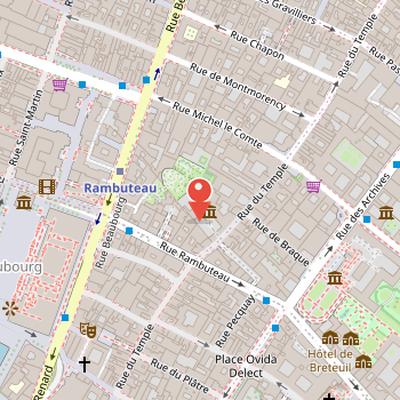
Nearby Objects
-
 Stravinsky Fountain 350 m away
 -
 Museum of National Archives 350 m away
 -
 Église Saint-Merry 400 m away
 -
 Les Bains-Douches 400 m away
 -
 Boulevard de Sébastopol 450 m away
Collections, Research, and Public Programming
Installed in the hotel de Saint-Aignan in the Marais district of Paris, the Musee d'Art et d'Histoire du Judaisme retraces the history of Jewish culture from Antiquity through a collection that combines religious and everyday objects, manuscripts, and artworks. Its holdings present both an art collection and a historical and ethnographic fund, illustrating Jewish contributions to France and the world, especially in art. The museum also conserves materials on the Dreyfus Affair that were donated by Dreyfus's family.
A significant part of the presentation is devoted to Jewish presence in the arts, including painters of the Ecole de Paris such as Chagall, Kikoine, and Soutine, as well as contemporary artists such as Christian Boltanski and Sophie Calle. The institution also maintains a research library with about 30,000 documents on Jewish art, archaeology, and French Jewish history, including audiovisual documents and a photo library. The library is accessible to all by appointment.
The museum extends its role through public facilities and programs. Its bookstore is accessible without ticket purchase and offers more than 6,000 titles. An auditorium with 190 seats hosts conferences, debates, meetings, concerts, and projections on Jewish cultures. Guided tours and workshops are also offered. The permanent collection is free to access every first Saturday of the month from October to June.
Origins and Opening of the Museum
The musee project originated in the mid-1980s and partly inherited the Musee d'Art Juif de Paris, which had been founded in 1948 by Holocaust survivors from Eastern Europe. The earlier museum was located on Rue des Saules in the arrondissement. In 1985, the new project was launched by Claude-Geraard Marcus, Victor Klagsbald, and Alain Erlande-Brandenburg, with support from the City of Paris and the Ministry of Culture. From 1988, Laurence Sigal led the project, which also received support from the Directorate of Museums of France and the Directorate of Cultural Affairs of the City of Paris. The museum later opened in the Hotel de Saint-Aignan.
The Permanent Collection and Its Historical Narrative
The permanent collection rooms are organized through chronological, geographical, and thematic sections that emphasize both the diversity and the unity of Jewish communities in Europe and the Mediterranean basin. The displays cover Jewish rites, beliefs, artistic productions, and material culture, while also illustrating the variety of French Judaism through several historical communities.
The visit begins with objects and documents that present the persistence of Jewish identity and civilization. It then moves to the golden age of Jews in medieval France, including works by Salomon, son of Isaac the Frenchman, known as Rashi, the Rabbi and Talmudist from Champagne who lived circa 1040 to 1105. An audiovisual presentation also focuses on Rashi as a commentator on the Bible and the Talmud. The museum documents the expulsions of Jews from France under Philippe Auguste in 1182, Philippe le Bel in 1306, and Charles VI in 1394, as well as the expulsion from Provence in 1501 after its attachment to the French kingdom.
The collection also presents 13th-century funerary steles from a Parisian Jewish cemetery, including steles discovered in 1849 during the construction of the Hachette bookstore on Rue Pierre-Sarrazin. These funerary steles form the largest archaeological ensemble discovered on French soil. Among them are the stele of Prcieuse dated 1261 and the stele of Rabbi Salomon dated 1281. The museum also displays precious manuscripts and rare religious objects, including a medieval Hanukkah lamp.
Another section introduces community organization, knowledge networks, and Jewish integration in the Christian world. It then turns to Renaissance Italian Jewish cultural activity in cities such as Modena and Venice, with synagogue furniture including a Holy Ark from Modena dated 1472, along with silversmith pieces and liturgical embroidery from the Italian Renaissance. Life cycle events are represented through objects, jewelry, and manuscripts, including illuminated marriage contracts displayed in frames. The museum also shows 18th-century paintings by Marco Marcola depicting religious scenes of Venetian Jewish life, as well as a 1720 painting by Alessandro Magnasco of Jewish Funerals in rococo style.
Across these sections, the museum presents different historical communities, including those surviving under the Ancien Regime in Alsace and Comtat Venaissin, those reconstituted from the 16th century in Lorraine and on the Aquitaine coast, and those formed through immigrations after emancipation from Central and Eastern Europe, the Levant, and North Africa.
Hanukkah Lamps in the Collection
The museum has a room dedicated to Hanukkah that presents a collection of hanukkiyot in a range of styles and periods. Among the objects are a 14th century Hanukkah lamp from France and a 16th century example from Comtat Venaissin, France. The collection also includes a 17th century Hanukkah lamp by Johann Michael Schuler from Frankfurt, Germany, as well as 18th century lamps from Italy and from Breslau, Germany, today Wroclaw, Poland. Later examples include a Hanukkah lamp from Eastern France, identified as Alsace-Lorraine, from the end of the 19th century, and an early 19th century lamp from Central Europe. The museum also holds 20th century Hanukkah lamps from Yemen and Tunisia, together with a 20th century lamp by Luigi Del Monte from Israel. Together, these objects show the geographic and chronological breadth of the museum's holdings on Hanukkah traditions.
Jewish Histories, Rituals, and Modernity
The museum presents Jewish history through a sequence of objects, images, and archives that connect ritual practice, migration, cultural life, and modern social change. Its collection includes Dutch engravings showing the wandering of Spanish Jews after their expulsion from Spain in 1492, as well as Bernard Picart's series Mours et coutumes de tous les peuples du monde, which illustrates the integration of Portuguese Jews in Amsterdam, London, and Bordeaux after their expulsion from Portugal in 1496-1497. A showcase of rare books traces the development of Hebrew printing, while ritual objects evoke the three pilgrimage festivals Pessa'h, Chavouot, and Souccot.
Several displays focus on religious life and communal identity. Objects related to Shabbat, prayer, and liturgy appear alongside a brief overview of the organization of study and major religious thought currents. An exceptional collection of mappot, used exclusively in Eastern France, is also shown. In parallel, the museum mirrors these themes in their Sephardic variations, emphasizing formal affinities and influences between traditions. A restored 19th century soukka from Austria or southern Germany is decorated with paintings of the first words of the Decalogue, Jerusalem, and a typical Austrian or German village, underlining the essential place of Jerusalem in Jewish consciousness.
The museum also presents Jewish communities across Europe through architecture, imagery, and social history. It exhibits several synagogue models from Poland, Ukraine, and Lithuania, reflecting particular architectural forms that were almost all destroyed by the Nazis. Paintings such as Cimetiere juif by Samuel Hirszenberg and two works by Marc Chagall depict the difficult living conditions of Jews in Poland and Russia and the existence of Jews in the shtetls of Eastern Europe. A historical overview of French Judaism in the 19th century emphasizes emancipation beginning with the French Revolution and highlights key moments of Jewish integration into modern society.
This transition continues in the displays on modern Jewish culture. The museum shows artworks with Jewish themes by Moritz Oppenheim and genre scenes by French and European artists including Alphonse Levy, Edouard Brandon, Edouard Moyse, and Maurycy Gottlieb, encouraging reflection on the possibility of Jewish art beyond liturgical or traditional forms. A sequence presents the intellectual flourishing of Jewish culture in Europe around the turn of the century, including Jewish sciences in France and Germany, Yiddish literature and culture, the revival of Hebrew, theatrical creation, the modern Jewish press, Zionism, and political movements such as Bund. A graphic art cabinet devoted to the Jewish cultural renaissance in Germany and Russia adds works on paper and books from the early 20th century, grouped around folklore, ornament, biblical sources, and calligraphy. The presentation concludes with artists of the School of Paris, whose diverse trajectories and confrontation with modernity are used to mark the transition to a new Jewish identity beyond the religious.
Courtyard Displays and Dreyfus Commemoration
The museum has used its courtyard for works that connect the site to memory and historical commemoration. It displayed a mural by Christian Boltanski honoring the 1939 inhabitants of the Hotel de Saint-Aignan, most of whom were Jewish artisans and many of whom were later murdered in Nazi camps. In the inner courtyard, the museum also exhibited a modern statue by Tim showing Alfred Dreyfus holding his broken sword. This statue is a copy of Hommage au capitaine Dreyfus.
The Dreyfus affair has also been a recurring subject in the museum's exhibitions and publications. In 2006, the museum presented Alfred Dreyfus, le combat pour la justice. It also published an online presentation of the Dreyfus affair and related family archives, and enabled online consultation of more than 3,000 documents connected to the case. Related material reached the wider public through the auction in Nantes of drawings by journalist Maurice Feuillet from the 1898 and 1899 Dreyfus trials, while national museums largely preempted the drawings to enrich their collections.
The museum's visual identity was also updated over time. Its logo was created in 1997 by Philippe Apeloig, and in 2016 it adopted a new logotype designed by atelier Doc Levin.
From Private Mansion to Museum Site
The Htel de Saint-Aignan was built between 1644 and 1650 for Claude de Mesmes, comte dAvaux, superintendent of Mazarin's finances, outside the Philippe-Auguste enclosure along the wall. Pierre Le Muet, architect of the king, drew up the plans. In 1688, the building was purchased by Paul de Beauvilliers, duc de Saint-Aignan, who carried out repair and modernization works. He also arranged the first floor into apartments and commissioned Andre Le Notre to redesign a French garden.
After the Revolution, the Htel de Saint-Aignan was seized and placed under sequestration in 1792. It became the seat of the seventh municipality in 1795 and then served as the seat of the seventh arrondissement until 1823. After that, it was divided into various commercial premises and, from 1842 onward, was successively resold and used for trade and small industry. Photographs by Eugene Atget show the building inhabited by Jewish artisans from Poland, Romania, and Ukraine. During the anti-Jewish raids of 1942, several residents were arrested and deported, and thirteen Jewish inhabitants were murdered in the camps.
The City of Paris purchased the Htel de Saint-Aignan in 1962, and it was classified as a historic monument in 1963. Restoration campaigns began in 1978 under Jean-Pierre Jouve and in 1991 under Bernard Fonquernie. During the 1978 campaign, the building was assigned to the Paris archives. In 1998, following an initiative by Jacques Chirac as mayor of Paris, it was designated for a museum of Jewish civilization.
Architecture and Historical Transformations
The Hotel de Saint-Aignan was built on a large irregular plot where the family hotel inherited by Claude de Mesmes had previously stood. Pierre Le Muet demolished the older building and adopted the usual floor plan of grand aristocratic hotels, while also proposing an unprecedented civil architecture decoration for the Paris residence. The main building corps is set back from the street at the end of a slightly rectangular large courtyard. The complex includes a single return wing on the right, with a large gallery on the upper floor. Its ground floor once housed kitchens, now remodeled to accommodate workshops. A passage leads to a small lower courtyard with sheds and stables opening to the street. The dining room, connected to the mahJ bookstore, features fresco decorations attributed to Remy Vuibert.
The architecture is marked by four identical facades around the courtyard, which do not distinguish the main building body, and by sculpted pilasters called colossaux running without break from bottom to top. A trompe-l'oeil facade called renard masks a wall on the Philippe Auguste enclosure line. Overall, the design creates a strong vertical rhythm that confers majesty on the building. The hotel was bought by Paul de Beauvilliers, duc de Saint-Aignan, in 1688, after which repairs, modernization, enlargement of the garden facade, a grand staircase, and first-floor apartment arrangements were undertaken. The garden was redesigned in a French style with ornamental parterres by Andre Le Notre.
The building later served public and commercial functions. It was seized in 1792, became the seat of the seventh municipality in 1795, and then served as the seat of the seventh arrondissement until 1823. From 1842 it was divided into commercial premises and used for commerce and small industry, and was later transformed into a tenement with the main building raised by three levels. The City of Paris bought the hotel in 1962, and it was classified as a historic monument in 1963 and again in 1988. Restoration began in 1978 under Jean-Pierre Jouve and continued from 1991 under Bernard Fonquernie, being completed in 1998. The restoration returned the building to near its original design except for the 1690 additions, and the hotel is regarded as an example of Parisian architectural atticism from Anne d'Autriche's regency.