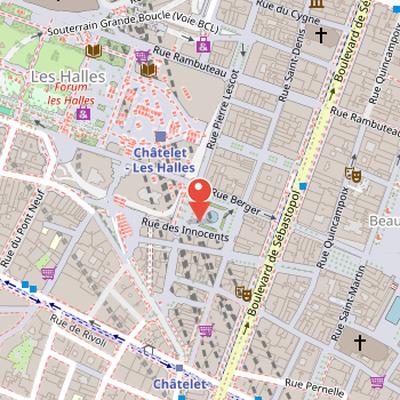
Saints Innocents Cemetery, known in Italian as Il cimitero degli Innocenti, was a medieval Latin Rite Catholic cemetery in Paris. It was one of the city’s largest parish cemeteries and was located in the area of the present-day Place Joachim-du-Bellay, near the Halles district and the Church of Saint-Eustache, less than one kilometer north of Notre-Dame. The cemetery measured about 130 meters long and approximately 65 meters wide, and it was bounded by several streets that frame the site today. It took its name from the nearby Church of the Holy Innocents, which stood at the northeast corner of the square and was demolished in 1787.
The cemetery was dedicated to the infant martyrs of the Massacre of the Innocents from the Gospel of Matthew. It became notorious for poor sanitary conditions, overcrowded burials, and overflowing ossuaries. The site was closed in 1780 and dismantled in 1786. After closure, bodies were exhumed and moved to the Catacombs of Paris near Cimetière de Montparnasse. Historic records also refer to earlier cemetery remains and a sacellum in the same broader area, indicating a long burial history in this part of Paris.
Nearby Objects
-
 Église Saint-Merry 300 m away
 -
 Stravinsky Fountain 300 m away
 -
 Théâtre du Châtelet 350 m away
 -
 Place du Châtelet 350 m away
 -
 Church of Saint-Eustache 350 m away
Location and Conditions of the Saints Innocents Cemetery
The Saints Innocents Cemetery, known in French as Il cimitero degli Innocenti, was constructed in the Middle Ages and became one of the largest parish cemeteries in Paris. It was located at what is now Place Joachim-du-Bellay, near the Halles district and the Church of Saint-Eustache, and less than one kilometer north of the Cathedral of Notre-Dame. The cemetery measured 130 meters in length and about 65 meters in width. It was bounded by Rue Aux Fers, now Rue Berger, to the north, Rue Saint Denis to the east, Rue de la Ferronerie to the south, and Rue de la Lingerie to the west.
The cemetery took its name from the nearby Church of the Holy Innocents, which stood at the northeast corner of the square and was demolished in 1787. Its dedication referred to the infant martyrs of the Massacre of the Innocents from the Gospel of Matthew. Over time, the site became known as the Carnage of the Innocents because of its poor sanitary conditions. Bodies were buried in overcrowded pits, often stacked on top of each other, and overflowing ossuaries sometimes collapsed and spilled remains beyond the walls. Decomposition products were said to flow into the streets and contact passersby, causing epidemics. It was also said that a body could decompose to bones within nine days in the ground of the cemetery. The cemetery was closed in 1780 and dismantled in 1786, and the bodies were later exhumed and moved to the new Catacombs of Paris near Cimetiere de Montparnasse.
Early Development and Expansion
Storia confirms the existence of an ancient cemetery with a Merovingian-era sacellum outside the walls of Paris, but this early site disappeared in the 9th century because of Norman incursions. In the 10th century, a sacellum dedicated to Saint Michael was erected in the Champeaux quarter, the area now known as the Halles quarter. A major change came in 1130, when Louis VI of France promised to replace this sacellum with a larger church. The new church, dedicated to the Holy Innocents, was built northeast along Rue Saint-Denis, and a cemetery of the same name was established around the same time. The cemetery became church property.
The cemetery gained notable importance in 1137, during the reign of Louis VII of France, when Champeaux became the new central Paris market. It soon acquired a poor reputation because of dirtiness, roaming animals, criminals, and grave robbers. Storia notes that grave robbers sold extracted organs to medical students at the University of Paris. The earliest documented reference to Ecclesia Sanctorum Innocentum has a post quem date of 1156. At first, the cemetery was used only for the burial of priests from the Saint-Germain-l'Auxerrois parish, but after the founding of the Saint Innocents parish it also accepted burials of Parisian citizens.
Between 1185 and 1190, Philip II of France ordered a major reconstruction of the Innocents complex. During this work, the church took its final form, the cemetery was expanded, and three meter high walls were built around it. The first fountain within the cemetery complex was also erected. With the construction of the Philippe Auguste Wall from 1190 to 1209, the cemetery came to lie inside the city walls. The complex was expanded again in 1218 through a donation by Bishop Pierre de La Chapelle.
By the turn of the 15th century, population growth had led to overcrowded burials near the cemetery walls. Mass graves were dug along the walls for burial reuse, and tombs were emptied within the cemetery for the same purpose. At the same time, private individuals were allowed to build large ossuary galleries called charniers along the west wall on Rue de la Lingerie. Bertrand de Rouen financed the first charnier before 1387, Nicolas Flamel built one in 1389, and several Parisian bourgeois followed their example.
Fifteenth-Century Art at Saints Innocents Cemetery
Storia identifies the 15th century as the period when the most famous artworks in the area were created. In 1407, Nicolas Flamel commissioned a sculptural group for the Little Ossuary, and in 1408 Duke John of Berry commissioned The Meeting of the Three Living and Three Dead. Another notable work was the Dance of Death fresco, painted under the ossuary on the cemetery's south side between August 1424 and Lent 1425, during the dual monarchy of England and France. At that time, John Plantagenet governed Paris as regent. Storia describes the Dance of Death as one of the earliest and most famous representations of the theme from that period.
Historical Uses and Alterations of Saints Innocents Cemetery
Saints Innocents Cemetery had a long history of practical, symbolic, and urban uses. In the 16th century, the anatomist Andrea Vesalio is reported to have used bodies from the cemetery for practical studies, and the site was also mentioned in Francois Rabelais's Pantagruel in 1532. Gilles Corrozet's Paris guide recorded a legend that associated the cemetery with magical powers. A Fontana delle Ninfe was erected next to the church in 1549.
The cemetery also figured in moments of crisis and violence. During the siege of Paris in 1590, the population assaulted the cemetery to extract flour from dead bones. Henri IV of France was assassinated near the cemetery on Rue de la Ferronnerie on May 14, 1610. In 1669, Louis XIV ordered a major restructuring and extension of Rue de la Ferronnerie at the cemetery's expense. This work demolished the Ossario des Lingheres and destroyed the Danza Macabra fresco, while also creating a new entrance to the cemetery.
Between the 17th and 18th centuries, the cemetery's secular vocation increased despite unsanitary conditions. Ambroise Ledru noted that modistes and public scriveners invaded the ossuaries during the 18th century. Maps from 1733 and 1756 named the ossuaries Ossari degli Scrittori and Ossario des Lingheres. The site also became a pilgrimage destination for alchemists and occult enthusiasts. By 1780, maps showed further changes, including a small boundary wall and a caretaker's house between the church and cemetery, as well as high buildings incorporated into the perimeter walls and ossuaries along Rue de la Ferronnerie. Structures along Rue de la Lingerie were also present, though they were not labeled as houses on the map.
Closure and Relocation of the Cemetery
In the 18th century, the Cimitero degli Innocenti had become intolerably unhealthy, and inspectors under King Louis XV of France complained about its poor hygiene. King Louis XVI later issued two edicts ordering all Paris parish cemeteries to be relocated outside the city, but ecclesiastical authorities rejected the orders and instead received funds for cemetery renovations, including at Parrocchia degli Innocenti. A separate decision increased burial taxes in an effort to reduce the number of burials.
On March 10, 1776, a decree ordered the closure of the cemetery by December 1780. Conditions worsened in spring 1780 after prolonged rain, and on May 7 a perimeter wall of a cemetery pit collapsed near a restaurant basement on Rue de la Lingerie. Storia attributes the collapse to liquefaction caused by decomposing bodies and the excessive weight of bones. Dead bodies were found in the restaurant cellar when the innkeeper went down to draw wine. The resulting scandal led Lieutenant General of Police Jean-Charles-Pierre Lenoir to decide on September 4, 1780, to close the cemetery permanently and ban all further burials. The ruling was extended to all Paris parish cemeteries because of sanitary concerns and was ratified by the King. The cemetery closed its gates on December 1, 1780.
After the closure, parish authorities protested the loss of burial tax revenues, and poor hygienic conditions continued to be a concern. On November 9, 1785, Charles-Axel Guillaumot proposed exhuming bodies and relocating bones. Only bones found no deeper than 1.60 meters were moved, and many deceased remain under Place Joachim-du-Bellay. Lenoir also promoted the creation of the Paris Catacombs in old stone quarries near Montparnasse, with the construction site near Rue de la Tombe-Issoire. The relocation work took 15 months and involved daily processions with priests. Many exhumed bodies were incomplete or decomposing, and high fat concentrations, especially margaric acid, were recovered for candles and soaps.
Demolition and Reuse of the Site
On November 15, 1785, Archbishop Antoine-Elieonor-Leon Le Clerc de Juigne merged the Santi Innocenti and Sant-Jacques-la-Boucherie parishes. Surviving tombstones were moved to the Sant-Jacques-la-Boucherie church. The Cimitero degli Innocenti was demolished in 1786 to provide materials for Louvre renovations, and the Church of the Innocents was demolished between 1786 and 1787. The cemetery site was then reused for an expanded city market, which opened in 1788 as the Mercato degli Innocenti. The Fountain of the Nymphs was dismantled and rebuilt in the center of the market as the Fountain of the Innocents, later renovated and moved to Place Joachim-du-Bellay. Architect Charles-Louis Bernier made many drawings of the area before and during the demolition. In 1856, Victor Baltard redesigned the market as modular steel and glass pavilions called Les Halles, a redevelopment that erased the visual memory of the old cemetery complex. About twenty years later, Valentin Dufour published the first monograph on the Cimitero degli Innocenti.
Layout and Ossuaries of Saints Innocents Cemetery
The Cimitero degli Innocenti measured 130 by 65 m and covered about one hectare, making it the largest cemetery in Paris at the time. Its perimeter was defined by four streets: Rue Aux Fers to the north, Rue Saint Denis to the east, Rue de la Ferronerie to the south, and Rue de la Lingerie to the west. Within this enclosed area, the cemetery included several secondary buildings and monuments.
Among these structures, the Old Ossuary stood along Rue Aux Fers and had 19 arches. On Rue Saint-Denis was the Small Ossuary, also called the Ossuary of the Virgin, with 4 arches. The Ossuary des Lingeres, located along Rue de la Ferronerie, had 27 to 28 arches and contained the fresco of the Dance of Death. Along Rue de la Lingerie was the Ossuary des Ecrivains, which had 17 arches. These elements formed part of the cemetery's built environment and defined its internal organization.
The Dance of the Innocents and the Ossuary Imagery
The ossuaries at the Saints Innocents Cemetery combined pictorial and poetic-literary elements. The texts and subject were likely authored by Jean Gerson, and the fresco was attributed to Giovanni d'Orleans, a painter who served Charles VI of France and was close to the late Duke of Berry. In this work, the memento mori theme was expressed through the Triumph of Death iconographic motif and through theological and philosophical speculation. Although such ideas had circulated since the 13th and 14th centuries, written words had only an indirect influence on most believers, making the shift to visual representation crucial for the Dance Macabre and related meditation themes.
The appearance of the Dance of the Innocents in the heart of Paris was described as epochal. It emerged during the Hundred Years' War, a period that extended from 1337 to 1453, and its imagery reflected a broader memento mori tradition that spread systematically in the Alpine area and in neighboring regions including Germany, France, and Italy from the 1350s, after the devastation of the Black Death. Descrizione considers the iconography of death codified in the cemetery's pictorial and sculptural apparatuses.
The painted cycle is described in detailed visual terms. Under scenes painted between gallery arches appear Gerson's poem octaves. Beneath each roughly reproduced architectural arch there is a narrator, four dead musicians, two pairs of living and dead figures, and a deceased king. The background is bare except for some schematically drawn flowers. The dead are shown as elongated, emaciated, flayed, with open and eviscerated abdomens, and decomposition appears for the first time in medieval art in this work. The dead often bow ironically to their victim, clutching the living person opposite and grabbing the person addressed, while the living figures parade in hierarchical order with all their rank insignia. In contrast, the cadavers are all identical and anonymous.
The accompanying texts present death and bodily decay as the common destiny of all humans. This strong emphasis on social equality distinguishes the French Dance Macabre from the Germanic version. The theme, which Descrizione treats as one of the major thematic depictions of the Late Middle Ages, also included the Dance of Death and the Meeting of the Three Living and the Three Dead. Both of those artworks are currently lost, although the only surviving related object is the 16th century alabaster statue of the Death of the Innocents or Great Death, now housed in the Louvre Museum. The theme later spread across Europe with wider impact than previous religious ideas, and it was mentioned in 15th century intellectual works such as Francois Villon's Le Testament. It also appears in incunabula reproductions of the Dance of the Innocents, including Guidone Mercatore's incunabulum printed in Paris in 1485.
Architecture and History of the Church of Saints Innocents
The Church of Saints Innocents had an unclear and obscure origin, with Descrizione placing its terminus post quem in 1156. It was an early French Gothic church oriented on the east-west axis and described as being based on the model of the famous Paris cathedral. The church had three naves and a gallery adjoining the south nave, while the northern nave and the gallery were occupied by side chapels. Its structure featured pointed arches on very solid pillars and highly pronounced flying buttresses in the apse area. The apse was dominated by the choir, flanked to the south by the Chapel of the Virgin and to the north by the Sacristy. The entrance was preceded by a porch containing the communion chapel, baptismal font, and a small sacristy. Similar models were found in small Gothic churches of Ile-de-France, including Saint-Hermeland in Bagneux and Saint-Denys in Arcueil. After 1550, an enclosing wall separating the church from the cemetery was added, and a custodian's house was built along this wall; a 1780 map is cited as evidence for these additions. The church was demolished in 1786-1787, immediately after the demolition of the cemetery. At the time of the church's demolition in 1785, the fountain was dismantled, transformed into a neoclassical tetrapylon, and placed in its current location.
Burial Practices and Overcrowding
The Cemetery of the Innocents served as a major burial ground for Paris. It is estimated to have received corpses from 22 Parisian parishes until the 18th century, as well as bodies from the Hotel-Dieu in Paris, plague victims, unknown corpses from the Seine, and corpses found along streets or near the Court of Miracles crossroads. Around two million Parisians were buried there in total. In the 12th century, the cemetery assigned single graves to citizens. Rich citizens were buried in wooden coffins, while poor citizens were wrapped in simple sheets. From the late 14th century, the dead began to be piled in charnel houses, and graves and coffins were recycled because of limited space. A 17th-century tariff shows a structured burial system with different prices for chapels, ossuaries, inhumation in the ground, and children's burials, depending on whether a new or reused coffin was used. This heavy concentration of burials created poor hygiene, which led to the cemetery's closure in the 1780s.
Social and Religious Life at the Cemetery
From the 14th century, Paris established religious confraternities connected with the Cemetery of the Innocents. The site was also associated with the macabre taste, which Funzionamento describes as linked to its social success. Citizens used the cemetery as a meeting place and for socializing, and festivities were held there in the 15th century. Medieval liturgical celebrations included theatrical dramatization with dialogue, music, and scenography, and French Mysteries relied on religious structures such as churches, cemeteries, and hospitals. By the 15th century, shops had also opened at the cemetery, showing that it functioned not only as a burial ground but also as an active urban space.
The cemetery was the burial place of several notable figures, including Pernelle Flamel in 1407, Jean le Boulanger, Jean de La Fontaine before his remains were moved elsewhere, Louis Marchand, Jean-Baptiste Barriere, Louise Julie de Mailly, and Edme Dumont. Relics of Riccardo di Pontoise were deposited in the Church of the Innocents. The Roman Martyrology also inscribed martyrs with liturgical memory on December 28 at the Cemetery of the Innocents.
In Popular Culture
Saints Innocents Cemetery has been used as a setting in several works of popular culture. In Andrew Miller's novel Pure, the destruction of the church and the removal of the cemetery are subjects in the story, and the novel won the 2011 Costa Book Awards. Anne Rice's book Scelti dalle tenebre also places the vampire Lestat de Lioncourt in the Cimitero degli Innocenti, with his residence ending when the cemetery is destroyed. The cemetery appears in the 1996 film Il gobbo di Notre Dame as a cemetery near Notre-Dame Cathedral, where Quasimodo and Febo use it as an entrance to the Court of Miracles. In the film, it is placed south rather than north of the temple.