Église Saint-Merry is a Catholic Roman parish church located in the Saint-Merri quarter of Paris, in Île-de-France. Dedicated to Saint Médéric, it is affiliated with the Archdiocese of Paris and entrusted to the community of Sant'Egidio. Construction began in 1500 and was completed in 1565. The church brings together Gothic flamboyant, baroque, and classical styles, reflecting its long building history. It stands on the monceau Saint-Merri, one of the hills closest to the Seine and the Île de la Cité, in an area once surrounded by marshy lands flooded by the river and known as the Marais. The site has a long religious history linked to the cult of Saint Médéric, whose tomb was venerated and whose remains were later enshrined. Over time, the chapel and then the church took the name Saint-Merri, and the new church became part of the historical and religious development of the right bank of Paris.
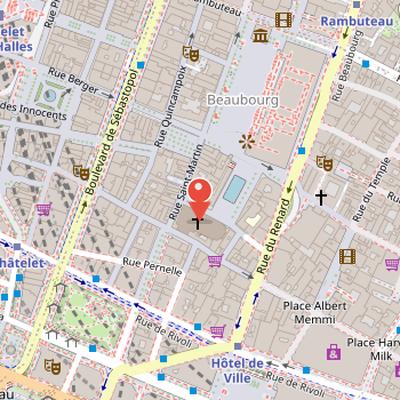
Nearby Objects
-
 Stravinsky Fountain 60 m away
 -
 Saints Innocents Cemetery 300 m away
 -
 Théâtre de la Ville 300 m away
 -
 Hôtel de Ville 300 m away
 -
 Place du Châtelet 300 m away
Architecture and Ecclesiastical Role
Eglise Saint-Merry is a Catholic Roman parish church located in the Saint-Merri quarter of Paris, in Ile-de-France, at latitude 48.859 and longitude 2.351. It is dedicated to Saint Mederic and is affiliated with the Archdiocese of Paris. Construction began in 1500 and was completed in 1565. The church features a combination of Gothic flamboyant, baroque, and classical styles. It is entrusted to the community of Sant'Egidio.
Origins of Saint Merri
Saint Merri was established on the monceau Saint Merri, one of the hills closest to the Seine and the Ile de la Cite, in an area once surrounded by marshy lands flooded by the river and known as the Marais. The site was among the first places of settlement on the right bank of Paris in the Early Middle Ages. According to tradition, Mederic, abbot of Saint Martin d Autun, lived as a hermit near the oratory Saint Pierre des Bois, where he died after two years and nine months and was buried on August 29. The oratory was later transformed into a chapel called Saint Pierre, and then increasingly referred to as the chapel of the holy man of God. Because Mederic's tomb was associated with many miracles, his cult grew around the site. In 884, the priest Theodelbert asked Bishop Gozlin of Paris to exhume and enshrine Mederic's remains, which came to be regarded as relics. Mederic was then known as Saint Merri, and during the last siege of Paris by the Normans he was chosen as the patron saint of the right bank. The chapel was renamed Saint Mederic or Saint Merri, and the devotion to Saint Merri led to the construction of a new Saint Pierre Saint Merri church initiated by Eudes Le Fauconnier in the 9th century.
History and Architectural Development
The exact construction date of Saint-Merri is unknown, but archaeological findings confirm Eudes Le Fauconnier as its founder. An old cemetery revealed a skeleton with an inscription identifying Odo Falconarius as the church's founder. The new edifice received donations from count Adalard, with support from kings Eudes and Carloman, and these donations were confirmed by a charter from Louis d'Outremer issued at Laon on October 16, 877. Around 1010, bishop Renaud de Vendome donated the church to the chapter of Notre-Dame, after which it became a collegiate served by a community of seven canons from the chapter. In 1200, it was erected as a parish named Saint-Merry. It is one of the four daughters of Notre-Dame and the last surviving one today. Its later importance reflected demographic growth in the Halles and Beau-Bourg districts, which required new construction.
The current building was constructed between 1500 and 1565. The nave was built between 1500 and 1515, the transept between 1525 and 1535, and the choir between 1535 and 1565. The bell tower was raised by one floor in 1612. A rood screen dated 1558 was destroyed in 1709. In 1743, architect Germain Boffrand built the Communion chapel to the south. The choir was remodeled by the Slodtz brothers in 1759, when its pointed arches were rounded and paneled with marble and stucco; at the same time, the floor was covered with marble paving, furniture was renewed, and some stained glass was replaced by clear glass.
The church was closed in 1793 because of the Revolution, then used as a saltpeter factory. Between 1797 and 1801, theophilanthropists transformed it into the temple of Commerce. It was returned to Catholic worship in 1803, and Pope Pius VII visited it and celebrated the Holy Mysteries there. From 1843 to 1849, the chapels of the ambulatory were frescoed by major painters. The church was registered as a historic monument in 1862. In 1871, fire destroyed the third floor of its square bell tower, restoring its original two-floor height. It was listed as a monument in peril by the World Monuments Fund in 2008, and its classified decorations are now seriously threatened.
Flamboyant Gothic Design and Faade Details
Saint-Merri is entirely built in flamboyant Gothic style, with no traces of Renaissance architecture. Its plan is described as homogeneous, with a second collateral only on the right side of the nave, and an additional south side aisle. The church has the same plan as Notre-Dame de Paris cathedral and was managed by seven canons of the cathedral, which led to its nickname, Notre-Dame la petite.
The west facade is richly decorated in flamboyant Gothic style, with canopies, arcatures, baldachins, leaf friezes, and fantastic animals. The main portal has three ogival doors topped with crockets and florets. Its voussoirs are sculpted with multiple statuettes of martyrs and angels made from Vassy cement. These statuettes were created in the mid-19th century by architect Etienne-Hippolyte Godde using molds from the southern portal statuettes of Notre-Dame de Paris. The central facade porch also includes apostle statues by Louis Desprez and Joseph-Silvestre Brun from the 19th century, replacing figures destroyed during the Revolution.
A small door to the left of the west facade, now walled up, once gave access to houses on the north collateral stairway. The north side houses were destroyed in 1950, and numerous gargoyles were placed along the north facade. The south facade is not visible from the street because of adjoining buildings, although a view from 1892 was recorded from a nearby window. The apse is also hidden by buildings on the east side.
One of the most unusual features is the slender and narrow campanile, topped with wood and housing a very old bell dating from 1311. This bell is considered the oldest in Paris. The facade also includes a figure representing Baphomet, described as a small horned demon with half-man half-woman features and bat wings. Its iconography derives from 19th-century occultist imagery inspired by Templiers' ancient figures, and the figure has been noted in the works of Claude Seignolle, Umberto Eco, Eric Giacometti, and Jacques Ravenne. The main facade, including the Baphomet figure, was restored during works in 2013-2014.
Stained Glass Program
Saint-Merri is notable for a stained glass program that spans several centuries and parts of the church. The high windows in the first bays of the nave date from the early 16th century, while the lateral stained glass windows in the choir are also from that period. In the nave, the right side includes scenes from the lives of Saint Nicolas de Myre, Sainte Agnes, Saint Francois d'Assise, and the Virgin Mary, while the left side shows the life of Sainte Marie Madeleine, miracles of Christ, and the lives of Saint Jean Baptiste and Saint Thomas. The choir windows on the left illustrate the history of Patriarch Joseph in Egypt, and those on the right show the apostleship of Saint Peter.
The apse contains stained glass centered on the Resurrection of Christ, made in 1866 from cartoons by Claudius Lavergne. Other 16th century windows survive in the chapel to the left of the axial chapel of the Virgin, including Saint Martin sharing his cloak with a poor man, a Pieta, and Saint Eloi. The axial chapel of the Virgin also contains 16th century fragments mounted as medallions in the 19th century. Additional windows in the transept and northern choir were attributed to Nicolas Beaurain, and further dating details were noted in 1997 for windows attributed to Jean Chastellain on the south side and Nicolas Pinaigrier. Some nave windows were destroyed and replaced by clear windows in 1733, and the ambulatory windows were destroyed between 1750 and 1754. Prosper Lafaye restored the apse and choir windows between 1847 and 1865, with further restorations undertaken in 1870.
Nave, Transept, and Choir
The nave of Saint-Merri has five bays and a rib vault completed in 1520. Its pointed arcades are supported by large pillars with multiple shafts, and the nave includes one north aisle and two south aisles. Beneath the high windows, a frieze shows four reclining figures among foliage and animals. The figures on the left are Saint Merry and Moses holding the Tables of the Law, while those on the right are Saint Peter and Aaron. At the entrance of the second right aisle, there is a Renaissance wooden enclosure from the Judges-Consuls chapel dating from the 16th century.
The transept was begun around 1526 and completed before 1535. Its right arm is flanked by two Saint Gilles spiral staircases, which recall the work of architect Martin Chambiges at the transepts of Sens and Beauvais, and possibly Saint-Gervais. The choir was completed in 1552 by the master mason Pierre Anglart. It is approximately the same length as the nave, was adorned with stucco in the 18th century, and is decorated by renowned sculptors.
The Chapelle de la Communion and Related Features
The chapelle de la Communion was built in 1743 by Pierre-Louis Richard, following plans by Gabriel-Germain Boffrand. Boffrand withdrew before the chapel was completed after a dispute with the marguilliers. The chapel was constructed separately from the church over a charnel house, on the former charnels of Pierre II Chambiges. In 1760, Richard established access between the chapel and the church.
The chapelle de la Communion is notable for its early use of zenithal lighting with three glass domes, an innovation later used in the grande galerie of the Louvre. Its interior is organized into three square bays, which symbolize the real world, and three oval lanterns illuminate these bays. The space also includes arcades separated by Corinthian pilasters, while the openwork domes symbolize the celestial vault.
Other parts of Saint-Merri also preserve distinctive features. The square bell tower had a third story added in 1612 and returned to two stories after the fire of 1871. To the left of the bell tower stands an octagonal turret decorated with arcatures and topped by a campanile containing Paris's oldest bell, dated 1331. The crypt under the fifth chapel on the left of the nave was completed by 1515 and has contained the shrine with relics of Saint Merri since 1884. It has a square plan with vaults resting on a central pillar whose capital is decorated with grapes and vines, and it also holds the funerary slabs of Guillaume Le Sueur, who died in 1530, and Radegonde Bude, who died in 1522.
The presbytery of Saint-Merry dates from the 16th century and was remodeled in 1731 by Jean-Francois Blondel. It connects with the south transept arm, and its door is flanked by fluted pilasters supporting a cornice. Above the door, two fire pots decorated with garlands rest on the cornice, with a curved window between them decorated with two seated cherubs on the archivolt.
Baroque and Classical Interiors at Saint-Merri
The decorative elements of the current Saint-Merri church are described by Patrimoine as being inspired by themes after the Council of Trent and by the spiritual renewal of the 17th century. In this view, beauty is valued as a way to approach the Creator, and medieval-type furniture was removed to make way for new liturgical tastes. Saint-Merri therefore illustrates the transformations experienced by many Gothic Parisian churches when they were revisited in Baroque and Classical styles.
The church also preserves an important collection of 17th-century paintings and sculptures. Among the works cited are Charles-Joseph Travies's Saint Antoine au desert in the first right chapel of the ambulatory, Simon Vouet's LAdoration du nom divin par les quatre saints, Amaury-Duval's Sainte Philomene, and Francois-Gabriel Lepaulle's fresco representing Saint Vincent de Paul as a slave in Africa. The altar and painting dedicated to the blessed Marie de lIncarnation were baptized at Saint-Merri in 1633, and Carle Van Loo painted La Vierge bleue.
Further decorative campaigns extended into the 19th century. Sebastien Cornu, Gabriel Lepaulle, Theodore Chasseriau, Amaury-Duval and Henri Lehmann painted the walls of the first five left chapels of the ambulatory in the 1840s, while Jacques-Emile Lafon, Henri-Leopold Levy, Leon Glaize and Louis Matout painted chapels 2, 3, 5 and 6 of the right ambulatory in the 1870s. The Communion chapel also contains numerous artworks, including an altar and tabernacle, Louis-Alexandre Peron's La Vision de saint Jean Chrysostome, Guillaume-Francois Colson's Saint Charles Borromee giving communion to the plague victims of Milan, and Paul-Ambroise Slodtz's bas-relief L'ange tenant le calice, created in 1748.
The church also contained the tomb of Paul-Esprit Feydeau de Brou, garde des sceaux de France, located in the family chapel of the Feydeau in the apse. The tomb was destroyed during the Revolution, and elements of it were later transported to the musee des Monuments francais in 1794. Its medallion is now in the musee de l'Histoire de France in Versailles, while a pleureuse from the tomb, created by Louis-Claude Vasse, is conserved at the musee du Louvre.
Organs and Interior Furnishings
Saint-Merri is notable for its historic organs and a small set of preserved interior furnishings. The great organ was built by François de Heman from 1647 to 1650 and has five turrets. Its turret case was made in 1647 by the master carpenter Germain Pilon. Two bird-bodied angels support the large lateral turrets. The wooden gallery dates from 1755 and was created by Michel-Ange Slodtz. It is supported by four fluted wooden pillars with Ionic capitals and decorated with a frieze of reeds and ears, a lion mask, and two fire pots.
The great organ was enlarged by François-Henri Clicquot in 1779, transformed by Cavaillé-Coll from 1855 to 1857, and transformed again by Victor Gonzalez in 1947. Composers Nicolas Lebegue and Jean-Francois Dandrieu were titular organists of the great organ, and later Alexis Chauvet, Camille Saint-Saens, Paul Wachs, and Norbert Dufourcq held the same role. Stephane Bechy, a harpsichordist and organist and international concertist, was also titular organist until 2022.
Saint-Merri also contains the Merklin organ from 1880, restored by Danion-Gonzalez in 1968. This instrument has two keyboards of 56 notes, a pedalboard of 30 notes, mechanical transmissions, and 16 stops, of which 14 are real. Among the other patrimony preserved in the church are a pulpit, a baptismal font with the arms of Louis XII and Anne de Bretagne, and a glory above the high altar.
Parish Life and Public Engagement
Saint-Merri has been occupied by Vie paroissiale, the community of the Saint-Merry pastoral center formerly known as CPHB, which was oriented toward left-wing Catholicism. The group participates in the life of the Saint-Merry parish and regularly hosts concerts and theatrical performances in the church. It also organizes contemporary art exhibitions through the association Voir & Dire.
Beyond cultural activity, Vie paroissiale was engaged in migrant reception, LGBT support, and support for divorced and remarried couples. It received groups of irregular foreigners in the church in association with the Christian network of immigrants, and it was linked with Solidarites nouvelles face au chomage and the Christian homosexual association David and Jonathan. The community also took part in creating the Restos du coeur in the 1980s.
The parish life around Saint-Merri was marked by several curates. Jacques Merienne served from 2004 to 2013. On Assumption Day, August 15, 2004, he refused to read the prayer of Archbishop Andre Vingt-Trois, and Vie paroissiale recorded his statement that marriage for homosexuals should happen gradually. Daniel Duigou was curé from 2013 to 2019, and Alexandre Denis from 2019 to 2021. The group also recorded Duigou's work as journalist, writer, and psychoanalyst, and Denis's additional role as a prestidigitator.
The center experienced major tensions between the pastoral center and priests at Saint-Merry, leading to resignations. Archbishop of Paris Michel Aupetit announced and decided the definitive dissolution of the CPHB. On May 7, 2017, Vie paroissiale published a communiqué titled We are Catholics and we will vote Macron, opposing Marine Le Pen and stating that Christians must engage and not remain silent in the face of major risks.
Parish Life and Community Services
Since a decision by Archbishop Michel Aupetit, the parish of Saint-Merri has been directed by the community of Sant'Egidio, whose members included priests Philippe Perraud and Nicolas Bassy. Founded in Rome in 1968 and now active in 74 countries, Sant'Egidio works with the poor and for world peace, and has used the parish for several ongoing services aimed at the most vulnerable people in the neighborhood.
Among these activities, the parish hosts the volunteer movement Jeunes pour la paix, which provides homework help to neighborhood children and families through l'ecole de la paix and also carries out marauding activities for the poorest in the parish. The community also operates the cantine familiale, which provides meals to hundreds of homeless people every Sunday. In addition, the parish prepares breakfast every morning for several hundred homeless people, a service that has continued without interruption for several years.
Saint-Merri has also been associated with major annual acts of solidarity. Sant'Egidio has organized the traditional Noel meal every year since 1982 in all countries where it is present. In 2017, more than 240,000 people took part in the Christmas meal in 600 cities across 78 countries. In 2022, more than 1000 meals and gifts were offered to homeless, elderly, refugees, and isolated people in Paris and France, in a range of settings including churches, town halls, streets, parks, gyms, emergency shelters, prisons, and retirement homes.
The parish also hosted musical activity through the Academie vocale de Paris choir, created in 1993 and known for public auditions every Saturday during school periods. Directed by Iain Simcock and recognized nationally and internationally, the choir had an exceptional repertoire following the liturgical calendar. This collaboration ended in 2013.
Saint-Merry in Literature and Film
Saint-Merry has appeared repeatedly in modern cultural works. It is described in the third part of Joris-Karl Huysmans' Trois Eglises and is mentioned in Guillaume Apollinaire's poem Le Musicien de Saint-Merry in Calligrammes. Robert Desnos recalled it in Confessions d'un enfant du siecle in 1926 and again in Le mystere d'Abraham Juif in 1929, while Louis Aragon mentioned it in Complainte de Robert le Diable in 1960. The church was also featured in Jean Ferrat's album Ferrat chante Aragon as a tribute to Desnos. In fiction, Umberto Eco referenced Saint-Merry in Le Pendule de Foucault and noted an unusual Baphomet sculpture on the keystone of the main portal. It also appears in Le Pantacle de l'ange dechue by Charles-Gustave Burg. More recently, Saint-Merry served as a filming location for a tracking shot in Leos Carax's 2012 film Holy Motors.