Musée du Petit Palais is located in the Petit Palais in Avignon, Provence-Alpes-Côte d'Azur, in a former residence of the archbishops of Avignon dating from the 14th century. Opened in 1976, the museum is dedicated to medieval and early Renaissance painting and sculpture. Its collections are displayed in nineteen rooms spread over three levels and include approximately 390 paintings and 600 sculptures.
The museum focuses mainly on painting before the second half of the 15th century and includes one of the most important international collections of Italian primitives, with 326 paintings by more than 130 artists. It has the largest collection in France alongside the Louvre museum. The holdings come mainly from the Louvre reserve funds, other French provincial museums, the Campana collection, and the musée Calvet d'Avignon. The collections include works by Simone Martini, Paolo Veneziano, Lippo Memmi, Sandro Botticelli, Vittore Carpaccio, Lorenzo Monaco, Carlo Crivelli, Josse Lieferinxe, and Enguerrand Quarton, as well as Avignon school painting, sculpture, and medieval statuary from the papacy era.
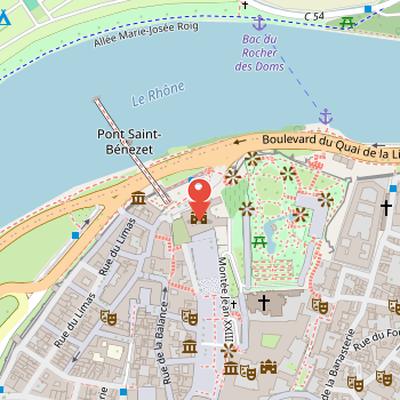
Nearby Objects
-
 Jardin des Doms 110 m away
 -
 Notre-Dame-des-Doms 140 m away
 -
 La Cour d'Honneur 200 m away
 -
 Saint Martial's Chapel 200 m away
 -
 Palais des Papes 200 m away
Collections and Setting of the Petit Palais Museum
The Musée du Petit Palais is located in the Petit Palais in Avignon, Provence-Alpes-Cote d'Azur, the former residence of the archbishops of Avignon from the 14th century. It opened in 1976 in a cardinal residence that was contemporary with the papal stay in Avignon. Its name contrasts with the nearby Palais des Papes in Avignon's historic center.
The museum is dedicated to medieval and early Renaissance painting and sculpture. Its collections include approximately 390 paintings and 600 sculptures, with a particular focus on painting before the second half of the 15th century. It holds one of the most important international collections of Italian primitives, with 326 paintings by more than 130 artists, and has the largest collection in France alongside the Louvre Museum. The collections also include painting and sculpture by masters of the Avignon school.
The Museum Collections
The museum collections are displayed in nineteen rooms spread over three levels. They come mainly from the Louvre reserve funds and other French provincial museums, as well as from the Campana collection, a major Italian ancient painting collection. More than 300 of the 326 Italian primitives from the former Campana collection are included, alongside paintings and ancient sculptures from the Musee Calvet d'Avignon. These holdings provide works from the Avignon school of the Middle Ages and Renaissance, including about sixty paintings and 600 sculptures.
The permanent exhibition presents works dating from the 14th century and is dominated by paintings from the 14th and early 15th centuries. The collection mainly features Italian painters, but also includes works from the Avignon painting school. Named artists represented include Sandro Botticelli, Vittore Carpaccio, Simone Martini, Paolo Veneziano, Lippo Memmi, Lorenzo Monaco, Carlo Crivelli, Josse Lieferinxe, and Enguerrand Quarton.
The sculpture collection includes Avignon medieval statuary, especially from the papacy era. It also contains Romanesque pieces such as sculpted capitals from Avignon churches, including the cloister of Notre-Dame des Doms cathedral, as well as many 14th-century statues from funerary monuments in Avignon churches. The collection features tombs of Jean XXII, Innocent VI, Urban V, and other cardinals, together with sculptures by Antoine Le Moiturier and Jean de la Huerta representing refined Avignon statuary.
Collections by Exhibition Room
The museum organizes part of its collection by exhibition room, bringing together capitals, sculptures, funerary statuettes from Avignon, and paintings. One room holds frescoes from Sorgues dated 1380, discovered in 1936 in two rooms of the Maison de la Reine Jeanne. These frescoes represent the kiss, the carole dance, the lady with the bird, and figures in front of a castle.
The same display also includes sculptures from various tombs, such as Saint Pierre, Saint Paul, Saint Andre, Saint Philippe, an angel holding a thurible, and Christ blessing. Another group of funerary sculptures is connected to the tomb of Cardinal Jean de Lagrange. His 1402 testament provided for the completion of his monumental tomb in the choir of Saint-Martial church in Avignon. He also had a tomb in Notre-Dame cathedral in Amiens, with his bones interred in Avignon and his flesh deposited in Amiens according to his wishes. The Avignon tomb was demolished during the Revolution and is known through a late 18th-century drawing found in the Vatican library. Some sculptures from the demolished tomb are displayed in the same room. The museum collection also includes paintings on wood panels, mainly made of poplar.
Sienese and Florentine Painting Rooms
The collection distribution by exhibition rooms includes a focused selection of Italian painting that is organized by artistic tradition and chronology. One room presents Sienese painting from 1350 to 1420, bringing together works such as Crucifixion from the Berlinghieri school, La Vierge de majeste by the master of 1310, Vierge et l'Enfant by Taddeo Gaddi, Le couronnement de la Vierge by Puccio di Simone, Christ de pitie by Giovanni Baronzio, and La Vierge et l'Enfant by Paolo Veneziano. The same area also includes Vierge de l'Annonciation by Bartolo di Fredi, La Vierge et l'Enfant by Taddeo di Bartolo, Assomption de la Vierge by Turino Vanni, Saint Jean-Baptiste et sainte Madeleine by Angelo Puccinelli, and Vierge et l'Enfant entre saint Jean-baptiste et saint Michel by Barnaba da Modena.
A related section highlights the period after the 1348 Black Death in Florence. This display brings together artworks that illustrate artistic responses in Florence during this period, including a reconstructed triptych by Tommaso del Mazza made for the main altar of a Florence hospital founded in 1386, and a fresco fragment attributed to Tommaso del Mazza showing Saint Christophe and the Enfant Jesus. It also includes Saint diacre by Alvaro Pires from around 1425, a gold background wood painting possibly depicting Saint Laurent by the same artist, and the triptych of Saint Laurent by Lorenzo Monaco.
Other works in the collection distribution emphasize the interaction between Byzantine tradition and Gothic style. The facts note that Byzantine painting influence lasted longer in Venice than in other peninsula kingdoms, while interest in the Gothic style appeared at the beginning of the second half of the 14th century. In this context, the exhibition presents works showing fidelity to Byzantine tradition alongside openness to Gothic style, including Ange de l'Annonciation and Vierge de l'Annonciation by Gherardo Starnina, La Crucifixion by the Maitre du crucifix de Pesaro, Saint Louis de Toulouse by the Maitre de la Madonna del Parto, Le couronnement de la Vierge by Simone dei Crocifissi, Le Couronnement de la Vierge by Jacopo di Paolo, La Vierge de misericorde by Pietro di Domenico da Montepulciano, Saint Jerome guerisant le lion by Ottavianno Nelli, L'ange de l'Annonciation by Sano di Pietro, Triptyque de la Nativite entre Saint Vittorino et Saint Ansano ou Galgano by Giovanni di Paolo, La Vierge et l'Enfant, saint Jean-Baptiste et saint Jerome by Francesco d'Antonio, Vierge et enfant entoures d'anges by Zanobi Strozzi, L'Annonciation by Bartolomeo Caporali, La Vierge et l'Enfant by Neri di Bicci, and La Vierge et l'enfant avec six saints by Neri di Bicci.
Botticelli and Florentine Painting
The collection display includes several works attributed to Sandro Botticelli, among them La Vierge et l Enfant avec le petit saint Jean, La Vierge et l Enfant, and La Vierge et l Enfant avec un ange. The rooms also present three important painters active in Florence in the second half of the 15th century: Bartolomeo della Gatta, Cosimo Rosselli, and Sandro Botticelli. The display notes that Pope Sixtus IV summoned all three to Rome to take part in the decoration of the Sistine Chapel.
Collections Displayed in the Exhibition Rooms
The museum's distribution of collections across its exhibition rooms includes a number of paintings and devotional works, showing the breadth of the holdings presented to visitors. Among the listed works are L'Annonciation avec saint Julien l'hospitalier, Saint Bernardin de Sienne by Bartolomeo della Gatta, and L'Annonciation by Cosimo Rosselli. Several images of the Virgin and Child are also included, such as Vierge et l'Enfant attributed to Pseudo Pier Francesco Fiorentino, Vierge a l'Enfant by Francesco Fiorentino, La Vierge et l'Enfant by Zanobi Machiavelli, Vierge et Enfant by Ludovico Urbani, Vierge et Enfant dans une gloire de cherubins by Luca di Paolo, Vierge et Enfant by Vittorio Crivelli, and La Vierge et l'Enfant by Francesco di Giorgio Martini and by Jacopo del Sellaio. Other religious subjects listed in the room arrangement include Saint Jean-Baptiste by Giovanni Angelo d'Antonio and by Cristoforo Scacco, Saint Jacques by Nicola di Maestro Antonio, Saint Petronne et saint Jacques by Vivarini, Saint Jean-Baptiste et saint Louis de Toulouse by Vivarini, Le Christ a la colonne by Liberale da Verona, Saint Laurent by the Maetre du Tondo Borghese, and Saint Leonard et saint Jacques by Agnolo and Domenico di Domenico del Mazziere. The collection display also includes larger narrative or devotional compositions such as triptyque della Rovere by Giovanni Mazone, Assomption de la Vierge by Ludovico Brea, La Vierge et l'Enfant entre saint Jean l'evangeliste, sainte Brigitte de Suede et deux anges by Ansano di Michele Ciampanti, La Vierge et l'Enfant avec huit saints by Ansano di Michele Ciampanti, Le Couronnement de la Vierge by Raffaellino del Garbo, Sainte Conversation by Vittore Carpaccio, La Sainte famille avec les bergers by Maetre de Memphis, and La Nativite by Lattanzio di Niccolo.
Display of Collections in the Exhibition Rooms
The distribution of the collections across the exhibition rooms shows a dense and varied grouping of works. One very small room exhibits three works, indicating a compact display arrangement in at least part of the museum. The listed works include Le Calvaire by anonyme, La Vierge et l'Enfant by Enguerrand Quarton, Sainte Catherine d'Alexandrie and L'Annonciation by Josse Lieferinxe, and Saint Siffren by anonyme. Other entries include Deux anges by Antoine Le Moiturier, La Toison de Gedeon by Nicolas Dipre, and La Vierge et l'Enfant entre deux saints et deux donateurs by anonyme. The collection also includes Saint Augustin, Saint Jerome, and Saint Ambroise, all by anonyme, as well as Adoration de l'Enfant by anonyme. Sculpture remains important in the display, with works such as Sainte Marthe et saint Lazare, Vierge de piete, Sainte Catherine de Sienne, and Buste de chevalier. The arrangement suggests that sculpture activity is maintained at a high level by foreign masters working in Avignon, and the presence of these works reflects that sustained artistic activity in the Petit Palais.