Located within the Palais des Papes in Avignon, the Cour d'Honneur is commonly known as "la cour d'honneur." It is identified as the first place of the Festival d'Avignon and as its most prestigious and most emblematic venue. The courtyard belongs to the papal palace and is described as a square bounded by the old palace to the north and east, and by the new palace to the south and west. Central remains of Jean XXII's audience hall are preserved in the courtyard, and a well dug by Urbain V is also mentioned. The courtyard originally had three doors. Its historical setting is tied to the expansion of the papal palace under Clément VI, who entrusted Jean du Louvres, called "de Loubières," with enlargement works. In the history of the festival, the Cour d'Honneur became a notable performance space from 1947 onward, when it hosted events such as "A Week of Art in Avignon" and later productions directed by Jean Vilar.
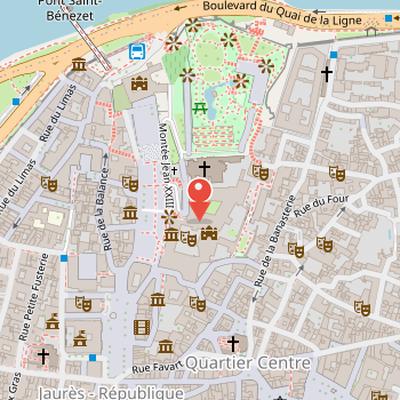
Nearby Objects
-
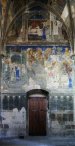 Saint Martial's Chapel 0 m away
 -
 Palais des Papes 0 m away
 -
 Notre-Dame-des-Doms 90 m away
 -
 Église Saint Pierre 200 m away
 -
 Opéra d'Avignon 200 m away
The Cour d'Honneur at the Palais des Papes
Located in the Palais des papes d'Avignon, the site is more commonly known as la cour d'honneur. It holds a central place in the festival d'Avignon, where it is described as the first place of the festival. It is also presented as the most prestigious and the most emblematic place associated with the event. These facts highlight its strong cultural significance within the festival context and its recognized importance in Avignon's public heritage.
The Cour d'Honneur and the Expansion of the Papal Palace
The Cour d'Honneur of the Palais des Papes is linked to the enlargement of the papal residence under Clément VI, who entered the palace built for Benoit XII and entrusted Jean du Louvres, called de Loubieres, with its expansion. The construction of the new palace began, and after the works were completed the total area of the papal palace had increased significantly. The courtyard itself is a square of approximately square meters and is enclosed on the north and east by the old palace, and on the south and west by the new palace. In its center are the remains of Jean XXII's audience hall. The courtyard also contains a well, dug by Urbain V, with a depth of meters. It originally had three doors, reflecting its role within the organized complex of the palace.
The Cour d'Honneur as a Festival Stage
The Cour d'Honneur of the Palais des Papes developed into a major festival venue through a series of productions and artistic initiatives linked to Jean Vilar, Christian Zervos, Rene Char, and Jeanne Laurent. It first hosted a modern art exhibition organized by Christian Zervos and Rene Char in the great chapel of the palace, and Zervos and Char later asked Jean Vilar to stage T. S. Eliot's play Murder in the Cathedral there. Vilar refused that proposal but suggested three other works: The Tragedy of King Richard II by Shakespeare, La Terrasse de midi by Maurice Clavel, and The Story of Tobie and Sara by Paul Claudel.
The space also became important in the context of cultural decentralization. Jeanne Laurent sought to establish permanent acting troupes in the provinces, and after Jean Vilar requested such a troupe for Avignon, she proposed the wall of the Cour d'Honneur at the Palais des Papes as a location. Following municipal approval, the venue was arranged for A Week of Art in Avignon from July 25 to August 1, 1947. That event brought 3000 spectators to seven performances across three venues: the Palais des Papes courtyard, the municipal theater, and the Verger d'Urbain V.
Vilar returned repeatedly to the Cour d'Honneur for later Drama Art Weeks, with reprises and premieres including The Tragedy of King Richard II, The Death of Danton by Georg Buchner, and Scheherazade by Jules Supervielle. He directed all three plays there and formed an acting company that gathered an increasingly large and loyal audience each year. In 1949, the entire Art Week was held there, with The Tragedy of King Richard II, Le Cid, and a shared evening for Oedipe and Pasiphae. Further productions followed in 1950, 1951, and 1952, including Le Cid, Henry IV of England, and The Prince de Hombourg. With Gerard Philipe, the Cour d'Honneur became a symbol of the Avignon Festival.
Leadership Changes at the Festival Courtyard
In 1980, Paul Puaux became director of La cour d'honneur, lieu de festival, following Jean Vilar. That same year, he moved to the Maison Jean-Vilar, which was associated with La cour d'honneur, lieu de festival. Also in 1980, Bernard Faivre d'Arcier replaced Paul Puaux as director of the Avignon Festival. The festival also became an association under the 1901 law at La cour d'honneur, lieu de festival.
The Cour d'Honneur as a Festival Stage
In the 1980s, the Cour d'Honneur, a festival venue at the Palais des Papes, was transformed to host major performances by Theatre du Soleil and other artists. Ariane Mnouchkine's Theatre du Soleil presented Shakespeare's plays there, including La Nuit des rois and Richard II in 1982, and Henri IV in 1984. The decade also saw a new generation of theatre at the site, along with dance performances by Jean-Claude Gallotta and Pina Bausch. Other notable stage productions included Antoine Vitez's Lucrce Borgia by Victor Hugo in 1985, Alfredo Arias's La Tempete by Shakespeare in 1986, Patrice Chereau's Hamlet in 1988, and Vitez's presentation of Paul Claudel's Soulier de satin in 1987, a 12-hour performance that was the longest ever presented at the Cour d'Honneur. The venue was also used for film events. Jean-Luc Godard premiered La Chinoise there in 1967 as a silent film with orchestra, Francois Truffaut presented Baisers voles in 1968, and silent films such as Intolerance and Octobre were shown with orchestra in the 1980s, including Griffith's Intolerance in 1986 and Serguei Eisenstein's Octobre in 1989. Peter Brook's Mahabharata was presented at Boulbon near the Cour d'Honneur in 1985.
Cour d'Honneur as a Festival Stage
The Cour d'Honneur du Palais des Papes has functioned as a major festival venue, with a continuous sequence of theatrical and choreographic presentations recorded from 1990 onward. In 1990, it hosted Les Fourberies de Scapin by Jean-Pierre Vincent, with Daniel Auteuil. The following year, the space opened in 1991 with Comedies Barbares by Ramon del Valle-Inclan, directed by Jorge Lavelli and performed with Michel Aumont and Maria Casares. During the 1990s, the courtyard also presented La Legende de Dom Juan in 1992, Dom Juan in 1993, Henry VI by Shakespeare in 1994, Andromaque by Euripides in 1994, and a double bill in 1995 with Cafe Muller by Pina Bausch and Les pieds dans l'eau by Jerome Deschamps.
From 2001 onward, the venue continued to receive works that combined theatre and choreography. These included Je suis sang by Jan Fabre in 2001, Platonov by Tchekhov directed by Eric Lacascade in 2002, and a planned 2003 program of Platonov and Je suis Sang that was interrupted by the festival cancellation. In 2004, the Cour d'Honneur came under the direction of Vincent Baudriller and Hortense Archambault, and that year it hosted Woyzeck by Georg Buchner directed by Thomas Ostermeier. Subsequent editions featured L'histoire des larmes in 2005, Asobu in 2006, and l'acte inconnu by Valere Novarina in 2007.
The space was repeatedly described as being reinvested in all its dimensions, notably with Romeo Castellucci's Inferno in 2008. That same year it also presented Thomas Ostermeier's Hamlet. In 2009, the Cour d'Honneur hosted the first three parts of Wajdi Mouawad's Le temps des promesses over eleven hours, as well as Warlikowski's (A)pollonia. The 2010 festival opened there with Christoph Marthaler's controversial Papperlapapp and also included Jean-Baptiste Sastre's La tragedie du Roi Richard II. In 2011, it hosted Boris Charmatz's Enfant, Anne Teresa De Keersmaeker's Cesena at 4:30 a.m., and Guy Cassiers' Sang & Roses at the end of the festival.
The venue continued to serve as a central festival stage in the following years. It opened the 2012 festival with Simon McBurney's Le Maitre et Marguerite and also presented Arthur Nauzyciel's La Mouette. In 2013 it hosted Stanislas Nordey's Par les villages and Jerome Bel's spectacle Cour d'Honneur. In 2014, Olivier Py's new direction was featured, the festival opened with Le Prince de Hombourg, and Lemi Ponifasio presented the choreography I am. Olivier Py also translated and directed Le roi Lear for the festival opening in 2015. In 2016, the courtyard hosted Ivo Van Hove's Les damnes, Amos Gitai's Yitzak Rabin: Chronique d'un assassinat for one evening, and closed with Sidi Larbi Cherkaoui's Babel 7.16. In 2017 it opened with the Japanese play Antigone directed by Satoshi Miyagi and also hosted Israel Galvan's La Fiesta.
Later presentations included Thomas Jolly's Thyeste by Seneca, with the opening date unspecified, and the 2019 festival opening with Pascal Rambert's Architecture. During the 74th edition of the festival in 2020, the Cour d'Honneur was empty because of the coronavirus pandemic. Its structure of seats and stage was redesigned for summer 2021, when it hosted Isabelle Huppert in La Cerisaie by Tchekov directed by Tiago Rodrigues, as well as a dialogue between Nicolas Truong and philosopher Edgar Morin conducted via video communication. In 2022, it hosted Kirill Serebrennikov opening the festival and presented his play Moine noir, adapted from Anton Tchekov, performed over three hours.
Spectatorship and Ritual in the Cour d'Honneur
The Cour d'Honneur du Palais des Papes is presented as a place embedded in national and international cultural memory, shaped as much by spectatorship as by performance. Audiences climb the steps of the Palais to the sound of Maurice Jarre's trumpets and enter a space where echoes of Gerard Philipe and Jean Vilar's tirades are imagined to remain. The spectators are described as a mix of returning festivalgoers, recent regulars, and novices, all ascending with a combination of memories, hopes, and apprehension. In doing so, they consider themselves participants in an extraordinary and important event.
The cour is also associated with a specific ritual of audience presence and reaction. Unlike in most other Avignon festival venues, it allows spectators to express disagreement freely during performances. They may stand up and leave loudly to signal dissatisfaction, hiss, or take sides in a way that can sometimes interrupt the show. This direct and public response connects the space to theater's popular origins, when spectators addressed actors directly.
At the same time, the Cour d'Honneur is described as a place where magical moments can occur. The first rays of dawn may light the cour, while spectators are scattered across the space, some wrapped in festival blankets or asleep on neighbors. The final curtain can bring a torrent of applause, with spectators applauding themselves as much as the actors. Specific productions associated with the cour include Antoine Vitez's 1987 staging of Soulier de satin, the 2009 presentation of the first two parts of Wajdi Mouawad's trilogy Littoral, Incendie, Forets, and Anne Teresa De Keersmaeker's Cesena in 2011, performed at 4:30 AM so that natural light could illuminate the dancers' bodies.
The Cour d'Honneur Wall in Staging
The cour d'honneur at the Palais des Papes has exerted a strong presence on staged performances, and many directors faced pressure from its wall when mounting their spectacles. Some tried to reduce or ignore this presence, while others transformed it into a central scenic element. Alfredo Arias played with the wall by reconstructing part of it on stage in La tempete. Marthaler altered its appearance in Papperlapapp by adding air conditioner vents and double-glazed PVC windows. Simon McBurney projected its demolition with astonishing realism in Le maitre et Marguerite, while Romeo Castellucci made the wall appear to be climbed hand over hand toward the heavens in Inferno. Antoine Vitez revealed its full measure and sober splendor in Lucrece Borgia, using minimalism and austerity, and Eric Lacascade did so in Platonov with plenitude and dynamism. The wall also posed a challenge to many renowned metteurs en scene, who failed before both the cour d'honneur wall and the spectators' wall in the stands.