Saint Martial's Chapel is located in the Palace of Popes in Avignon, on the second floor of the Saint-Jean tower. Its painted decoration retraces the main events of Saint Martial's life. The reading direction of the scenes goes from top to bottom, organizing the narrative across the chapel's surfaces.
The vaults illustrate thirteen scenes from the early life of Saint Martial. These scenes include his encounter with Christ's teaching when young, his baptism, the preaching of Christ, fishing, and Christ's appearance to Saint Peter with the request to send Martial to evangelize Gaul. Other scenes show Martial being sent with two companions to Gaul, the handing over of Saint Peter's pastoral staff, the resurrection of Austriclinien, the healing of Arnulfus's daughter, the resurrection of Nerva's son, and the baptism of the people of Toulx. Matteo Giovanetti worked on the decoration between 1344 and 1345.
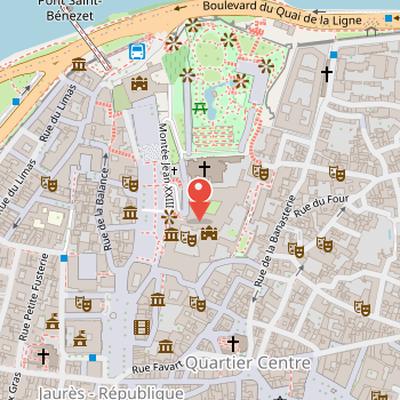
Nearby Objects
-
 La Cour d'Honneur 0 m away
 -
 Palais des Papes 0 m away
 -
 Notre-Dame-des-Doms 90 m away
 -
 Église Saint Pierre 200 m away
 -
 Opéra d'Avignon 200 m away
Decoration of the Chapelle Saint-Martial
Under Pope Clement VI, Histoire directed painter teams from across Europe to decorate the Palais des Papes d'Avignon. After the death of Martini, Histoire was assigned to decorate the chapels. He began decorating the Chapelle Saint-Martial, which opens in the Grand Tinel, and later completed its decoration. This work formed part of a broader sequence of decorative projects at the palace. Histoire also decorated the Oratoire Saint-Michel from 1345 to 1346, started the frescoes of the Grand Tinel in 1346 and finished them in 1347, worked in the Salle du Consistoire from 1 January 1347 to 31 March 1347, and worked in the Chapelle Saint-Jean in 1347.
Saint Martial's Chapel in the Saint-Jean Tower
Saint Martial's Chapel is located on the second floor of the Saint-Jean tower. Its painted decoration retraces the main events of Saint Martial's life, with scenes arranged to be read from top to bottom. Matteo Giovanetti worked on the chapel between 1344 and 1345. The vaults illustrate thirteen scenes from the early life of Saint Martial, giving the space a structured narrative character.
The Thirteen Scenes of Saint Martial
The chapel features a cycle of thirteen scenes centered on Saint Martial and key moments associated with his mission and miracles. The scenes include Saint Martial's encounter with Christ's teaching when he was young, his baptism, the preaching of Christ, and fishing. They also show Christ appearing to Saint Peter and asking that Martial be sent to evangelize Gaul, followed by the sending of Martial with two companions to Gaul. Another scene depicts the handing over of Saint Peter's pastoral staff to Martial.
The later scenes focus on acts of healing and resurrection attributed to Martial. These include the resurrection of Austriclinien, during which Martial imposes Saint Peter's staff on death, the healing of Arnulfus's daughter, and the resurrection of Nerva's son. The cycle also includes the baptism of the people of Toulx, the miracle of Ahun, and the healing of the paralytic. Taken together, the thirteen scenes present a narrative of calling, mission, and miraculous activity.
The Three Registers of the Description
The Description is organized into three registers. The upper register continues with seven other scenes in four panels. It includes the resurrection of Andrew and Aurelian in Limoges, the martyrdom of Saint Valerie, the ascent of her soul to heaven, the resurrection of her executioner, the honorable amends of Duke Etienne, the resurrection of Hildebert, one of his officers, the destruction of idols in Bordeaux, the healing of Sigisbert, Count of Bordeaux, and the extinguishing of the fire in Bordeaux.
The middle register contains nine other scenes in four panels. These scenes include the appearance of Christ to Martial in Poitiers and the martyrdom of Saints Peter and Paul, the ordination of Saint Aurelian and the creation of thirteen churches in Gaul, Christ's appearance to announce Martial's death, Saint Valerie's offering of her severed head to Martial, Martial's death, the funeral procession, and the healing of the sick through Martial's shroud. This register is closer to the ground and is in worse condition than the rest.
The lower register, just above ground level, is reserved for trompe-l'oeil motifs.
Saint Jean Chapel in the Palace of Popes
The chapelle Saint-Jean is located under the chapelle Saint-Martial and can be reached from the salle du Consistoire, which is level with the cloister built by Benoit XII. It has a northern entrance. Matteo Giovannetti worked on the chapel from 1347 to 1348.
The artwork in the chapel is read from top to bottom, and the story begins in the upper register. It presents two parallel sequences: one for saint Jean-Baptiste in the south and east, and one for saint Jean l'evangeliste in the north and west. The voetains show the relatives of the two saints. For saint Jean-Baptiste, these are sainte Elisabeth as mother, saint Zacharie as father, and sainte Ismerie as maternal grandmother. For saint Jean l'evangeliste, the relatives shown are sainte Marie-Salome as mother, saint Zebedee as father, and sainte Anne as maternal grandmother. In total, eight characters appear on the voetains with the two saints Jean.