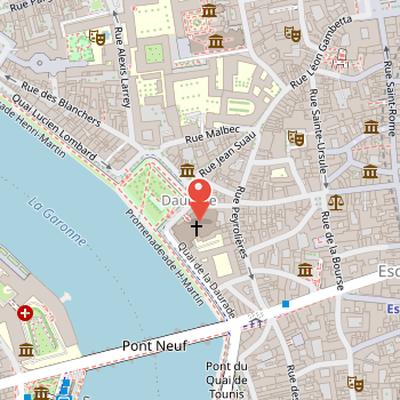
Notre-Dame de la Daurade, also known as Sainte-Marie de la Daurade, is a church in Toulouse with the status of a minor basilica. It stands along the banks of the Garonne River, near the place and port named after the river, and adjoins the Beaux-Arts school. The church is described as having a classical facade and apparently no bell tower, although a small undersized bell tower appears in a painting by Henri Rachou. Its architecture is said to be better appreciated from the opposite bank of the river.
The present building was totally rebuilt at the end of the 19th century on the site of one of the oldest churches in Toulouse. The church is associated with a Benedictine abbey and was bordered by mills until the end of the 19th century. It also overlooked the main bridge of Toulouse, the pont de la Daurade, from the 12th to the 19th century. The site has been classified as a historical monument since 24 August 1907.
Nearby Objects
-
 Quai de la Daurade 50 m away
 -
 Hôtel d'Assézat 200 m away
 -
 Fondation Bemberg 200 m away
 -
 Hôtel de Bernuy 250 m away
 -
 Toulouse Regional Conservatory 300 m away
Location and Status
Notre-Dame de la Daurade, also called Sainte-Marie de la Daurade, is a church in Toulouse with the status of a minor basilica. It stands along the banks of the Garonne River, near the place and port named after the Garonne. The basilica also adjoins the Beaux-Arts school, placing it within a prominent urban setting in the city.
Architecture and Historical Setting
Notre-Dame de la Daurade is described as a church with a classical facade and apparently without a bell tower, although a small undersized bell tower is visible in the painting by Henri Rachou. Its architecture is said to be better appreciated from the other side of the river. The building was totally rebuilt at the end of the 19th century on the site of one of the oldest churches in Toulouse. It was probably the chapel of the Visigoth kings and had an apse covered with paleochristian golden mosaics. The church is also identified as the seat of a Benedictine abbey whose prior was a principal figure in medieval Toulouse. From the 12th to the 19th century, it overlooked the main bridge of Toulouse, the pont de la Daurade, and it was bordered by mills until the end of the 19th century. It has been classified as a historical monument since August 24, 1907.
Origins and Name of Notre-Dame de la Daurade
Notre-Dame de la Daurade was built on the remains of a dodecagonal Roman temple, likely dedicated to Apollo and topped with a dome. According to the facts provided, Roman emperors entrusted this temple to Christians. After the cult of the Virgin received new dogmatic definitions at Ephesus in 431, the church of the Daurade was built and dedicated to the Virgin Mary, depicted there as a black virgin. The church was initially called the basilica Sainte-Marie de Toulouse. It is now known as the basilica of the Daurade because of its golden mosaics. Its name derives from a golden mosaic called Deaurata, meaning covered in gold.
History and Reconstruction
Notre-Dame de la Daurade was integrated into a Benedictine monastery in an unspecified century and was attached to the abbey of Moissac, itself dependent on Cluny, in 1077. In the 11th century, the church, which remained dodecagonal, was extended by a Romanesque nave, and the monastery was expanded with a cloister. The dome was destroyed in 1703 because it was at risk of collapsing, and a new dome installed in 1760 weakened the church walls. The entire Romanesque church was then demolished in 1761 due to poor maintenance.
A reconstruction project began in 1764, but it was halted to allow construction of the Garonne quays by architect Saget. The new project aimed to reproduce St. Peter's Basilica in Rome, and nine years after work began, the plans were modified with a rotation and translation of the whole structure. The choir of the original basilica, built on the temple remains, is now located under the transept. Construction was interrupted by the French Revolution, but the church was consecrated in 1836, elevated to basilica status by Pope Pius IX in 1876, and completed in 1883.
The basilica houses the remains of the poet Pierre Goudouli, whose statue stands in the center of Place Wilson garden. Devotion to Notre-Dame La Daurade has also been the subject of academic research. Restoration costs amounted to 5.7 million euros, and this restoration was the first since the basilica's construction. Since the restoration, the basilica has been open daily for visits except during liturgy times reserved for worship.
The Bells of Notre-Dame de la Daurade
In 2017, the basilique de la Daurade had five bells. Two of them were large bells equipped to ring by swinging, while three were fixed bells tuned to Si 3, Re # 4, Fa 4, Fa # 4, and Sol # 4. Four of the bells had been cast in 1845 by Jean-Louis Louison, a founder in Toulouse, and one bell had been cast in 1816 by the founder Chatelet.
The bells were restored in 2018, when two new bells were added, tuned to Do # 4 and La # 4. The Fa 4 bell was replaced during this restoration, and the new set included three bells named Maria Dauratae, Peire Garona, and Benoit. Maria Dauratae was named according to the church's dedication, Peire Garona after Pierre Goudouli, a Toulouse poet whose ashes are in the basilique, and Benoit after the inspirer of the rule of the church's monastic builders.
The three new bells were cast publicly on Quai de la Daurade during European Heritage Days. Casting began at 22 h on Saturday, September 15, and the molds were removed at 10 h on Sunday, September 16. Before returning to Toulouse, the bells were polished and tuned at the Paccard foundry in Annecy. They were baptized at an 11 a.m. mass on the Sunday after casting. The casting order began with the smallest bell and continued to the largest. During the casting of the medium bell, a mold leak released 30 kg of molten bronze, but the leak was sealed and casting succeeded. The largest bell initially lacked sufficient metal for the upper part and was recast entirely at Paccard foundry in Annecy using a new mold and a new casting process.
Bell Restoration and Musical Heritage
The restoration of the bells at Notre-Dame de la Daurade was intended to let them play the beginning of Toulouse by Claude Nougaro, a song originally released in 1967 under the title O Toulouse. The song is considered an emblematic anthem of the city of Toulouse. Its musical theme was inspired by the carillon melody of the church of Minimes in Toulouse, itself associated with a popular Marian hymn from the 19th century. This melody had been programmed in the clock mechanism made by Lussault, installed during the 1892 renovation of the bell tower at the Minimes church. The restoration thus aimed to revive an old carillon melody at a different bell tower.
Listed Elements and Restoration
The elements recorded at Notre-Dame de la Daurade are listed as historical monuments in the Palissy database. Among these recorded elements is the Monument aux morts de la guerre 1914-1918. Photographs of Notre-Dame de la Daurade were taken in 2014, before the restoration. The restoration of the site took place in autumn 2017.
Interior Features and Decorative Program
The documented interior of Notre-Dame de la Daurade includes several devotional spaces, furnishings, and painted works. A gallery of images shows the basilica in Toulouse in photographs taken in 2009, 2014, and 2017, all before the restoration that began in autumn 2017. Among the highlighted spaces are the Chapelle des anges, where angels are shown lifting the cross above a marble altar and tabernacle, and the chapelle des anges adorateurs, decorated with ceramics by Gaston Virebent and showing angels adoring an imitation tabernacle. The gallery also records the vault of the choir, the baptistry, and the baptismal fonts. In the baptistry, a stained glass window represents the crucifixion of Jesus, with God the Father supporting the cross. Another image presents a Pieta beneath a stained glass window showing Christ Roi and the cross held by two angels. The gallery also identifies the left statue as Sainte Jeanne d'Arc and the right statue as Sainte Germaine de Pibrac, with a painting of Notre-Dame de Guadalupe placed in front. A 19th-century gilded wooden pulpit is also documented. Between 1810 and 1820, the painter Joseph Roques produced seven paintings on the life of the Virgin for the basilica: Presentation at the Temple, Immaculate Conception, Annunciation, Nativity, Assumption, Visitation, and Purification.
Jeux floraux and the Basilica
Notre-Dame de la Daurade is associated with the ceremonial life of the Jeux floraux. During the morning when the trophies are blessed, a mass is held in the basilica. The trophies themselves are flowers made of gold and silver, placed in the church in keeping with an ancient religious custom. They are intended for the laureates of the Academie des Jeux floraux. The flowers are then solemnly brought to the academy session to be awarded.
The tradition has changed over time. Formerly, the flowers were carried in procession from the church by three capitouls-bailes and three commissioners of the Academie, with trumpets and oboes of the city following behind. Today, they are brought to the Capitole by a delegation of maintainers, and the awards are presented in the Salle des Illustres.
The Daurade Mills and the Bazacle Dam
The moulins de la Daurade received rights from the prieur de la Daurade to use part of the Garonne river in Toulouse. They remained active throughout the 14th century, but their operation ended after the elevation of the Bazacle dam in 1356. This change also ruined the mills' owners, marking a decisive break in the history of the site.