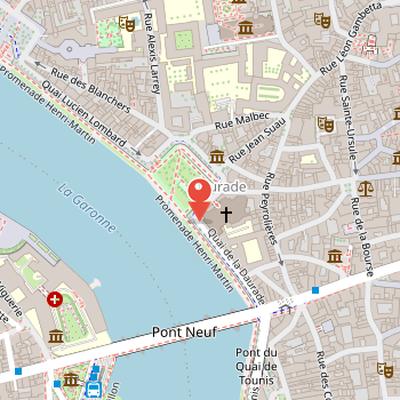
Quai de la Daurade is a public road and riverfront in Toulouse, in the Occitanie region of southern France. It runs northwest along the Garonne, about ten meters above the river, and belongs to the Capitole district. The quai begins north of place du Pont-Neuf at the Pont-Neuf bridge outlet and extends for 182 meters before reaching place de la Daurade. It is 16 meters wide and includes a bicycle lane along its full length. The roadway is a one-way vehicular lane from place de la Daurade toward place du Pont-Neuf and lies within a meeting zone with a speed limit of 20 km/h. The quai passes the buildings of the former prieuré de la Daurade and the École des Beaux-Arts, and it also passes basilique Notre-Dame-de-la-Daurade, whose forecourt is named Rémy-Peyranne. The name of the quai refers to the Benedictine priory of La Daurade, on land that partly belonged to the priory.
Nearby Objects
-
 Notre-Dame de la Daurade 50 m away
 -
 Hôtel d'Assézat 200 m away
 -
 Fondation Bemberg 250 m away
 -
 Hôtel de Bernuy 250 m away
 -
 Toulouse Regional Conservatory 300 m away
Location and Local Names
The quai de la Daurade is part of two streets in Toulouse, the capital of the Occitanie region in the Midi of France. In Occitan, it is known as cai de la Daurada and as parvis Remy-Peyranne. These names reflect the local linguistic context of the area and its place within the street network of Toulouse.
Location and access
Quai de la Daurade is a public road in the quartier Capitole, alongside the parvis Remy-Peyranne. It begins north of place du Pont-Neuf, at the outlet of Pont-Neuf bridge, and runs northwest along the Garonne for 182 meters. The quay is 16 meters wide and lies about ten meters above the river.
Its route passes the buildings of the former priore de la Daurade and the Ecole des Beaux-Arts, as well as the basilique Notre-Dame-de-la-Daurade, whose forecourt is named Remy-Peyranne. After 61 meters, the quay gives rise to rue du Tabac on the right side, and it ends 121 meters further at place de la Daurade. Along the way, it intersects Pont-Neuf on the left side, place du Pont-Neuf on the right side, rue du Tabac on the right side, and place de la Daurade.
The roadway has a single one-way vehicular lane from place de la Daurade toward place du Pont-Neuf. It belongs to a meeting zone with a speed limit of 20 km/h and has a bicycle lane along its entire length. Public transport access includes direct service by shuttle navette, stops for LinEO lines and buses at the opening onto place du Pont-Neuf, and proximity to Esquirol metro station.
Access and Nearby Bike Stations
The nearest VeloToulouse self-service bike stations to quai de la Daurade are located at 2 place de la Daurade, 122 quai de Tounis, and 12 place du Pont-Neuf. These stations provide convenient access points in the immediate surrounding area.
Name and Historical Associations
The quai de la Daurade takes its name from the Benedictine priory of La Daurade. Odonymic research notes that the quai is partly situated on land that once belonged to the priory, including the cemetery of the Counts and gardens descending towards the Garonne. This link with the priory gives the waterfront a toponymic and historical connection to an earlier religious landscape.
The name also reflects a history of temporary renaming. In 1794, during the French Revolution, the quai was briefly called quai Rousseau. According to the same source, this name did not persist, and the traditional name remained in use.
The area in front of the basilica Notre-Dame de la Daurade is also associated with the painter and art teacher Remy Peyranne (1935-2018). The municipal council named the square in his honor. Peyranne was a Toulouse painter and a student at the school of fine arts, where he studied under Raoul Bergougnan. He was eligible for the Prix de Rome competition in 1958, exhibited at the Galerie du Taur, and met Renee Aspe there. In 1967, he was appointed professor of Architectural Drawing at the same school of fine arts. He died at Castelnau-d'Etretefonds, and part of his work is preserved at Les Abattoirs.
Development of the Daurade Quay
Before the construction of quays on the right bank of the Garonne, the riverbank area was occupied by gardens and by the possessions and cemetery of the priory of La Daurade. The Daurade quay was developed beginning in 1766 by the Etats de Languedoc, at the instigation of Etienne-Charles de Lomenie de Brienne, archbishop of Toulouse. Work began in April on land taken from the La Daurade priory, despite opposition from the Benedictines. In 1767, construction continued with a retaining wall supported to the south by Pont-Neuf and to the north by the old La Daurade bridge abutment. At the same time, the tower at the entrance to the old La Daurade bridge, opposite the La Daurade church, was demolished.
The quay later became a significant urban setting. The School of Arts moved on 3 March 1881 from the Augustins convent on rue des Arts to the Tobacco factory, and the new School of Arts was inaugurated the next day. The new building, called the Palace of Arts and Sciences, was constructed on the Daurade quay. The quay was also described as a popular promenade location. In 1920, the cafe des Pyrenees, run by Coussieres, was located there and later became cafe Bellevue in 1935.