The Basilica of St. Michael is a church building and minor basilica in Bordeaux, southwestern France. It is the second largest Catholic church in the city and is characteristic of the flamboyant Gothic style. Built from the 14th to the 16th century, it succeeds an older parish church that stood outside the city walls. The later construction of the third city wall, which included the ancient sanctuary, contributed to the development of the district in the 13th century, an area associated with merchants and artisans such as carpenters and coopers.
Construction of the new church began around 1330, and the church hall emerged in 1430 after a century marked by war and plague. The parish council decided to raise the central nave in order to make a basilica. The building became an important stage on the route to Santiago de Compostela, and a chapel dedicated to Saint James reflects this role. Its bell tower, built independently of the sanctuary, rises in front of the church and is the tallest in southern France. The tower base preserves a crypt that once served as an ossuary. The basilica was classified as a historic monument in 1846 and has been part of the UNESCO World Heritage listing for the Routes of Santiago de Compostela in France since 1998.
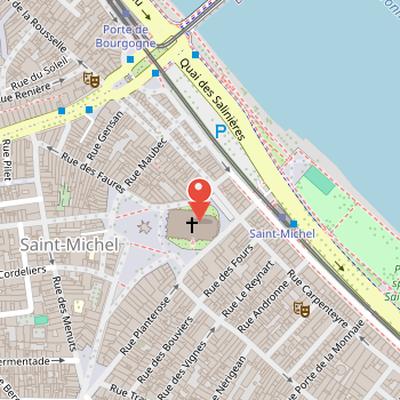
Nearby Objects
-
 Porte de la Monnaie 300 m away
 -
 Church of the Holy Cross 450 m away
 -
 Hôtel Saint-François 500 m away
 -
 Église Saint-Éloi 500 m away
 -
 Conservatoire de Bordeaux Jacques Thibaud 550 m away
Architecture and Heritage
The Basilica of St. Michael is the second largest Catholic church in Bordeaux, in southwestern France. It was built from the to the century and is characteristic of the flamboyant Gothic style. The basilica gave its name to the neighborhood where it is located. It shares with Saint-Andre Cathedral the feature of having a bell tower independent of the sanctuary. Its bell tower rises to a height of and is the tallest in southern France, as well as the fourth tallest in France after the spires of Rouen, Strasbourg, and Chartres cathedrals. The base of the tower preserves a crypt that once served as an ossuary. This crypt later became an exhibition site for mummies exhumed during the in Meynard square. The basilica was classified as a historic monument in 1846 and has been listed as a UNESCO World Heritage site since 1998 as part of the Routes of Santiago de Compostela in France.
Construction and Urban Role
The present building of the Basilica of St. Michael replaced an older parish church that had stood outside the city walls. Its setting changed in the 13th century, when the construction of a third city wall incorporated the ancient sanctuary and contributed to the development of the district. That area was associated with merchants and artisans, including carpenters and coopers.
A new church was begun around 1330, but the work was slowed by a century marked by calamities such as the Hundred Years War and the plague of 1348. The church hall was completed in 1430. The parish council then decided to raise the central nave to form a basilica in the flamboyant Gothic style.
Construction received important support from Louis XI, who donated generously during a visit in 1462, after placing France under the protection of Saint Michael. In 1466, a college of canons was established in the church while it was still under construction. From 1472 to 1492, Jean Lebas of Saintes and his sons directed the building works and erected a bell tower fifteen meters in front of the church. The height of this arrow-shaped tower raised concerns about wind, and the Saint-Michel tower later suffered weather damage several times.
Brotherhoods and guilds also contributed to the building campaign, but the works remained unfinished before the 16th century. The church gained further significance as an important stage on the route to Saint James of Compostela, as shown by the Saint James chapel. The building later suffered damage from the earthquake that struck Bordeaux on June 25, 1759.
Bell Tower Restorations and Later Reconstruction
The bell tower spire of the Basilica of St. Michael was struck by lightning several times and was later destroyed by a hurricane in 1767, which reduced its height to 18 meters. A restoration project proposed in 1755 remained unexecuted. In 1773, the church fabric entrusted the restoration of the bell tower to the royal architect Jacques Hardouin-Mansart de Sagonne, the last of the Mansarts and a grandson of Jules Hardouin-Mansart. However, the 18th century restoration plan did not succeed because of insufficient funds, even after a fundraising campaign in 1774. The estimated cost of the bell tower construction was 60,000 livres. Mansart de Sagonne's project was definitively rejected in 1811, when the parish adopted Louis Combes's project instead. Before hosting the Chappe telegraph in the early 19th century, the bell tower had a truncated appearance. Its spire reconstruction began in 1860 under architect Paul Abadie in the Gothic style and was completed in 1869.
Later History and Heritage Status
The old parish cemetery surrounding the church was ordered to be removed by the departmental directory in 1791. The ossuaries were then stacked in the crypt beneath the bell tower and covered with earth. This crypt contained several dozen mummified bodies known as the Saint-Michel mummies, and it remained open to visitors until 1979, when the bodies were reburied in the Chartreuse cemetery. The building was listed in the historic monuments inventory in 1846 and was declared a minor basilica by Pope Leo XIII in a brief apostolic letter. Its stained glass windows were partially destroyed by bombings and replaced after the conflict by modernist glass by Max Ingrand and Jean-Henri Couturat. In 1998, it was included in the UNESCO World Heritage List as part of the Saint James Way in France.
Architectural Layout
The Basilica of St. Michael is one of the largest places of worship in Bordeaux and is characteristic of the flamboyant Gothic style. It has a Latin cross plan and a triple nave. The nave is high and divided into four bays, entirely covered by an oblong rib vault. The side aisles share the same oblong rib vault as the nave and are flanked by 17 lateral chapels. A large transept separates the nave from the choir, which is formed of three bays. The structure is closed by three polygonal apsidioles. The basilica measures de long from the choir to the entrance of the nave and de large from one transept arm to the other.
Chapels and Interior Furnishings
The basilica contains a series of chapels, each dedicated to a confraternity or corporation, and many of them preserve works of art. Among the most notable is the Saint-Jacques chapel, built from 1470 to 1475 and dedicated to pilgrims to Santiago de Compostela. It contains a wooden altarpiece, with a painted center representing the apotheosis of Saint-Jacques from 1632, and it also houses the tomb of a jacquet. Another chapel is dedicated to Saint Catherine of Alexandria, patron saint of boatmen. The Ferron chapel is decorated with a sculpted composition of the Deposition from the Cross dating from 1493.
Other interior works include a pieta dating from the late period mentioned in the source, and a sculpture of Saint Ursula of Cologne sheltering the virgin martyrs of Cologne beneath her cloak. In the nave, a chair combining mahogany wood and marble panels is topped by a statue of Saint Michael, the patron saint of the church. Numbered or engraved slabs in the nave testify to the custom of burying wealthy people inside the church, a practice that declined during the for public health reasons.
The interior is illuminated by large flamboyant gothic tracery bays. Most of the stained glass windows date from the and , and one of the oldest is the Jesse Tree, dominated by red, yellow, and blue tones. In the choir, stained glass by Max Ingrand replaced windows destroyed by bombings.
Organ and Tower Features
The Basilica of St. Michael in Bordeaux includes a notable organ and a distinctive bell tower. The buffet d'orgue was constructed from 1762 to 1765 by Cessy and Audebert. The Grandes orgues were restored several times by the organ builder Micot, and later reconstructed by Joseph Merklin in 1865. The instrument has 41 jeux for three claviers and one pedalier. It was dismantled in 2008 for another restoration, then restored from 2008 to 2011 by Bernard Hurvy, Olivier Robert, Stephane Robert, and Michel Jurine. Its restoration was inaugurated with an improvisation by Thierry Escaich and a concerto performance with the Orchestre National Bordeaux Aquitaine. The buffet was classified as a monument historique in 1846, and the instrumental part in 1987. Paul Darrouy is identified as the titulaire of the instrument.
The clocher-tour is designed as an independent octagonal structure with a base pierced by six arches. It has three etages a claires-voies and a drum topped with a spire. The ajourée spire of the tour Saint-Michel was built by Paul Abadie from 1861 to 1869. The flèche Saint-Michel de Bordeaux is recognized as the tallest clocher in southern France. The campanile is equipped with a carillon of 22 bells, and restoration work made the carillon functional again. Restoration works on the spire also lasted five years.
The Crypte and the Mummies
The crypte is located under the clocher. In 1791, terracing work at the old parish cemetery led to the discovery of several dozen mummified bodies. These mummies were arranged in a circle in the crypte, which became a museum and drew curious visitors, including Victor Hugo in 1843 and Theophile Gautier a few years later. The crypte was closed to the public in 1979, and the mummies were reburied in the Chartreuse cemetery in 1990.
Heritage Protection and Recognition
The Basilica of St. Michael has received several official heritage designations. According to protection patrimoniale, the church was classified as a historical monument in 1846. It later became a minor basilica in 1903, marking another important step in its ecclesiastical recognition. In 1998, the church was inscribed on the UNESCO World Heritage list, placing it within an internationally recognized framework of cultural heritage protection.