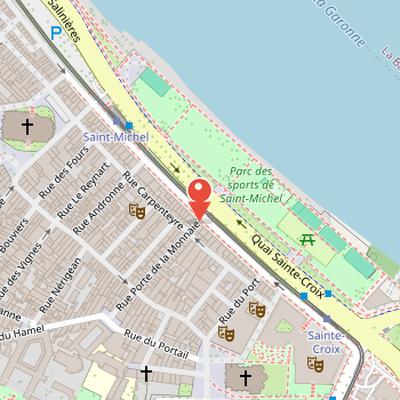
Porte de la Monnaie is a city gate in Bordeaux, located on the quais de la Monnaie, halfway between Pont de pierre and Pont Saint-Jean and a few steps from the conservatory of music. The gate was built to address the difficulty created by city walls, which prevented inhabitants between Porte de la Grave and Porte Sainte-Croix from communicating with the port. On the proposal of intendant Tourny, the jurats ordered the construction of a new gate. Work began in 1756 under architect Jean Alary, following plans by André Portier, and was completed in 1759. The gate takes its name from the coin workshop moved from the nearby old Hôtel de la Bourse, now located in Pessac. Its spelling evolved from Porte de la Monnoye to Porte de la Monnoie and finally Porte de la Monnaie. The building was listed as a historical monument by decree on December 12, 1929.
Nearby Objects
-
 Church of the Holy Cross 250 m away
 -
 Conservatoire de Bordeaux Jacques Thibaud 250 m away
 -
 Basilica of St. Michael 300 m away
 -
 Rock School Barbey 650 m away
 -
 Hôtel Saint-François 750 m away
Location of the Porte de la Monnaie
The Porte de la Monnaie is a city gate in Bordeaux. It is located on the quais de la Monnaie, halfway between the Pont de Pierre and Pont Saint-Jean. The gate is also a few steps away from the Conservatoire de Musique, placing it in a prominent riverside area of the city.
Origins and Naming of Porte de la Monnaie
City walls once prevented inhabitants between Porte de la Grave and Porte Sainte-Croix from communicating with the port. In response, the jurats ordered the construction of a new gate on the proposal of intendant Tourny. Work began in 1756 under architect Jean Alary, following plans by architect Andre Portier, and was completed in 1759.
The gate takes its name from the coin workshop that was moved from the old Hotel de la Bourse nearby. That workshop is now located in Pessac. The spelling of the gate's name evolved over time, from Porte de la Monnoye to Porte de la Monnoie and finally Porte de la Monnaie. The adjacent street was called rue porte de la Monnaie and had previously been named rue Anglaise; it was also known by the nicknames rue des Anglais and rue des Arlots, the latter derived from English meaning daughter of joy.
Porte de la Monnaie was listed as a historical monument by decree on December 12, 1929.