The Church of the Holy Cross was constructed towards the end of the 11th century and the beginning of the 12th century. It has a Romanesque Saintongeais facade and a Latin cross plan. The interior consists of a nave with five bays, collateral aisles 4.5 meters wide, a transept with a large absidiole on each arm, and a polygonal apse reaching a height of 16 meters.
The building was restored by Paul Abadie between 1861 and 1865, during which he added a symmetrical bell tower to the left of the facade. The church also preserves important artworks, including two paintings by Guillaume Cureau, Saint Mommolin healing a possessed man and Saint Maur healing a sick person, as well as Exaltation of the Cross by A. Bourgneuf from 1636. Its organ was made in 1750 by the monk Dom Bedos de Celles and restored in 1995 by Pascal Quoirin.
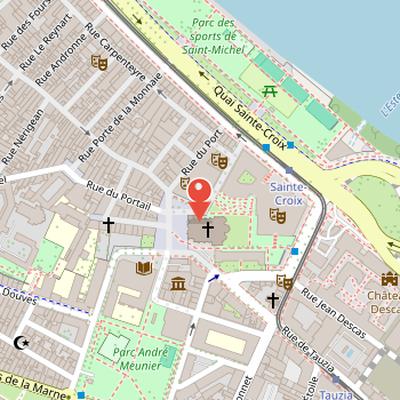
Nearby Objects
-
 Conservatoire de Bordeaux Jacques Thibaud 140 m away
 -
 Porte de la Monnaie 250 m away
 -
 Rock School Barbey 450 m away
 -
 Basilica of St. Michael 450 m away
 -
 Hôtel Saint-François 850 m away
Architecture and Interior Features
The Church of the Holy Cross was constructed towards the end of the 11th century and the beginning of the 12th century, and it features a Romanesque Saintongeais facade. Its plan is in the form of a Latin cross. The building consists of a nave with five bays and collateral aisles measuring 4.5 meters wide, as well as a transept with a large absidiole on each arm. It also includes a polygonal apse reaching a height of 16 meters.
The church was restored by Paul Abadie between 1861 and 1865, during which he added a symmetrical bell tower to the left of the facade. The organ was made in 1750 by the monk Dom Bedos de Celles and restored in 1995 by the organ builder Pascal Quoirin. The interior also contains two works by the painter Guillaume Cureau, Saint Mommolin healing a possessed man and Saint Maur healing a sick person, as well as a painting titled Exaltation of the Cross by A. Bourgneuf from 1636.
Origins and Medieval Development
The Church of the Holy Cross is linked to an abbey founded in the Merovingian period south of Bordeaux, on an elevation in a marsh crossed by the Eau Bourde stream. Its exact foundation date is unknown, but a 7th-century epitaph states that Saint Mommolin, abbot of Fleury sur Loire, died there around 679. The monks followed the Benedictine rule.
The original abbey was destroyed by Saracens around 730 and was probably reconstructed at the end of that century. It was then completely destroyed by Norman raids by the mid-9th century. Around 970, Guillaume le Bon, count of Bordeaux, rebuilt it on the site of Saint Mommolin's oratory. The abbey later held Saint-Hilaire du Taillan and Soulac, and its possessions were expanded to include Saint-Macaire and Macau. Its privileges were confirmed by the successive dukes of Aquitaine.
The abbey church itself was built at the end of the 11th or the beginning of the 12th century, alongside the basilica of Soulac and Macau church.
Architectural Transformations of the Church
The abbey church of Histoire de l'abbaye was initially completed with wooden roofs or open frameworks. In later centuries, the church received transitional Gothic vaults during renovations in the 14th and 15th centuries, showing forms between Angevin and Parisian styles. Around the wider abbey complex, the regular convent buildings such as kitchens, dormitories, and refectories were allowed to decay gradually. At the same time, the abbey continued to develop other functional works, including customs toll collection outside the city walls to the south and the construction of a mill battery on Eau de Peyrelongue to meet the growing city's milling demands. In the 17th century, monks of the Saint-Benoit congregation obtained permission in 1664 to build a new monastery, which was completed in 1672. Later, architect Etienne Laclotte was commissioned in 1784 to build a bridge over the Estey de Begles, a cemetery, and a chapel annex to Sainte-Croix church. After the French Revolution, the site was converted into a hospice in 1793, the Saint-Benoit chapel became a warehouse in 1797, and the Ecole des Beaux-Arts was installed there in 1890.
Sculpted Portal Iconography
The sculpted portal of the Church of the Holy Cross presents a detailed iconographic program on the central door, organized through five voussures. The first voussure shows men pulling a rope, symbolizing human struggles between good and evil. The second includes zodiac signs, months of the year, and motifs of human work, expressing the temporality of human life. In the upper part of the door, 24 crowned elders in white robes and musical instruments appear, based on the first scene of the Book of Revelation. The left arcade depicts greed through a man burdened by a purse hanging from his neck and tormented by a demon, while the right arcade represents lust through a woman bitten on the breasts by a serpent.
Parish Life and Church Access
The Church of the Holy Cross is part of the Vie paroissiale, which includes the church Saint-Michel, the abbey Sainte-Croix, the church of the Sacred Heart, and the church Saint-Jean in Belcier. Vie paroissiale forms the pastoral sector of Saint Jean and is grouped into one parish. In 2021, it was entrusted to the spiritual family of Regnum Christi. After acts of vandalism, parishioners began opening the church on Friday afternoons between 14 h and 16 h, and it is also open on the first Sundays of the month.
The Dom Bedos Organ
The Church of the Holy Cross is associated with the Dom Bedos organ, a major historical instrument built at the abbey church Sainte-Croix by the Benedictine monk, theoretician, and organ maker Dom Francois Bedos de Celles. It was established in 1730 by the monks of Sainte-Croix as a more imposing organ, replacing an earlier instrument made by Jean Haon in 1661. Dom Francois Bedos de Celles arrived fifteen years after 1730 to create the organ, which was completed in three years. At the time of its completion, it was one of the largest classic French organs, with a sixteen feet stop, 45 stops, five manuals, and one pedalboard.
After the Revolution, the organ was restored, and in 1811 its instrumental part was transferred by order of the archbishop to Saint-Andre cathedral. It remained there until 1970, when it was returned to Sainte-Croix in its original case. From 1984, Pascal Quoirin was assigned to restore the instrumental part, a process that took twelve years. In the early 1990s, the case was stripped of brown paint to reveal the original polychromy. The organ was inaugurated on the 23rd, with performances by Francis Chapelet, Jean Boyer, Jean-Pierre Leguay, and Michel Chapuis.
Saint Mommolin and the Chapel Tradition
Saint Mommolin, patron of the people of Bordeaux, died in Bordeaux in 623 and is identified in the church tradition as a Benedictine monk. He was venerated by the people until the French Revolution and was reputed to cure mental illnesses and possessed persons. According to tradition, possessed persons were said to be freed after staying tied all night before his chapel.
Several physical traces of this devotion remain in the Church of the Holy Cross. Rings fixed at the base of some pillars are associated with this practice, while the sarcophagus of Saint Mommolin and his statue are both missing. His relics, which were preserved after being hidden for centuries, are now kept in a lateral chapel. The saint is also depicted in two paintings in the church, which help maintain his presence despite the loss of some earlier objects linked to his cult.