Conservatoire de Bordeaux Jacques Thibaud is an artistic educational institution in Bordeaux, Gironde, France, approved and controlled by the French State through the regional cultural affairs directorate. Classified as a regional outreach conservatory, it offers three specialties: music, theater, and dance. Its history is linked to a series of local musical initiatives that began with an early project for a music conservatory proposed to the municipal council, though it initially had no follow-up. The project was resumed in 1835 by Ryckmans, a musician in the Grand Théâtre orchestra, and included free access for children from modest families as well as monthly concerts presenting the talent of Bordeaux city artists. In 1850, Charles de Mézeray created a music school, later followed by a free music school in 1852 and the Sainte-Cécile philanthropic society. The institution later moved to larger premises, organized concerts and contests, and became a municipal conservatory on December 2, 1920. It adopted national music school status in 1968.
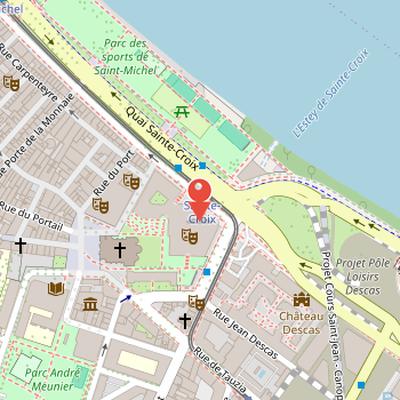
Nearby Objects
-
 Church of the Holy Cross 140 m away
 -
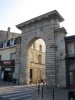 Porte de la Monnaie 250 m away
 -
 Rock School Barbey 550 m away
 -
 Basilica of St. Michael 550 m away
 -
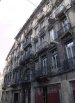 Hôtel Saint-François 950 m away
Institutional Status and Offerings
The Conservatoire de Bordeaux Jacques Thibaud is an artistic educational institution approved and controlled by the French State. It is represented in Bordeaux, Gironde, France, by the regional cultural affairs directorate, and it is classified as a regional outreach conservatory. Located in Bordeaux, it offers instruction in three specialties: music, theater, and dance.
From a Civic Music School to a Conservatory
The history of the Conservatoire de Bordeaux Jacques Thibaud began with an unfulfilled proposal by Historique for a music conservatory project submitted to the municipal council. The idea was taken up again in 1835 by Ryckmans, a musician in the Grand Theatre orchestra. This early project already combined musical instruction with public access, including free admission for children from modest families and monthly concerts intended to showcase the talent of Bordeaux artists.
In 1850, Historique's Charles de Mezeray created a music school, and in 1852 Historique established a free music school with sixty students studying solfege and singing. De Mezeray also founded the Sainte-Cecile philanthropic society with sixty-four musicians from the city orchestra. The society organized year-end contests and musical events, and the school was transferred to a larger venue on rue de Montmejean in 1856. The following year, Historique organized a national Orpheon tournament in Bordeaux and named Camille Saint-Saens an honorary member of the Sainte-Cecile society and jury member of the tournament.
The Sainte-Cecile society was recognized as a public utility by Adolphe Thiers in 1873, after which popular concerts were created. The society later moved from rue des Trois-Conils to 124 rue de la Tresorie in the 1880s, and it continued its pedagogical work during World War I. It resisted annexation by the State before becoming a municipal conservatory on December 2, 1920. From 1932 to 1948, the conservatory was directed by the virtuoso violinist Gaston Poulet, who revitalized musical life at the institution and in Bordeaux musical events.
The conservatory adopted national music school status in 1968, when it employed eighty-two professors teaching music, dance, and theater to eighteen hundred students. In 1972, it became a regional national conservatory with State assistance. Its later location was rue Albert Barraud from 1946.
New Premises and Architectural Layout
In 1972, an architecture competition was launched for new premises for the Conservatoire de Bordeaux Jacques Thibaud, and the Bordeaux agency Perrier and Mothes was selected for the project. The conservatory occupies new premises designed for music, dance, and theater. Its facade opens onto newly developed quays, while a contemporary construction at the rear is arranged as terraces. The complex also includes the Romanesque church of the Sainte-Croix abbey and the fine arts school installed in the abbey building from the 17th century, with the buildings connected by an open-air theater.
The new building covers 5,400 square meters on three levels. It houses several educational departments, with forty-five teaching rooms and forty-seven work studios. The program also includes one organ hall and rooms intended for a limited audience during year-end exams.
Leadership and Program Development
In 1989, Michel Fuste-Lambezat became director of Historique. Under his direction, the number of orchestras at the institution was increased to four. He also incorporated contemporary music into both teaching programs and concerts, and contributed to the development of the music composition class. These changes indicate a period of expansion in performance activity and curriculum at Historique.
Expansion of Teaching at the Conservatoire
The Conservatoire developed its teaching offer gradually over more than a century. Cello and violin classes were created in 1858, and Hippolyte Beaudoin taught Charles Lamoureux and Edouard Colonne there. Clarinet and piano classes were added in 1862 and 1863, followed by the organ harmonium class in 1866. In 1877, the institution founded a free harmony school for 250 students. Brass and woodwind classes were created in 1888, and the dramatic declamation class was established in 1896. In 1903, the Conservatoire opened two new violin classes and created a harp class. Later, under Jacques Pernoo, new writing classes began, teaching harmony, counterpoint, fugue, and composition. From the 1980s onward, further subjects were introduced, including contemporary dance, Ondes Martenot, harpsichord, Baroque and electroacoustic music departments, jazz, and current music.
Teaching and Qualifications
In 2022, the Conservatoire Jacques-Thibaud delivered courses as part of its teaching activity. As a Conservatoire a Rayonnement Regional (CRR), the Conservatoire de Bordeaux also issued the certificat d'etudes musicales. It further issued the diplome d'etudes musicales at the end of the specialized cycle.
Administration and Resources
The Conservatoire de Bordeaux Jacques Thibaud is managed by Maxime Leschiera and is organized into three deputy departments: Pedagogie et Ressources, Pedagogie et Action culturelle, and Administration. It also includes a resource center for artistic teaching and research needs. This center functions as a place for information, loan, and consultation of documents, and it is open to both internal and external publics of the conservatoire. The organisation has three rooms. Its funding comes from the city of Bordeaux, as well as from the State, represented by the regional direction of cultural affairs (DRAC).
Partnerships and Educational Cooperation
The Conservatoire de Bordeaux Jacques Thibaud maintains partnerships with National Education through adapted schedule classes in music and dance known as CHAM and CHAD. It brings together students from Andre-Meunier Elementary School, Alienor-d'Aquitaine and Jacques Ellul Colleges, Camille-Jullian High School for the S2TMD baccalaureate, and Bremontier and Gustave-Eiffel High Schools in Bordeaux for schedule adaptations. The institution also develops links with numerous cultural partners in Bordeaux and in the metropolitan, departmental, and regional areas within the framework of Scenes publiques. In addition, it establishes international relations for certain specific actions. Since 2015, the conservatoire has developed sponsorship to generate new resources for general interest projects carried out for the City of Bordeaux. It invites companies and individuals to support these projects through donations.