Église Saint-Éloi is a historic church in Bordeaux, Gironde, located against the porte de la Grosse cloche. It was the church of the Jurade de Bordeaux and was erected as a personal parish by the archbishop of Bordeaux in 2007. The building is entrusted to the Institut du Bon Pasteur and is classified as a monument historique.
Architecturally, the church has a nave and a single aisle whose length is greater than their height. The choir is slightly deviated to follow the line of the ramparts. Among its notable features are a remarkable 18th-century main altar, neo-Gothic altars, and organs restored in the early 2010s. Near the door, the church also preserves a classified funerary inscription from 1633 for Théophile de Lauvergnac and family. Saint-Éloi is one of the two churches in the Bordeaux area celebrating mass according to the extraordinary form of the Roman rite or Tridentine rite.
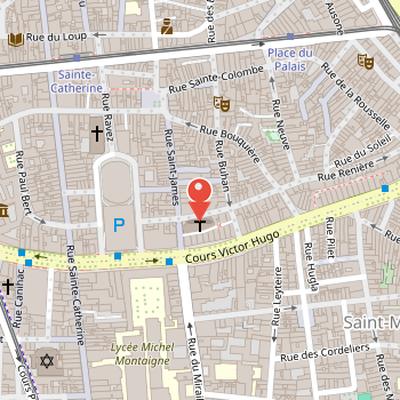
Nearby Objects
-
 Hôtel Saint-François 150 m away
 -
 Saint-Paul-Saint-François-Xavier Church 200 m away
 -
 Synagogue 300 m away
 -
 Aquitaine Museum 300 m away
 -
 Place Camille Jullian 400 m away
History and Status
Eglise Saint-Eloi de Bordeaux is a historic church in Gironde, located against the porte de la Grosse cloche in Bordeaux. It was formerly the church of the Jurade de Bordeaux. In 2007, it was erected as a personal parish by the archbishop of Bordeaux and entrusted to the Institut du Bon Pasteur. The church is classified as a monument historique, reflecting its recognized heritage status.
Liturgical Role and Public Controversy
Saint-Eloi is one of the two churches in the Bordeaux area that celebrate mass according to the extraordinary form of the Roman rite, also described as the Tridentine rite. Histoire reported on a case involving the far-right group Dies Irae and said that links were revealed between the group and the parish of Saint-Eloi church in France 2 coverage. The president of Dies Irae denied any connection. The report said the case increased tensions between the traditional rite parish and other local clergymen. Abbé Philippe Laguerie later filed a defamation lawsuit against France 2 journalists, including David Pujadas, and the journalists were acquitted in 2014.
Architecture and Interior Features
The church is noted for a nave and single aisle that emphasize length more than height. Its choir is slightly deviated so that it follows the line of the ramparts. Inside, the main altar is a notable 18th-century feature, while the other altars are neo-Gothic. Near the door, a classified funerary inscription from 1633 commemorates Theophile de Lauvergnac and family. The organs were restored in the early 2010s.