Église Saint-Pierre-du-Châtel is the remains of a former Catholic church in Rouen, Seine-Maritime, Normandie. The church takes its name from the Châtel, the site of the first Normandy count Rollon’s castle; in Old French, Châtel means “castle.” Rebuilt several times, it assumed its current 16th-century form and is described as an example of flamboyant Gothic architecture. The building includes a nave with a collateral on the south side supported by the tower, and it preserves eight statues in the tower-bell area. Its roof is noted for a finely carved wooden vault, described as unique among Rouen churches.
The church was severely damaged during Allied bombings in 1944, when the west wall was blown out and part of the main nave roof structure collapsed. Only the eastern bays and roof frame remained intact, with well-preserved 16th-century sculptures in the surviving sections. In 2016, the municipality of Rouen conserved and reassembled these sculptures on site. The church has been listed as a historic monument by decree.
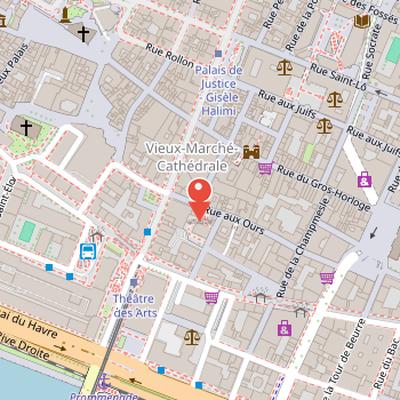
Nearby Objects
-
 Église Saint-Vincent 130 m away
 -
 Rouen Opera House 140 m away
 -
 Place de la Pucelle-d'Orléans 200 m away
 -
 Saint-Éloi de Rouen 250 m away
 -
 Church of St Joan of Arc 300 m away
Remains of Saint-Pierre-du-Chatel
Eglise Saint-Pierre-du-Chatel is the remains of a former Catholic church located in Rouen, in Seine-Maritime, Normandie. The building was severely damaged in 1944, and it survives today as a remnant of its earlier form. It has been listed as a historic monument by decree, reflecting its protected status within the local heritage of Rouen.
History and Architecture of Saint-Pierre-du-Chatel
The church of Saint-Pierre-du-Chatel takes its name from the Chatel, the site of the first castle of the Normandy count Rollon. Chatel is the Old French word for castle, and the name reflects the earlier occupation and fortification of the city by Rollon. The church was rebuilt several times before taking its current form in the 16th century, and it is considered an example of flamboyant Gothic architecture.
Its plan includes a nave with a collateral on the south side, supported by the tower and placed beside the old parish cemetery. The roof is noted for a finely carved wooden vault, described as unique among Rouen churches. The tower-bell area preserves eight statues, and the surviving bays and beams contain well-preserved 16th-century sculptures. After the fire of 1944, only the eastern bays and the roof frame remained intact. In 2016, the municipality of Rouen conserved the sculptures and reassembled them on site.
The church also has a recorded cultural history. François-Adrien Boieldieu was baptized there in 1775. During the Revolution, the Saint-Pierre parish was suppressed and merged with the cathedral parish. On May 28, 1791, the church, presbytery, and adjacent buildings were sold as national property to merchant Jean-Baptiste Payenneville. In the 19th century, the building was used first for storage and then as a stable, while its furnishings and stained glass windows were gradually dispersed.
Damage, Dispersal, and Deferred Restoration
In 1922, the sculptures of the tower-bell were sawn off and dismantled after complaints about their dilapidated condition. The removed pieces, including eight prophet statues, were then sold. A public subscription made it possible to repurchase five of the eight statues within a month, and these five were later exhibited in the garden of the Rouen Departmental Museum of Antiquities.
The church suffered further major losses during the Allied bombings in Rouen during the red week, when its west wall was blown out and part of the main nave roof structure collapsed. The remaining roof structure was placed under shelter, but the building was not reconstructed immediately. At the same time, the surrounding neighborhood changed completely, and rue des Cordeliers disappeared.
In 1951, stonework at the apse was damaged during street works on rue Saint-Saens by the bridges and roads service. The apse was then dismantled completely because of the stone damage, and the service acknowledged responsibility for the damage. Reassembly was never undertaken, although the stones remained stored.
The City of Rouen purchased the church in 1958. In 2019, it was put up for sale with conditions requiring the church to be restored using the preserved roof structure and nave arches.
Adaptive Reuse Project
Rouen city has unveiled the winner of the project call led by La Metropolitaine company for the ruins of Saint-Pierre-du-Chatel. The proposed scheme would renovate the historic remains and add a restaurant, three boutique hotel rooms, and a rooftop terrace on the bell tower. Architects also plan to reconstruct the original roof structure and insert a glass and steel building within the existing walls. The project's viability is being considered in light of its announced cost, which is complicated by additional expenses linked to preventive archaeological excavations. Inrap is scheduled to carry out these excavations at the end of 2024.