Salle Pleyel is a concert and performance hall located at 252 rue du Faubourg-Saint-Honoré, between avenue Hoche and place des Ternes, near place Charles-de-Gaulle and the south-west gate of Parc Monceau. Inaugurated in 1927, it was designed in Art Deco style and succeeded several Pleyel halls created during the 19th century. Its name recalls the French piano manufacturer Pleyel, whose origins go back to the Pleyel factory founded in 1807 by Ignace Pleyel. The hall was associated with symphonic music for most of its history and functioned as a symphonic concert hall until 2015, when classical programming ended. Since then, its programming has shifted to modern music repertoire. Salle Pleyel has hosted approximately twenty-five million spectators in twenty thousand concerts since its opening. It has undergone several renovations, reopened in 2006 after four years of interruption, and was listed as a historic monument in 1983. It is directly served by the Ternes metro station.
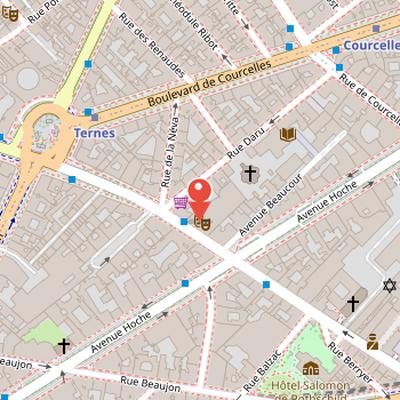
Nearby Objects
-
 Alexander Nevsky Cathedral 90 m away
 -
 Boulevard Haussmann 500 m away
 -
 Le Lido 500 m away
 -
 La Marseillaise 550 m away
 -
 Tomb of the Unknown Soldier 550 m away
Architecture and musical role of Salle Pleyel
Salle Pleyel is a concert and performance hall located at 252 rue du Faubourg-Saint-Honore, between avenue Hoche and place des Ternes, and also described as being between place Charles-de-Gaulle and the south-west gate of Parc Monceau. It is directly served by the Ternes metro station. Inaugurated in 1927, it was named after the French piano manufacturer Pleyel and succeeded several Pleyel halls created during the 19th century. Designed in Art Deco style, it is recognized as one of the major French halls of the 20th century.
The hall was listed as a historic monument in 1983 and has undergone several renovations. After four years of interruption, it reopened in 2006. Works conducted in 2015 established its seating capacity. Since its opening, it has hosted approximately twenty-five million spectators in twenty thousand concerts, reflecting its long-standing public presence.
Salle Pleyel functioned as a symphonic concert hall until 2015, when classical music programming ended. It was the only Parisian hall constructed specifically for symphonic music before the opening of the Maison de la Radio auditorium in 2014 and the Philharmonie de Paris in 2015. From 2006 to 2014, it was managed by the Cite de la musique, which became its owner in June 2009. During that period, it hosted the Orchestre de Paris and the Orchestre philharmonique de Radio France in residence. Since 2015, its programming has been managed by the Philharmonie de Paris and shifted to modern music repertoire, with no longer any classical music concerts.
Origins of Salle Pleyel
Salle Pleyel has its distant origin in two concert halls built by Camille Pleyel, the son of Ignace Pleyel, who founded the Pleyel piano factory in 1807. During the Restoration and the July Monarchy, Ignace Pleyel and Camille Pleyel were official piano makers to the king, and the two successive halls were intended to promote the quality and the French sound of Pleyel pianos. By the mid-19th century, these halls had increased the visibility and global reputation of the Pleyel brand.
The first public venue connected to this history was a salon of about 150 seats opened at 9 rue Cadet in the 9th arrondissement. It hosted noted pianists including Frederic Chopin in 1832 and Franz Liszt in 1833. The first proper Salle Pleyel was then built in 1838-1839 at 22 rue Rochechouart, near the factory, and inaugurated in 1839. With 550 seats, it hosted piano and chamber music concerts that became important in Parisian musical life. Chopin gave his last concert there in 1848, and Camille Saint-Saens made his debut there at the age of 11 in 1853. The hall also hosted the debuts of Cesar Franck and Anton Rubinstein, among others, while a well-appreciated concert by Edouard Potjes was given there in May 1893. In the early 1920s, engineer and architect Gustave Lyon directed the manufacture of Pleyel pianos.
Design, Opening, and Early Reputation
Gustave Lyon decided to create a large musical center around a three thousand-seat symphonic concert hall, combining studios and exhibition spaces intended to promote instruments produced by Pleyel. In 1922, he assigned architect Jacques Marcel Auburtin to carry out the project. After Auburtin died in 1926, André Granet and Jean-Baptiste Mathon took over the design. Construction began on rue du Faubourg-Saint-Honor, near place de l Etoile, and was completed in 1927.
The building is characterized by a white and black facade with streamlined lines. Its interior also includes Art deco features noted by Le Figaroscope. The opening ceremonies were attended by President Gaston Doumergue, Prime Minister Raymond Poincare, Minister Edouard Herriot, and composers Paul Dukas, Manuel de Falla, Andre Messager, and Reynaldo Hahn. At the time of its opening, musical critics and architect Le Corbusier praised the acoustics of the hall as revolutionary, and Henry Prunieres published an article in La Revue musicale celebrating them.
The hall soon became a major concert venue. It hosted concerts by the Orchestre symphonique de Paris and the Societe philharmonique de Paris, as well as performances by the orchestras Colonne, Lamoureux, and Pasdeloup. Pianists including Long, Cortot, Casadesus, Francois, Perlemuter, Rubinstein, Horowitz, Arrau, Nat, Landowska, Enesco, Thibaud, and Segovia performed there. Conductors Walter, Furtwangler, and Pierne also appeared, as did composers Honegger, Ravel, Schonberg, de Falla, Stravinsky, and Poulenc in the role of conductor.
In 1929, a Cavaille-Coll organ with seventy stops and four mobile keyboards was installed and inaugurated by Marcel Dupre. The hall was damaged by fire on a later date, affecting the Debussy and Chopin rooms as well. Repairs were completed quickly, allowing it to reopen by the end of that year. Fireproof materials, including metal seats, were used in the repairs, and the seating capacity was reduced afterward. The building and its Grande salle were renovated in 1958, 1981, 1994, and again in a major renovation in 2006.
A Disrupted Live Broadcast at Pleyel
On January 22, 1979, Salle Pleyel was the site of a live broadcast organized by RTL host Menie Gregoire under the title L'homosexualite, ce douloureux probleme. According to Histoire, the program was interrupted by activists from the Revolutionary Homosexual Action Front. The broadcast later resumed after RTL regained control following the disruption. This event is part of the hall's public history and reflects its use as a venue for live media events.
Renovation, Ownership, and Musical Use
In 1980, the Orchestre de Paris under Daniel Barenboim moved its residence to Salle Pleyel. The hall also became the setting for the Piano cycles founded in 1971, which settled there with a concert featuring Claudio Abbado and Rudolf Serkin. Its final concert was given by Charles Trenet on an unspecified date.
A major renovation was decided by Credit lyonnais in 1981, with Claude Hamayon, Xavier Rosset, and others appointed as architects. The renovated hall was later inaugurated on an unspecified date, but the work drew acoustic criticism. In 1994, Christian de Portzamparc carried out smaller works. Credit lyonnais kept ownership until 1998, when it sold the hall because of financial difficulties. The institution had also considered demolishing Salle Pleyel to build offices, but this was prevented by a 1945 ordinance. With no protection in the late 1990s, the building was listed as a Monument historique in 1999.
In 1997, Hubert Martigny learned that Salle Pleyel was for sale and prepared a financial, artistic, and renovation proposal. He bought the hall in 1998 for 10 million euros through the company IDSH and appointed his wife, Carla Maria Tarditi, as artistic director. In 2004, Histoire decided to renovate the Salle Pleyel again, investing 33 million euros from its own funds and planning an exhibition space on the left side of the entrance hall. A twenty-year operation agreement was signed by Jean-Jacques Aillagon on behalf of the State, but the Ministry of Economy, Finance, and Industry rejected it because of high rent. Renaud Donnedieu de Vabres later authorized a more favorable State agreement, and Histoire accepted a fifty-year lease of Salle Pleyel to Cité de la musique for a symbolic euro, with Cité de la musique due to become owner of the hall and annexes in 2056.
The renovation was also tied to continuing acoustic debate. Salle Pleyel's acoustics had long been criticized and had not been improved by earlier renovations. Gustave Lyon's parabolic ceiling created a uniform and flat redistribution of sound, and the hall's shape, which affected acoustics and volume, was never modified. A 1989 CSTB study identified acoustic problems including insufficient reverberation time and a lack of enveloping sensation. Salle Pleyel was never recognized by professionals as a reference musical hall, and many foreign orchestras and producers preferred the Theatre des Champs-Elysees despite its smaller capacity and similar rental price. After the first French concert of the Berlin Philharmonic conducted by Simon Rattle, the hall was closed for renovation. The work, entrusted to Artec Consultants and architect Francois Ceria, cost 30 million euros and was financed by Hubert Martigny's company through a loan from the Caisse d'epargne group. Sodéarif, a Bouygues Construction subsidiary, carried out the construction over 19 months. The renovated Salle Pleyel was later directed by Cité de la musique under Laurent Bayle and inaugurated with the Orchestre de Paris performing Mahlers Second Symphony, Resurrection, under Christoph Eschenbach.
Programming and Musical Use
From 2006 to 2014, Histoire hosted two permanent resident orchestras at Salle Pleyel, while also presenting a wider concert program at the venue. Histoire regularly scheduled symphonic concerts, vocal recitals, chamber music, and jazz concerts there. Its season included around 200 concerts, with about half performed by the three resident formations. The new musical season was described as including 160 concerts with two resident orchestras and one guest orchestra simultaneously. Histoire also hosted L Orchestre de Paris, L Orchestre philharmonique de Radio France, L Orchestre symphonique de Londres, and L Orchestre philharmonique de Berlin at Pleyel. In addition, it signed a three-year residency agreement with L Orchestre symphonique de Londres for all its Paris concerts at Pleyel. Since 2010, Histoire has co-produced the Days Off festival concerts with the Cite de la musique.
Management and Takeover Discussions
In 2012, discussions around Salle Pleyel focused on its legal form, the transfer of its concession, and the future direction of its mission. Following a report by senator Yann Gaillard, the government was prompted to redefine its role in relation to the Philharmonie de Paris. Gaillard also noted that there was a consensus that the venue would not organize classical concerts in the future. At the same time, official developments were announced by Laurent Bayle on France Musique, including the timing of a new manager announcement, which was expected between October and an unspecified later date. After the publication of a call for bids two weeks earlier, Challenges reported several takeover candidates for the hall, including TF1, Lagardere, Fimalac, Vivendi, and Jean-Marc Dumontet.
Renovation, Controversy, and Recent Uses
In 2014, the injunction issued by Cite de la musique to the future buyer of the Pleyel hall to renounce classical music caused controversy. Brigitte Kuster, the UMP mayor of the 16th arrondissement, launched an appeal in support of classical music at Pleyel, and the appeal was also supported by Christophe Girard, former PS deputy culture mayor of Paris. Musicians including conductor Laurent Petitgirard and historian Franck Ferrand also relayed the appeal. Public demonstrations took place during the judicial disputes over the hall's music programming. Because of the ongoing judicial procedures linked to the 2009 sale of the hall, a judge suspended the project, and a Paris commercial court judge prohibited Cite de la musique from leasing Salle Pleyel to private partners. The Paris court of appeal later lifted the injunction suspension, but the legal dispute took time to resolve.
The concession of Salle Pleyel was granted to the Fimalac group in early 2015. Fimalac then carried out acoustic renovation works costing eleven million euros to restore the hall's sound. The renovation changed the walls from a light color to black paint, and the balconies received wooden slatted facades with acoustic insulating material behind them. A stage frame returned after the 1958 renovation, enclosing a stage built over the former orchestra and choir spaces. As a result, the hall's original configuration, with orchestra space and rear tiered choir or audience seating, disappeared. Histoire notes that both the hall's aesthetic appearance and its acoustic characteristics were fundamentally altered.
Salle Pleyel reopened at the end of 2015 with a concert by French singer Benjamin Biolay. From 2017 to 2020, it hosted the Cesar Awards ceremonies while Theatre du Chatelet was under renovation. In January 2022, the hall also presented two solo grand piano concerts by Sofiane Pamart, featuring neoclassical music and coinciding with the release of his third solo album, Letter.
Architecture and Acoustics of Salle Pleyel
Salle Pleyel was designed by Gustave Lyon and constructed between 1924 and 1927 by Jean-Marcel Auburtin, Andre Granet, and Jean-Baptiste Mathon. Its architecture was conceived as modern, with an immense vaulted ceiling linking the backstage area to the second balcony. Lyon based the acoustic design on a funnel-shaped structure: the stage forms the narrowest part of the hall, while the ceiling connects to the rear wall above the orchestra and expands into a large rounded vault toward the back. A long stalls area extends in front of the stage to the two rear balconies, and the ceiling rises to nearly twice the height above the orchestra near the balconies. The hall was decorated in golden colors with panels by Marc Jaulmes.
The original acoustic intentions were complicated by later problems. After the 1928 fire, repairs revealed an echo as the main fault in the hall's acoustics, and three renovations over the following thirty years altered the configuration without solving the problem. Much later, the Grande salle was extensively transformed during the 2005-2006 renovation, which reduced its seating capacity to seats when a choir is on stage. Musicians of the Orchestre de Paris appreciated the new acoustics during rehearsals the previous week.
The building also includes a large lobby measuring twenty-four meters by twelve meters, with a central rotunda open to the upper floors and covered by a spherical dome. The lobby features Art Deco decorations by Raymond Subes, Le Bourgeois, and the house of Bagues. It also contained a Pleyel piano exhibition and sales room, a phonograph and radio store, display windows, a bookstore, an art gallery, and a tea room. The building has eight floors with apartments, exhibition rooms, assembly and service areas, maintenance workshops, a library, and sixty studios. A dance studio now replaces the exhibition gallery on the first floor. The Grande salle also includes a model 1/2 queue piano and a new grand piano P280 Concert-Blk Pleyel given for Frederic Chopin's bicentenary, reflecting the long association between the Pleyel brand and concert performance.
Management and Repositioning of Salle Pleyel
Salle Pleyel is owned by an organisation that bought the property prematurely in 2009 and later concluded a lease contract for 50 years at an annual rent of 1.5 million euros. To manage the venue, the organisation established Cité-Pleyel, with a 20 percent association of the city of Paris. Cité Pleyel, a subsidiary of the organisation, handles the exploitation of Salle Pleyel and finances its operations; Laurent Bayle serves as its president. The organisation also planned coherent programming for Salle Pleyel and for itself, while constructing the Philharmonie de Paris auditorium for classical music, which opened in early 2015. On July 16, 2014, Salle Pleyel's missions were redefined through a 15-year concession to Fimalac. Classical music programming at Salle Pleyel was prohibited in order to avoid competition with the Philharmonie de Paris, and the venue was intended to become a prestigious modern amplified music venue.
Pleyel Pianos and Chopin at Salle Pleyel
Salle Pleyel has a close association with Frédéric Chopin through the use of Pleyel pianos. Chopin considered Pleyel pianos the finest choice for piano instruments, and he played only on Pleyel pianos during concerts in the old Salle Pleyel. This connection continued to shape later musical presentations linked to his work. In 2010, the Concert historique Frederic-Chopin chose the Pleyel piano for the concert and presented eight pieces from its program online. The listed performances included Berceuse en re bemol majeur, op. 57, performed by Emmanuelle Swiercz; Ballade en fa majeur no 2, op. 38, performed by Vera Tsybakov; Nocturne no 2 en mi bemol majeur, op. 55, performed by Natacha Melkonian; Polonaise en ut mineur, op. 40, performed by Romain Herve; Polonaise en la mineur, op. 71, performed by Aymeric Loriaux; Trois Mazurkas, op. 59, performed by Juliette Journaux; Valse en la mineur, performed by Charles Heisser; and Polonaise en la Majeur, performed by Elian Ramamonjisoa. The appeal of Pleyel pianos also extends to some contemporary pianists, who prefer their French romantic sound. In one Paris concert at Salle Gaveau, Valentina Lisitsa chose a grand Pleyel concert grand piano over five Steinway instruments.
Recordings and Performances at Salle Pleyel
Salle Pleyel has been linked to a wide range of creations and recordings. Among the recorded performances made there are Julian Cannonball Adderley in 1960, Miles Davis in Live in Paris in 1964, Count Basie in Concert at Salle Pleyel in 1972, Georges Brassens in La Mauvaise Reputation in 1952, Keith Jarrett in Over the Rainbow and C The Blues in 1992, France Gall in Pleyel in 1994, later released in 2005, Oscar Peterson in Live at the Salle Pleyel in 1997, Charles Trenet in Charles Trenet a Pleyel in 1999, and Etienne Daho in Pleyel Paris in 2008. In 2010, Laurent Garnier was presented as the first and only DJ to perform with ten musicians in Its Just Musik Live a Pleyel. The venue is therefore associated with recordings and live projects spanning several decades and a variety of musical styles.