Alexander Nevsky Cathedral is a Russian Orthodox cathedral church located at 12 Rue Daru in the 8th arrondissement of Paris. It is under the jurisdiction of the Archdiocese of Orthodox Churches of Russian Tradition in Western Europe, based in Paris. Services in the main cathedral are conducted in Church Slavonic, while some services in the crypt are conducted in French.
The cathedral’s history begins with the first Russian Orthodox church in Paris, a small oratory constructed on Rue de Berri in 1816. As the Russian immigrant population grew during the 19th century, a larger church was needed. Permission to build it was granted in 1847, and construction was funded by a grant from Czar Alexander II. Work began in 1859 under Roman Kouzmine and chief engineer Strohm, and the church was established and consecrated in 1861 as the first Russian Orthodox place of worship in France. It received cathedral status in 1951.
The exterior uses the Byzantine form of the Greek cross, with a semi-circular pediment, five bell towers, gilded bulblike domes, and a central Russian Orthodox cross. The crypt, known as the Lower Church and dedicated to the Holy Trinity, became the official place of worship of the Russian Orthodox Church in France in 1963.
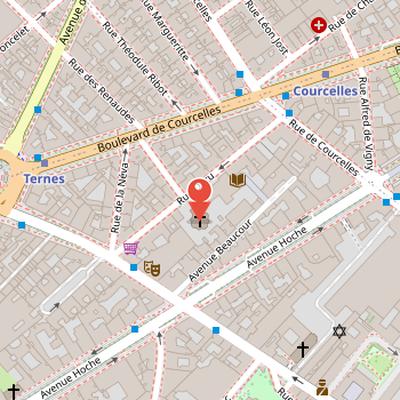
Nearby Objects
-
 Salle Pleyel 90 m away
 -
 Boulevard Haussmann 500 m away
 -
 Parc Monceau 550 m away
 -
 Le Lido 600 m away
 -
 La Marseillaise 650 m away
Location and Liturgical Practice
Alexander Nevsky Cathedral is a Russian Orthodox cathedral church at 12 Rue Daru in the 8th arrondissement of Paris. It is under the jurisdiction of the Archdiocese of Orthodox Churches of Russian Tradition in Western Europe, which is based in Paris. Services in the main cathedral are conducted in Church Slavonic, while some services in the Crypt are conducted in French. This arrangement reflects both the cathedral's role within the Russian Orthodox tradition and its local presence in Paris.
History and ecclesiastical status
The first Russian Orthodox church in Paris was a small oratory on Rue de Berri, built in 1816. As the Russian immigrant population in Paris grew during the 19th century, a larger church became necessary. In 1847, Father Joseph Vassiliev, chaplain of the Russian Embassy in Paris, received permission from Emperor Napoleon III to build a new church. Construction was funded by a grant of 200,000 French francs from Czar Alexander II. The church was named after Alexander Nevsky, the czar's patron saint, who lived from 1219 to 1263 and was associated with the unification of Russia and the establishment of the Russian Orthodox church in the Russian empire.
Work began in 1859 under Roman Kouzmine, chief architect of the Russian imperial Court, and chief engineer Strohm. The church was established and consecrated in 1861 as the first Russian Orthodox place of worship in France. It was formally given cathedral status in 1951. During the Soviet period, it served as the headquarters of an archbishop supervising Russian Orthodox churches in Western Europe independent of Moscow. After the downfall of the Soviet Union, the cathedral came under the jurisdiction of the Ecumenical Patriarchate of Constantinople and became the see of the Archdiocese of Russian Orthodox Churches in Western Europe. In 2016, a new Russian Orthodox cathedral, Holy Trinity Orthodox Cathedral, opened in Paris under the Patriarchal Exarchate in Western Europe, while Alexander Nevsky Cathedral remained independent of Moscow and the Holy Trinity cathedral.
Exterior and Lower Church
The exterior of Alexander Nevsky Cathedral in Paris was designed in the Byzantine form of a Greek cross and includes a semi-circular pediment with a mosaic image of Christ giving a blessing. It also features a group of five bell towers, symbolising Christ and the four evangelists. The towers are topped with gilded bulblike domes, representing the flames of candles carried by worshippers, and the central tower is surmounted by a Russian Orthodox cross. Beneath the building is a crypt known as the Lower Church, dedicated to the Holy Trinity. In 1963, this crypt became the official place of worship of the Russian Orthodox Church in France.
The Interior Iconostasis
The interior iconostasis is a highly decorated screen that separates the altar area from the nave. Its plan is inspired by Hagia Sophia basilica in Constantinople, and it presents a series of icons arranged in a specific theological hierarchy. The altar area behind it is used only by the clergy. The iconostasis has three portals: the Sacred Portal, or Royal Portal, in the center, and north and south portals. The Royal Portal is reserved for clergy, while the north and south portals are used by lesser clerics and religious officials.
The screen is richly decorated with paintings, gilding, and polychrome ornamentation illustrating church history and doctrines. The Royal Portal doors carry icons of the Annunciation and the four Evangelists painted by Evgraf Sorokine. To the right of the Royal Portal are icons of Christ, Aleksander Nevsky, and the Archangel Michael, while to the left are Virgin Mary, Saint Stephen, and Saint Nicholas of Myra. The upper level features a central icon of the Holy Trinity painted by Pauel Sorokine, flanked by saints and Old Testament figures.
The walls of the interior include murals by D. Sorokine and Feodor Bronnikov showing major events in Christian history and liturgy, including the Adoration of the Shepherds, Sermon on the Mount, Entry of Christ into Jerusalem, and Last Supper. Two additional murals by Bogolubov depict Christ Walking on the Waters and Christ Preaching at the Lake of Tiberias.
The Cathedral Crypt and Parish Life
The crypt forms the lower level of the cathedral and serves as the home of Parish La paroisse de la Tres Sainte Trinite. It was among the first parishes of a Russian Orthodox Church to hold services in both French and Slavic. The crypt was consecrated in 1863, and in 1964 it was formally declared the official place of worship for the French-Russian Orthodox community.
Notable Parishioners and Services
Alexander Nevsky Cathedral in Paris has been associated with a number of notable parishioners and ceremonial events. Gabriel Attal attended services there as a child, and Alexander Schmemann served as an altar boy and sub-deacon at the location in the 1930s. The cathedral was also the site of several marriages, including the wedding of Nikolai Aleksandrovich Semashko and Nadezhda Mikhailovna Nelidova on 13 August 1909, Pablo Picasso and Olga Khokhlova on 12 July 1918, and Vladimir Kramnik in 2006. Henri Troyat conducted the first marriage at the location in 1938.
The cathedral also hosted funerals for several prominent figures. These included Ivan Turgenev in 1883, Fyodor Chaliapin in 1938, Wassily Kandinsky in 1944, George Gurdjieff in 1949, Ivan Bunin in 1953, Andrei Tarkovsky in 1987, and Henri Troyat in 2007. Vassily Voskresensky was buried at the location in 1951. Other regular attendees included the Grand Duke Gavriil Constantinovitch of Russia, who attended services before his death in 1955, and Princess Romanovskaya-Strelninskaya, who also regularly attended before dying in 1950.