Boulevard Haussmann is a 2,530-meter boulevard in Paris that crosses the 8th and 9th arrondissements. It extends between the intersection of Boulevard des Italiens and Boulevard Montmartre and the intersection of Rue de Monceau and Rue du Faubourg Saint-Honoré, with Avenue de Friedland as its northwestern extension. The boulevard is 30 to 33.60 meters wide and was not built on former Paris city walls.
Planned as another rapid connection in the city, the boulevard formed part of a larger transformation of Paris from a medieval street labyrinth into a more manageable urban layout with numerous exit roads. Construction began on October 17, 1857, under prefect and city planner Haussmann, with chief engineer Eugène Belgrand. The route was developed block by block in six construction phases, and new buildings had to align with the planned street layout. The boulevard received its current name on March 2, 1864. Completion continued in stages until the final section opened to traffic on January 15, 1927, after 70 years of interrupted construction.
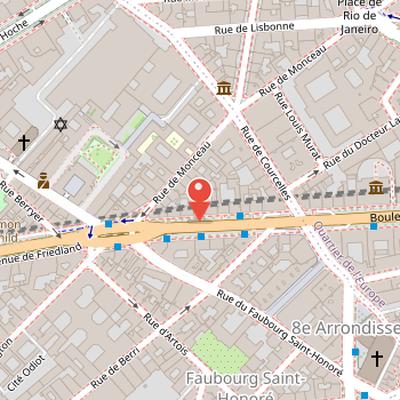
Nearby Objects
-
 Musée Jacquemart-André 250 m away
 -
 Alexander Nevsky Cathedral 500 m away
 -
 Salle Pleyel 500 m away
 -
 Parc Monceau 500 m away
 -
 Le Lido 550 m away
Route and Urban Setting
Boulevard Haussmann is a 2530 meter long boulevard in Paris. It runs through the 8th and 9th arrondissements, forming a route between the intersection of Boulevard des Italiens and Boulevard Montmartre and the intersection of Rue de Monceau and Rue du Faubourg Saint-Honore. Its northwestern extension is Avenue de Friedland.
Planning and Construction of Boulevard Haussmann
Boulevard Haussmann was designed as another rapid connection in Paris and was intended to help transform the medieval street labyrinth into a more manageable cityscape with numerous exit roads. The boulevard is 30 meters to 33.60 meters wide and was not built on the former Paris city walls. Haussmann, who held the office of prefect and Paris city planner from June 23, 1853, began construction on October 17, 1857. His aim was to connect the boulevard to Boulevard Montmartre. The work proceeded block by block in six construction phases. Haussmann and the chief engineer, Eugene Belgrand, did not hesitate to demolish many houses in order to advance the project. This makes the boulevard an example of the large-scale urban changes associated with Haussmann's planning.
Construction and Completion of Boulevard Haussmann
New buildings along Boulevard Haussmann had to follow the planned street layout of the boulevard. The street received its current name on March 2, 1864. A notable milestone came on May 11, 1865, when the Printemps department store moved into number 64, marking the completion of that section. Haussmann's term ended on January 5, 1870, and construction then began on the final section connecting the boulevard to Boulevard Montmartre. This last part required the demolition of 14 buildings on the north side of Boulevard des Italiens. House numbering on Boulevard Haussmann began on December 23, 1880, while further structural changes continued until January 12, 1922, when the boulevard extended to rue Taitbout. The boulevard was fully completed in December 1926 after 70 years of interrupted construction, and the last section, started in 1870, was opened to traffic on January 15, 1927. Haussmann died on January 11, 1891, before the boulevard was completed.
Architecture, culture, and commercial life
Boulevard Haussmann developed into a famous Parisian shopping street, known for many exquisite shops and boutiques. Its commercial character is reflected in the presence of Galeries Lafayette, whose expansion buildings reached number 40 in 1906; the second large Lafayette department store opened on October 8, 1912, with a 73 meter glass dome. The boulevard also hosts the French daily newspaper Le Figaro, which has been located there since 2005.
Several addresses on the boulevard are associated with notable people and institutions. The essayist Marcel Proust lived at number 102 between 1906 and 1919. A statue of Haussmann stands near number 132. At number 158, the Musee Jacquemart-Andre occupies a former Hotel particulier and displays an art collection ranging from old Italian masters to 19th century French works.
Boulevard Haussmann has also appeared in cultural memory through the 1988 song Ca s'passe boul'vard Haussmann a cinq heures by Alain Souchon and Laurent Voulzy, and it served as a filming location for much of the 1958 film Elevator to the Gallows near Rue de Courcelles.