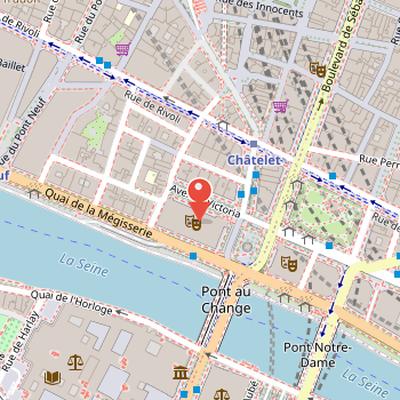
Théâtre du Châtelet is a theatre building at Place du Châtelet in the 1st arrondissement of Paris, inaugurated in 1862. Designed by Gabriel Davioud, the Théâtre impérial du Châtelet was constructed between 1856 and 1862 as part of the transformations of Paris under the Second Empire. It was requested by Napoleon III and Baron Haussmann and built concurrently with Théâtre de la Ville. The site formed part of the redevelopment of Place du Châtelet, which was created on the former location of the Grand Châtelet fortress. The theatre opened on 20 April 1862 with the play Rothomago in the presence of the Empress. It originally had a capacity of 2,000 seats and hosted theatrical performances. The building has been listed as a historical monument since 25 October 1975. Today, it presents musicals, operas, classical concerts, jazz, recitals, and dance. It has also hosted the César Cinema Awards from 1976 to 2003 and is a member of the European Network for Opera and Dance Awareness (RESEO).
Nearby Objects
-
 Place du Châtelet 70 m away
 -
 Théâtre de la Ville 140 m away
 -
 Palais de la Cité 150 m away
 -
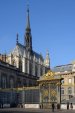 Sainte-Chapelle 300 m away
 -
 Saints Innocents Cemetery 350 m away
History and Cultural Role
Theatre du Chatelet is located at Place du Chatelet in the 1st arrondissement of Paris and was inaugurated in 1862. It has been listed as a historical monument since October 25, 1975. Since 2023, it has been directed by Olivier Py. The theater presents a varied program that includes musicals, operas, classical concerts, jazz, recitals, and dance. It was also the venue for the Cesar Cinema Awards from 1976 to 2003. In addition, it is a member of the European Network for Opera and Dance Awareness (RESEO).
Construction and Early Use of the Chatelet
The Theatre imperial du Chatelet was constructed between 1856 and 1862 by Gabriel Davioud after Napoleon III and Baron Haussmann requested its creation. It was built at Place du Chatelet, a site developed on the former Grand Chatelet fortress, which had served as a prison and tribunal under the Ancien Regime and was destroyed in 1808. The theater was part of the broader transformations of Paris during the Second Empire, and its construction was carried out at the same time as that of the Theatre de la Ville.
The project changed the surrounding urban fabric. It led to the removal of Rue Pierre-a-Poisson, Rue de la Saunerie, Rue de l'Arche-Pepin, and part of Rue Saint-Germain-l'Auxerrois. Two new roads, Rue Edouard-Colonne and Avenue Victoria, were created beside the theater. The wider redevelopment context also included an imperial decree declaring the boulevard du Prince-Eugene project a public utility. This boulevard connected Place du Chateau-d'Eau to Place du Trone and contributed to the disappearance of theaters on the north side of boulevard du Temple. The Prefect of the Seine aimed to end melodrama shows and replace small theaters with larger ones in a residential area, and most small theaters did not survive the expropriation.
Within this policy, three theaters were preserved and supported by the city: Theatre de la Gaite, Theatre-Lyrique, and the former Theatre du Cirque Imperial. Gabriel Davioud constructed two theaters at Place du Chatelet for Theatre-Lyrique and the former Theatre du Cirque Imperial. The Theatre imperial du Chatelet had a capacity of 2,000 seats and hosted theatrical performances. It opened on 20 April 1862 in the presence of the Empress with Rothomago by d'Ennery, Clairville, and Monnier.
The interior reflected a broad theatrical program. Nine cartouches on the ceiling displayed the words dance, opera, fairy tale, music, drama, tragedy, comedy, vaudeville, and pantomime. Masked balls were also held there during the Paris Carnival, which began annually on November 11, Saint Martin's Day. After the Commune de Paris of 1871, Historique took direction of the Chatelet, appointed Eugene Castellano as administrator, and established reduced-price tickets for the best seats. The theater also revived Le Voyage dans La Lune, as well as Rothomago and Les Sept chateaux du Diable during the 1878 Exposition universelle, and presented La Venus Noire and Le Beau Solignac.
Programming and Artistic Milestones
Under Historique, the theater's programming included operetta, ballet, classical and popular music concerts, and temporary film screenings at the start of the 20th century. In 1907, the theater had M. Fontaines as director, Georges Begusseau as secretary general, and Henri Prevost as stage director. The same year, it also featured electric call systems connecting the boxes to the buffet, reflecting the practical arrangements of the venue. Its public role was strengthened by a sequence of major artistic events and international appearances. The theater featured international dance companies, including the Ballets russes by Sergei Diaghilev, and included dancers such as Vaslav Nijinski, Anna Pavlova, Tamara Karsavina, and Michel Fokine from the Mariinsky ballet company. It also hosted renowned foreign composers and conductors including Tchaikovski, Mahler, and Richard Strauss. Among its notable creations were Martyre de saint Sebastien by Claude Debussy and Gabriele D'Annunzio for Ida Rubinstein, Petrouchka by Stravinsky, La Peri by Paul Dukas, L'Apres-midi d'un faune by Nijinski on 29 May 1912, Daphnis et Chloe by Ravel, and Parade by Satie and Cocteau.
From Operetta Temple to Musical Theatre
From 1945, the Theatre du Chatelet became, under Maurice Lehmann's direction, a temple of grand spectacle operetta. This period was marked by a long series of premieres and revivals that established its identity in popular musical theatre. Nina Rosa premiered there in 1945 with Andre Bauge, followed by repeated performances of L'Auberge du Cheval-Blanc and Valses de Vienne across several years in the late 1940s and early 1950s. Other productions included Les Chasseurs d'image in 1947, La Marechale Sans-Gene in 1948, and Pour Don Carlos in 1948 with Georges Guetary. In 1949, Annie du Far West was adapted there with Marcel Merkes, Paulette Merval, and Lily Fayol.
The 1950s continued this sequence of successful works. Le Chanteur de Mexico premiered in 1951 with Luis Mariano and Rudy Hirigoyen and remained on stage a thousand times at the theatre. Later premieres included La Toison d'or in 1953 with Andre Dassary, Mediterranee in 1955 with Tino Rossi, Rose de Noel in 1956 with Andre Dassary, and Le Secret de Marco Polo in 1957 with Luis Mariano. La Polka des lampions and Monsieur Carnaval also premiered at the theatre. Lehmann invited composers including Siegmund Romberg, Henri Christine, Maurice Yvain, Pierre Petit, Francis Lopez, Henri Betti, Jean-Michel Damase, Gerard Calvi, and Charles Aznavour. Marcel Lamy, former director of the Opera-Comique, produced Luis Mariano's last two operettas, Le Prince de Madrid in 1956 and La Caravelle d'or in 1957.
The theatre later regained momentum with Gipsy, directed by Andre Martial in 1969, and Volga, signed by Francis Lopez with Jose Todaro. In 1979, management transferred to the City of Paris, owner of the building. After major renovation, the theatre reopened in 1980 as Theatre musical de Paris under Jean-Albert Cartier, with productions including La Vie parisienne, La Veuve joyeuse, La Chauve-Souris, and La Fille de madame Angot. Subsequent opera seasons presented cycles of Verdi, Russian, and Wagnerian operas with international artists. In 1989, the acoustics were redesigned and the stage curtain was painted by Gerard Garouste, and the theatre reclaimed its original name.
Programming and Artistic Direction
From 1988 to 1999, Stephane Lissner directed the theatre, during which time acoustics and visibility were improved. His period in office also revived a tradition of creation and innovation that had existed in the early 20th century. The theatre retained artists including Patrice Chereau, Pierre Boulez, Daniel Barenboim, William Forsythe, and Robert Wilson. It also hosted resident orchestras such as the Orchestre de Paris and the Orchestre Philharmonique de Radio France, both of which were installed at Salle Pleyel, and the Philharmonia Orchestra of London in annual residence since 1992.
Jean-Pierre Brossmann became director in 1999 and attracted conductors such as John Eliot Gardiner, Simon Rattle, and Kent Nagano, as well as singers Jessye Norman, Thomas Hampson, and Felicity Lott. In his first season, the theatre programmed Trois Soeurs by Peter Eotvos. Jessye Norman later performed Erwartung by Arnold Schoenberg there in 2002. The venue also staged Les Troyens by Berlioz in 2003 and presented two new productions of Offenbachs La Belle Helene and La Grande-duchesse de Gerolstein, signed by Marc Minkowski and Laurent Pelly.
The theatre further expanded its public role by hosting the Cesar cinema awards ceremonies, taking over from Theatre des Champs-Elysees. Under Jean-Luc Choplin, who became director in 2006, it launched a new production of Le Chanteur de Mexico in 2006, 55 years after its original creation. It also hosted Quebec_numeriQ, an event directed by Richard Castelli, and celebrated the golden age of American musical theatre. This included works by Stephen Sondheim, with six sold-out performances of A Little Night Music in February, as well as The Sound of Music, Carousel, The King and I, Kiss Me, Kate, and My Fair Lady in coproduction with the Mariinsky Theatre of Saint Petersburg.
The theatre has also collaborated with contemporary artists such as Oleg Kulik, Pierrick Sorin, David Cronenberg, and Robert Wilson, and presented original creations including Monkey, Journey to the West, Bintou Were opera, and Le Verfugbar aux Enfers. It has hosted pop stars including Sting and Muse, created the family-oriented concert series Concert Tot and Concert Tea, and served as the venue for the final concert of the Bolshoi Orchestra in Paris, which appears in the film Le Concert.
Recent Leadership and Renovation
Between 2017 and 2021, the theatre underwent renovation and compliance work costing 35 million euros. During this period and afterward, its leadership changed several times. Thomas Lauriot-dit-Prevost took direction after Jean-Luc Choplin, and after Ruth Mackenzie was dismissed, he assumed sole direction of the institution. Olivier Py was later appointed head of the theatre by Paris mayor Anne Hidalgo. His nomination was reported to have been imposed over two initial female candidates supported by the selection committee, prompting criticism from Alice Coffin. Valerie Chevalier, director of the Montpellier National Opera Orchestra and a rejected candidate, described the selection process as a democratic sham and regretted what she saw as Anne Hidalgo's breach of the chosen framework. The institution also confirmed an idea of rapprochement with Theatre de la Ville through an association called Place des theatres, described by Olivier Py as a law 1901 association.