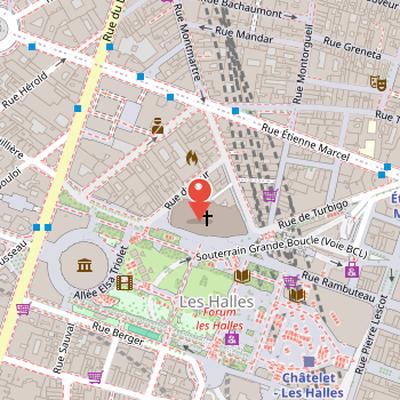
The Church of Saint-Eustache is a parish Catholic church located at 146, rue Rambuteau in the 1st arrondissement of Paris, in the heart of the Les Halles district. Dedicated to Saint Eustache, it is the third largest church in Paris, after Notre-Dame and Saint-Sulpice. The church’s symbols, associated with Saint Eustache, include intertwined letters S and E, a hunting horn, and a stag with a cross between its antlers; these appear on the exterior gables of the two transepts and on pedestals inside the building.
The origins of the site trace back to the beginning of the 13th century, when a chapel dedicated to Saint Agnes stood there. The chapel was built near the Coquillière and Montmartre gates on Philippe-Auguste’s enclosure and was donated by the Parisian bourgeois Jean Alais. In 1223, it was erected as a parish and renamed Saint-Eustache, after a relic of the martyr Saint Eustache was transferred from the Abbey of Saint-Denis. The present church was begun in 1532, with its first stone laid on 20 April 1532. Built in a Gothic style during the Renaissance period, it was entrusted successively to Boccador, Nicolas Le Mercier, and Charles David.
Nearby Objects
-
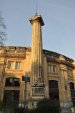 La colonne Médicis 150 m away
 -
 Hôtel de Bourgogne 250 m away
 -
 Saints Innocents Cemetery 350 m away
 -
 Rue Saint-Denis 400 m away
 -
 Place des Victoires 400 m away
Saint Eustache and Its Setting in Les Halles
The Church of Saint Eustache is a parish Catholic church at 146, rue Rambuteau in the 1st arrondissement of Paris, in the heart of the Les Halles district. It is the third largest church in Paris, after Notre Dame and Saint-Sulpice. The church is dedicated to Saint Eustache, who was born Placidus or Placidas and was a Roman general and hunting enthusiast before converting to Christianity. This dedication is reflected in the church's decoration and symbolism. The symbols associated with Saint Eustache include intertwined letters S and E, a hunting horn, and a stag with a cross between its antlers. These emblems are visible on the exterior of the church, on the gables of the two transepts, and also on pedestals inside the building.
Origins and Early Development
The origins of the Church of Saint Eustache date back to the beginning of the 13th century, when the first building was a chapel dedicated to Saint Agnes. This chapel stood near the Coquilliere gate and the Montmartre gate on the enclosure of Philippe Auguste, and it was donated by the Parisian bourgeois Jean Alais in gratitude for King Philippe Auguste granting the right to collect a denier on each fish basket arriving at Les Halles. In 1223, the site was erected as a parish and renamed Saint Eustache after the transfer of a relic of the martyr Saint Eustache from the Abbey of Saint Denis. The church also contains a crypt named after Saint Agnes on the eastern side, preserving a link to its earliest dedication. As the neighborhood population increased, the building was remodelled and expanded several times. Its importance was recognized through royal protection in the 14th century under King Philippe VI, and its mass was conducted by the confraternities of La Madeleine under this protection. The arrangement was later ratified by letters patent from Louis XI shortly before his death in 1483. In 1532, it was decided to build a church worthy of the heart of Paris, and the first stone of the present building was laid on 20 April 1532 by Jean de la Barre, provost of merchants.
Construction and Architectural Development
The Church of Saint Eustache was built from 1532 to 1633, after a prolonged process marked by frequent financial difficulties and six construction campaigns. Its work was successively entrusted to Boccador, Nicolas Le Mercier, and Charles David, and the first stone was laid by the Duke of Chartres. The building was conceived in a Gothic style during the Renaissance period, combining Greek and Roman antique columns with medieval lines. It aimed to create Gothic architecture with round arches and exhibits Gothic elevation, Romanesque curves, and Renaissance ornaments.
Progress was repeatedly slowed by a lack of funds. In 1569, the priest Rene Benoist, who was nicknamed the Pope of Les Halles for his influence on parishioners, became involved in efforts to raise support. In 1578, he printed a request for aid to complete the church, which was still unfinished at that date. Some funds were then obtained, allowing the construction of several nave pillars and windows. The church was finally completed in 1633 and consecrated by Jean-Francois de Gondi, archbishop of Paris.
Later alterations significantly changed the exterior. From 1667 to 1670, Charles de la Fosse was assigned to decorate the chapel of Marriages and paint Adam and Eve and The Marriage of the Virgin, but these paintings were destroyed during the construction of the new portal. The old western facade, which had unfinished towers, was weakened by the construction of two chapels ordered in 1665 by Colbert. Because the underpinning had to be redone, the facade was demolished and rebuilt along with the first bay of the nave and aisles on new plans by Louis Le Vau, financed by Colbert. The facade was modified again by the addition of a heavy pediment, which obscured the original design. The initial project had included two towers with two levels connected by a gallery, and the south tower remains unfinished today.
Work resumed from 1772 to 1788 under Louis-Pierre Moreau. In the 19th and 20th centuries, the church remained a notable urban parish: it was one of the 51 urban parishes in the Diocese of Paris in 1790, its surroundings became battlegrounds during the Three Glorious Days in 1830, and it was classified as a historic monument in 1862. Restoration campaigns later addressed the large attic and the roof above the nave in the 1980s, and the south facade was restored bay by bay in the early 2000s. Scaffolding was also erected to restore the south transept gable and mechanize the door to facilitate access for people with reduced mobility, with the duration and cost of the work supported by the City of Paris, the State, and advertising revenue from JCDecaux on scaffolding covers.
Notable baptisms, funerals, and musical premieres
The Church of Saint Eustache was the site of many baptisms, marriages, and burials of notable personalities. Among those baptized there were Richelieu in 1585, Moliere in 1622, Jean-Francois Regnard in 1655, Prince Eugene de Savoie-Carignan in 1668, Louis Armand de Brichanteau in 1683, and Madame de Pompadour in 1721. Louis XIV made his first communion there around 1649. The church also recorded marriages including Sully and Anne de Courtenay in 1583, Pomponne and Catherine Ladvocat in 1660, and Lully and Madeleine Lambertet in 1662.
The church was associated with several funerals and burials of prominent figures. Mirabeau's body was placed there the day after his death, and Joseph-Antoine Cerutti delivered the funeral oration before the remains were transferred to the Pantheon. Funerals held there included those of La Fontaine in 1695, Anna Maria Pertl, Mozart's mother, in 1778, Mirabeau in 1791, Marie Laforet, Gaspard Ulliel, and Michel Blanc. The funeral oration for Turenne was delivered there in 1676 by Flechier. The church also contains burials of Voiture, Vaugelas, Pierre Fenouillet, Colbert, Scaramouche, Admiral de Tourville, an unidentified person, Marivaux, Rameau, Francois de Chevert, and Marquis de Marigny.
Its historical role was not limited to family ceremonies. Massillon delivered his sermon Sur le petit nombre des elus there in 1704. The church was also a venue for musical premieres, with Berlioz conducting the first performance of his Te Deum there and Liszt conducting the first performance of his Solemn Mass there. In more recent times, Laurent Voulzy gave a unique concert there as part of his Lys & Love Tour. The church priest Francois-Robert Secousse, who served from 1696 to 1771, is known through an engraving by Jean Audran after Hyacinthe Rigaud.
Architecture and Interior Layout
The Church of Saint Eustache is designed in a hybrid style combining flamboyant Gothic and Renaissance elements. Its overall dimensions were made to recall those of Notre Dame Cathedral, although it is shorter and narrower, while the nave height matches that of Notre Dame. The building has a nave flanked by double side aisles and a row of chapels, with the chapels on the south aisle arranged with increasing depth in order to respect the former Rue Trainee alignment. The transept does not project outside the main body of the church, and the choir is surrounded by a double ambulatory and a row of chapels.
The interior emphasizes verticality through vault height, vertical masses, ribs, and pendants, which are associated with the flamboyant Gothic style. Renaissance features are present in the use of antique orders, pilasters, and decorated capitals. Additional Renaissance decoration appears on the pillars, with angel heads and foliage. The apse contains nine stained glass windows by Antoine Soulignac from 1631, together with flamboyant Gothic decoration including a choir pendant key. The choir also includes stalls installed after the Revolution and a main altar designed by Victor Baltard.
The churchs hybrid architecture was quickly criticized, but the building was nevertheless classified as a Historical Monument in 1862. On the south facade, it also carries a sundial positioned more than 12 meters high on the south transept, slightly declining and about 3 meters wide, with its style placed below the center of the rose window. A 3 meter high meridian line is located above and to the left of the south portal, with stone lines marking every quarter hour between 11 a.m. and 1 p.m.
Interior Furnishings and Stained Glass
When the construction of the Church of Saint Eustache was completed at the beginning of the 17th century, the interior already included mobilier et decors interieurs. Among the notable elements was an architectured high altar in the choir, installed during the 1630s. Financed by Claude de Bullion, Superintendent of Finances, it was one of the largest altars in Paris at the time. Around 1635, two canvases for its central part were commissioned from Simon Vouet. The church also preserves stained glass windows in the high choir that are among the few colored stained glasses of the 17th century in France, at a time when colored stained glass art was in strong decline. These windows were created in 1631 by the painter-glazier Antoine Soulignac, based on cartoons attributed to Philippe de Champaigne. They were restored after 1871 by Prosper Lafaye.
The Saint Eustache Paintings
The two canvases represented The Martyrdom of Saint Eustache and The Apotheosis of Saint Eustache. In the martyrdom scene, Saint Eustache is shown turning his eyes away from the pagan god Emperor Trajan asked him to worship. Trajan condemned him to be burned alive in a bronze bull with his wife and two sons. The wife and two sons are visible amid the smoke rising from the fire. Angels carrying laurel wreaths indicate divine recognition and anticipate the reception of Saint Eustache and his family with God. The painting marks the peak, around 1635, of the lyrical style developed by Simon Vouet after his return from Rome in 1627.
Colbert's Tomb in Saint-Eustache
Among the church's interior furnishings and decoration is the tomb of Colbert, shown by a statue of him kneeling in prayer and dressed with the mantle of the Knight of the Order of the Holy Spirit. The statue rests on a black marble sarcophagus supported by two tall consoles on a large base. The base is flanked by seated figures: Fidelity by Coysevox on the left and Faith or Abundance by Tuby on the right. Le Brun's design also included an angel descending from the arch and holding an open Bible read by Colbert. This angel disappeared during the Revolution, when Colbert's tomb was dismantled and its main elements confiscated. The confiscated pieces were displayed in the Museum of French Monuments before being returned to Saint-Eustache in 1817. They were then installed in a new location in the chapel of Saint-Louis-de-Gonzague, where they remain today.
Interior Furnishings and Restorations
The interior furnishings of the Church of Saint Eustache include a monumental and richly decorated workbench located between two pillars at the fourth bay in the nave. Created by Pierre Lepautre in 1720 from designs by Jean-Sylvain Cartaud, it is one of the few Ancien Regime benches still visible in Paris. The workbench has a portico form, with a large medallion suspended by angels and adorned with a Christ on the cross. Its vault is supported by four fluted Ionic columns and is crowned with an apotheosis of Saint Agnes. A Phrygian cap from the Revolution appears at the center of the arch in a medallion.
The church also underwent major restoration under architect Victor Baltard, who supervised works from 1842 to 1860. Commissioned in 1842 to design a new high altar, Baltard later designed the new organ case and pulpit after the fire of 1844 destroyed the first three bays. The pulpit was sculpted by Victor Pyanet from a design by Baltard, and its bowl is decorated with medallion bas-reliefs representing Faith, Hope, and Charity.
The Lateral Chapels and Their Decoration
A major decoration program for the lateral chapels was undertaken in 1850, and Mobilier et decors intérieurs notes that many recognized artists, often former Prix de Rome laureates, took part in these works. The church is presented as a remarkable panorama of mid-19th century religious painting. Its 25 chapels are arranged in sequence from the western facade recess on the north side, up to the ambulatory behind the choir on the east side, then down the south side and back to the western facade recess.
Among the chapels identified in the record, the first is the Chapel of the Redemption, with paintings by Auguste-Barthlemy Glaize. The second is the Chapel of the Baptismal Fonts. Other chapels feature a wide range of painters and objects: Chapelle Notre-Dame-des-Sept-Douleurs contains paintings by Leon Riesener and a statue of the Vierge de douleur; Chapelle Saint-Joseph preserves wall paintings from the eighteenth century, partly whitewashed in that century, then uncovered and partially repainted in 1850 under Victor Baltard's direction by Louis Basset, with restoration recorded in 2022-2023.
Several chapels bring together painting, sculpture, and stained glass. Chapelle Saint-Eustache includes paintings by Alphonse Le Henaff. Chapelle Saint-Louis contains paintings by Felix-Joseph Barrias, including Saint Louis in prayer before the cross. Chapelle Sainte-Genevieve holds Tobie et l'ange by Santi di Tito, dated 1575, and a painting by Auguste Pichon; the work had been in the sacristy of the basilica San Marco de Florence before later transfers and was deposited at Saint-Eustache in 1811. Chapelle Saint-Vincent-de-Paul, named in 1803 after Saint Vincent de Paul, includes Keith Haring's bronze triptych La Vie du Christ, with a white gold patina and dated circa 1989, as well as nineteenth century wall paintings.
Other noted spaces include Chapelle Sainte-Madeleine, with L'Extase de la Madeleine by Rutilio Manetti; Chapelle Saint-Louis-de-Gonzague, with the tomb of Jean-Baptiste Colbert created by Antoine Coysevox and Jean-Baptiste Tuby after a drawing by Charles Le Brun, and paintings by Jean-Louis Bezard; and Chapelle de la Vierge, built in 1640, restored from 1801 to 1804 after its original decoration was destroyed during the Revolution, and inaugurated by Pope Pius VII in 1804. This chapel contains a Virgin and Child sculpture by Jean-Baptiste Pigalle, three large canvases on the litanies of the Virgin by Thomas Couture, and nineteenth century stained glass showing a series of kings and saints.
The cycle continues with Chapelle des catechismes, with paintings by Emile Signol; Chapelle des Charcutiers, with paintings by Isidore Pils, a stained glass window from 1945, and two panels by John Armleder from 2000; and Chapelle des Saints-Anges, with seventeenth century murals, a 1633 decoration contract between the du Val family and painter Antoine Ricard, figures of the du Val family in the fresco, restoration under Baltard in 1850 after whitewashing during the Revolution, and Armand Cambon's Les Saints Anges portant a Dieu les prieres des hommes, exhibited in 1866. The sequence also includes Chapelle Sainte-Anne with paintings by Hippolyte Lazerges and Chapelle Sainte-Agnes with paintings by Theophile Vauchelet.
Interior Mobilier and Chapel Decorations
The interior mobilier and decor of the Church of Saint Eustache includes a number of paintings, reliefs, and chapel fittings distributed across several chapels and side areas. In the Chapelle Sainte-Agnes there is a copy of La Deposition du Christ after Luca Giordano. The Church also preserves a copy of Dominiquin's Le Martyre de sainte Agnes by Alexandre-Francois Caminade, which was bought in 1808 by the parish priest and hung above the door at the south collaterals. The original work, painted around 1620 for the Couvent Sainte-Agnes de Bologne, was seized during the Italian campaign, later exposed at the Louvre Museum, and is now exhibited at the Pinacotheque of Bologna after restitution.
Several chapels contain important 19th-century works. The Chapelle des Ames du Purgatoire includes the Ecce Homo high relief by Antoine Etex from 1856 and the painting La Transfiguration by Albert Magimel from 1855. The Chapelle des Saints-Innocents contains Henry de Triqueti's Le Mariage de la Vierge high-relief and two angels above the altar. In the Chapelle Saint-Cecile, Leon Brunel-Roque's Le Mariage de la Vierge from 1858 is present. The Chapelle du Sacre-Coeur contains paintings by Charles-Philippe Lariviere.
Other interior elements mentioned include the Chapelle du Calvaire, also called the Chapelle de la Crucifixion, with statues on the left side and an altar, as well as stained glass in the background of the crucifix in the church interior. Among the other works associated with the church are Les Pelerins d'Emmaus by Rubens and atelier, Saint Jean Baptiste by Francois Lemoyne, and L'Adoration des bergers by Tintoret, which is hung in the ambulatory at the choir's reverse.
The Grand Organ
The Church of Saint Eustache has two organs: one placed in the tribune at the back of the nave and another in the choir. Its grand organ was almost entirely rebuilt in 1989 by the Dutch builder van den Heuvel, with only the case and some stops retained. The instrument has 101 stops distributed over five manuals and a pedalboard, making it one of the largest organs in France. Since 2015, its titular organists have been Thomas Ospital and Baptiste-Florian Marle-Ouvrard.
Religious Events and Visitor Activities
After the fire at Notre-Dame cathedral, Saint-Eustache church hosted major religious events. According to Ev8nementiel, Easter and Christmas masses in 2019 were held there during the restoration period. The church also welcomed donors of the Chantiers du Cardinal association on March 7, 2019. That visit included donors accompanied by their grandchildren, with a tour based on games and observation. Medals were awarded to each visitor at the end of the event.
Cemeteries Around Saint Eustache
Before the construction of the current church, cemeteries already existed nearby. Cimetiere's first cemetery was located between rue des Vieilles-Etuves-Saint-Honore and rue Vauvilliers. After that cemetery was removed, Cimetiere opened a new burial ground between rue du Bouloi and rue Croix-des-Petits-Champs. This cemetery was itself removed at the beginning of the 17th century, and Cimetiere then replaced it with the Saint-Joseph cemetery, located between rue du Croissant, rue Montmartre, and rue Saint-Joseph. As population increased near Halles and the Saint-Eustache parish, Cimetiere opened another cemetery in the faubourg Montmartre, known as cimetiere des Porcherons, at 61 and 63 rue de Maubeuge.