Église Saint-Médard is a Roman Catholic church located at 141 Rue Mouffetard in the 5th arrondissement of Paris. It takes its name from Saint Medard, bishop of Noyon, who was the protector of Queen Radegund and helped her found a convent at Noyon. Saint Medard is also the patron saint of French farmers. A cemetery with Early Christian tombs from the Merovingian period was found a few meters from the present church, and this area was probably connected to an early oratory from the sixth or seventh century. A chapel dedicated to Saint Medard existed in the ninth century after the Norman invasions, near the Roman road between Roman Lutetia and Lyon. The church is documented in a papal bull of 1163. Construction of the present building began in the early or middle 15th century and continued until the 18th century, with interruptions during the Wars of Religion. In December 1561, it was the scene of a dispute between Protestants and Catholics and was pillaged by Protestants. The church later came directly under the Archbishop of Paris in 1655 and became a parish church in 1683. In the 18th century, it came under the influence of the Convulsionnaires of Saint-Médard and was frequented by Jansenists.
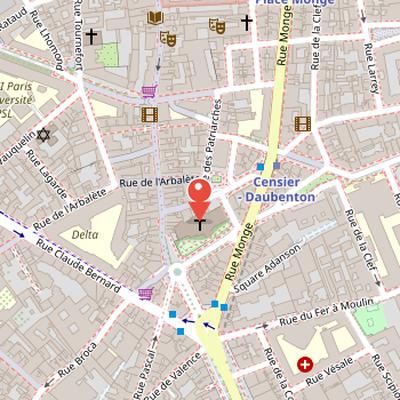
Nearby Objects
-
 Rue Mouffetard 250 m away
 -

-
 Val-de-Grâce 450 m away
 -
 Muséum national d'histoire naturelle 500 m away
 -
 Arènes de Lutèce 600 m away
Name and Dedication
The Church of Saint-Medard is a Roman Catholic church located at 141 Rue Mouffetard in the 5th arrondissement of Paris. It takes its name from Saint Medard, the bishop of Noyon in northern France. Saint Medard is associated with Queen Radegund, whom he protected and assisted in founding a convent at Noyon after she escaped her abusive husband, King Chlothar I. He is also known as the patron saint of French farmers. These associations give the church's name a historical and religious significance that connects it to both local devotion and wider French religious tradition.
History and Architectural Development
Early traces of the site around the present church include Early Christian tombs from the Merovingian period found a few meters away, suggesting that the cemetery may have been connected with an early oratory from the sixth or seventh century. A chapel dedicated to Saint Medard is also reported to have existed in the ninth century after the Norman invasions. The chapel stood near the route of the Roman road linking Roman Lutetia with Lyon, which crossed the Bievre River nearby. The church is documented in a papal bull of 1163 issued by Pope Alexander III, and its parish was later attached to the Abbey of Saint Genevieve.
Construction of the present church began in the early or middle 15th century and continued until the 18th century, with interruptions caused by the Wars of Religion. In December 1561, the church became the scene of a dispute between Protestants and Catholics and was pillaged by Protestants. In 1655, it was placed directly under the Archbishop of Paris and retained a close relationship with the nearby Abbey of Saint-Genevieve. It became a parish church in 1683 under the jurisdiction of the Abbot of Saint-Genevieve, after the faubourg Sant-Marcel was integrated into the city of Paris in 1724.
During the 18th century, the church came under the influence of the Convulsionnaires of Saint-Medard, who believed that trance and convulsions could cure illnesses and express Christian faith. The church was also frequented by Jansenists, including Blaise Pascal and Pierre Nicole, and François de Parris was buried in the church cemetery. Followers of both movements met secretly there at his grave until the Pope declared Jansenism a heresy and forbade access to the cemetery, after which Convulsionnaires were arrested and imprisoned in the Bastille. A new building program began in 1784 under architect Petit-Radel, who modified the choir and added a new axial chapel to the apse at the east end.
Revolutionary Changes and Restitution
During the French Revolution, the clergy of Eglise Saint-Medard were required to take an oath to the civil Constitution, and the church was shut down by the government in November 1793. It reopened in 1798 as a Constitutional church, when the clergy again took an oath to the government. In that year, the building was shared between Catholics and theophilanthropes. Theophilanthropes were soon replaced by Decadire, also called Constitutional Catholics, during a period when the week was changed from seven to ten days and the church became a Temple of Labor on every tenth day. The building was restored to the Catholic Church in 1801 after Napoleon signed a Concordat with the Pope.
Exterior Architecture and West Front
The exterior of Eglise Saint-Medard is marked by a collection of flying buttresses supported by massive abutments. These buttresses do not align with the chapels alongside the church, since the chapels were built after the buttresses. Rows of trees line the sides of the building, which makes the exterior difficult to see except in winter.
The west front faces rue Mouffetard and is dominated by a large bay with a large Flamboyant Gothic window. It is flanked by Flamboyant pinnacles that date the upper facade to the 15th century. By contrast, the lower part of the facade was rebuilt in the 18th century and again in the 19th century, and it has no decoration or architectural distinction. Some architectural historians believe the original facade may have resembled that of Saint-Nicolas-des-Champs in the 3rd arrondissement.
Nave, Choir, and Chapels
The church's main architectural fabric developed over several centuries. The first three traverses of the nave were built in the mid-15th to early-16th century in a Flamboyant, or late Gothic, style, with pointed arches carried on columns without capitals. In the 17th century, the next three traverses of the nave were made in a larger tier-point form. The choir was constructed between 1562 and 1620 in a Renaissance style with rounded arches, and a new wooden vaulted ceiling was installed there in 1622. The lower portions of the west front were entirely redesigned, and the west front was extensively changed in the 18th and 19th centuries.
The interior also includes a disambulatory around and behind the choir, leading to a series of chapels and an axial chapel at the east end. The oldest chapels are on the left side at the west end of the nave, and the chapels were filled with elaborate artwork and decoration. In 1784, architect Louis-Francois Petit-Radel constructed the chapel at the east end, which was dedicated to the Virgin Mary in accordance with a vow made by King Louis XIII. This Chapel of the Virgin was closed off from the rest of the church by a wall of stone rubble until recent times. Other later interior changes included grooves carved into the columns in the 18th century to give them a more classical appearance, and the creation of the carved wooden tower of the pulpit in 1718.
Art and Decoration
The interior of Eglise Saint-Medard contains a varied body of art and decorative features spanning several centuries. In the nave, several vestiges of sculpture remain in the column capitals and arches, alongside Gothic arch sculptures of a harpy and a dragon from the 15th century. The choir includes a Classical column capital. Among the sculptural and relief works are Archangel appearing to Saint Joan of Arc by Verrebout from 1888-1889 and a bas-relief of La Vierge et l'Enfan by Verrebout from the same period. The church also preserves a Saint Denis penitent sculpture from the 18th century.
The chapels contain paintings by artists of the 18th and 19th centuries, including works by Zurbaran originally painted for a convent altarpiece in Seville, Promenade of Saint Joseph with Infant Jesus by Francisco de Zurbaran, Saint Cecila by Pierre-Jacques Cazes, and The Marriage of the Virgin by Alexandre-Francois Caminade, commissioned by Cardinal Melchior de Polignac. The Chapel of Saint Catherine has a retable with 16th century anonymous paintings.
Stained glass is another notable feature. The church preserves old 16th century stained glass panels in newer windows, including Donors in Prayer in the Chapel of the Annunciation, Christ and St. Roch, St. Catherine, and Angel and Saints. Other stained glass windows include Three Saints from 1889, Christ in Majesty, Angel Musician, and Saint Francis of Assisi from 1889.
The Church Organ
The organ is located on the tribune at the west end of the nave. It was built by François-Henri Cliquot, and its carved oak case was made by Germain Pillon between 1644 and 1646. This case is one of the oldest in Paris. Its decoration includes three towers topped with heads of angels and harpies. At the top, the organ features a figure of Christ resurrected with two angels at his feet. The console is decorated with two angel-musicians.
External Documentation and Architectural Context
Available external links in French provide access to the church and parish website, as well as the Base Merimee listing for the church from the Ministry of Culture. They also include a detailed description of its art and architecture on patrimoine-histoire.fr. In addition, the links place the church in the context of Roman Catholic church buildings in the 5th arrondissement of Paris and associate it with Gothic architecture in Paris.