The Galerie de Paléontologie et d'Anatomie comparée is a gallery of the National Museum of Natural History (MNHN) in Paris. It is located east of the Jardin des Plantes, at the beginning of Rue Buffon, near Gare d'Austerlitz and Place Valhubert. The building was designed in 1892 by architect Ferdinand Dutert and constructed between 1893 and 1898. As one of the Museum’s galleries, it belongs to a group of buildings each specialized in a specific field of natural history.
The history of the gallery is linked to the Museum’s older collections. In 1635, the royal cabinet served as a major place for the conservation of natural history specimens at the Jardin royal des plantes médicinales. After the reorganization of the Jardin royal into the Muséum national in 1793, collections were assigned to teaching and research chairs. In 1802, Georges Cuvier established the first comparative anatomy cabinet of the Muséum and opened it to the public in 1806 as the first comparative anatomy gallery of the institution. The present gallery continues this historical development of exhibition and collection spaces within the Museum.
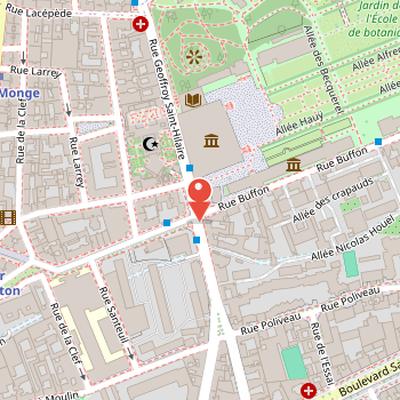
Nearby Objects
-
 Muséum national d'histoire naturelle 130 m away
 -
 Jardin des Plantes 400 m away
 -
 Église Saint-Médard 450 m away
 -
 Rue Mouffetard 450 m away
 -
 Arènes de Lutèce 500 m away
Architecture and Location
The Galerie de Paleontologie et d'Anatomie comparee is a gallery of Paleontology and Comparative Anatomy at the National Museum of Natural History. It belongs to the Museum's galleries, which are buildings each identified as a museum specialized in a specific field of natural history. The gallery is located east of the Jardin des Plantes in Paris, at the beginning of Rue Buffon, near Gare d'Austerlitz and Place Valhubert. Its building was designed in 1892 by the architect Ferdinand Dutert and constructed between 1893 and 1898.
From the Royal Cabinet to a Comparative Anatomy Gallery
The history of the Galerie de Paleontologie et d'Anatomie comparee begins with the royal cabinet, which was a main place for preserving natural history specimens at the foundation of the Jardin royal des plantes mediciniales in 1635. When the Jardin royal was reorganized as the Muséum national in 1793, the institution created twelve teaching and research chairs, and each professor was made responsible for the collections linked to their discipline, kept in the old royal cabinet. As collections grew, the Muséum needed more space and decided to build new galleries.
In 1802, Georges Cuvier replaced Jean-Claude Mertrud as professor of the animal anatomy chair, which was renamed when he took the position. Cuvier created a separate exhibition and collection space apart from the natural history cabinet, using a building previously owned by the Paris fiacres management and bought by the Muséum in 1795. He established the first comparative anatomy cabinet of the Muséum in this building in 1802, and opened it to the public in 1806 as the first comparative anatomy gallery of the Muséum. The building had two main wings separated by an interior courtyard and later became known under a different name; only one wing remains today.
The natural history cabinet also held botany, mineralogy, and geology libraries and collections, and it was known by different names according to political regimes and periods. Space constraints eventually led the Muséum to create new gallery buildings. The mineralogy and geology gallery, inaugurated in 1837 with Louis-Philippe present, housed parts of the Muséum libraries. By contrast, no new building was constructed for the anthropology gallery. After political authorities approved the creation of an anthropology museum in 1855, anthropology exhibition rooms opened that same year in the building Cuvier had dedicated to comparative anatomy.
Later, the Muséum granted Albert Gaudry the construction of two paleontology rooms annexed to the Baleine building courtyard. These rooms were inaugurated in 1885 as a provisional paleontology gallery and are identified as the embryo of the current gallery. The zoology collections gallery followed in 1889 and was renamed in 1994. Over time, the osteological collections of the Muséum overcrowded the comparative anatomy gallery created by Cuvier, reinforcing the need for a more complex shared display and research space.
Planning and Inauguration of the New Gallery
In 1891, Georges Pouchet, Albert Gaudry, and Armand de Quatrefages initiated a new gallery project. Edmond Fremy approved the project shortly before the end of his term in 1892, and in the same year Alphonse Milne-Edwards led the professors' assembly to appoint the architect Ferdinand Dutert to design the new building. Dutert also brought together several Art Nouveau artists to create the decorative elements. The foundation stone was laid in 1893, although Quatrefages had died in 1892 and Pouchet died in 1894 during the period of development. The gallery was inaugurated on 22 June 1898.
History and Interior Organization
The gallery's collections were built mainly from the missions of naturalist travelers in the 19th century, together with specimens from the Jardin des plantes menagerie. The paleontology section also received many objects through exchanges between institutions and from paleontological excavations during the 19th century. Its anthropology collections came from the collection created in 1855 by professors Etienne Serres and Armand de Quatrefages. A mezzanine overlooks the first floor and formerly presented anthropology and human anatomy collections from the Museum. After these collections were moved to the Museum of Man on the Chaillot hill in 1937, the mezzanine displayed fossil invertebrates. The second floor consists of a room under a glass roof topped with an interior balcony. The current gallery also includes the former prehistory room, now called the gallery of Atlas, which contains part of the collections of Alcide Dessalines d'Orbigny, the first professor to direct the paleontology chair at the Museum in 1853. In the 2010s, the fossil invertebrate collections were enriched by plant fossil specimens from the former Paleobotany gallery, which had been inaugurated in 1972 in the Mineralogy and Geology gallery and dismantled in 2005. The history of the site also includes changes at 57 rue Buffon, where botanical collections were housed until their transfer after 1935 to the new Botany gallery building, while the old building was later demolished because of obsolescence. A new Paleontology laboratory was built there in 1958 and 1959 in a style matching the gallery, with Jean-Pierre Lehman as its first director and Philippe Taquet later succeeding him in 1981. From 1981, the laboratory housed the CNRS UMR 5143 and became the Institut de Paleontologie after renovations to current standards.
Display, Research, and Renovation
The Galerie de Paleontologie et d'Anatomie comparee is closely linked to the Institut de Paleontologie and the laboratoire d'Anatomie comparee in the building south of rue Buffon. It presents paleontology on the upper floors and comparative anatomy on the ground floor, with the fossil collection of animals and plants spread across two floors to represent the Musuem's entire fossil collection. The ground-floor comparative anatomy gallery displays nearly one thousand skeletons, eggs, and phanerae, and explains biodiversity organization and classification.
The paleontology gallery includes four exhibits devoted to the evolution of birds, horses, elephants, and primates. Among the most popular specimens with the public are dinosaurs and mammoths. The institution also reflects Georges Cuvier's foundations for classifying and reconstructing fossil species by comparison with current species.
During the 1997-1999 centenary, displays named Osteological collections of the Museum were shown. Some osteological collections were preserved in their original form following ICOFOM recommendations, while others were reworked to show affinities between osteological characters of different vertebrate groups. The Institut de Paleontologie also contains fossil preparation rooms in the demi-sol level and a large research library, which is part of the Musuem's libraries managed by the DBD. The institute and its library are closed to the public and reserved for Musuem staff and invited researchers. The gallery has been undergoing progressive renovation without public closure, with new displays, updated labels, improved lighting, and a renovated facade on the side of gare d'Austerlitz in 2015.
Architecture and Interior Display
The Galerie de Pal6ontologie et d'Anatomie comparee was built in stone and metal as a long structure, with its design closely tied to the presentation of scientific collections. Large bay windows were placed on the lateral walls to light the ground floor collections, while roof windows brought direct light to the first floor. The second floor was designed mostly as a mezzanine overlooking the first floor, creating a layered interior arrangement for display. The building was ornamented extensively with naturalist-inspired sculptures on the exterior facades, along with busts of scientists and prehistoric-themed friezes inside and outside.
The fronton was decorated with a sculpture by Andre-Joseph Allar, and a sculpture by Emmanuel Fremiet was placed to the right of the entrance hall. In 1898, the building presented a sculpture representing a Malay hunter fighting an orangutan and its young. The ground floor gallery perimeter carried busts of Louis Georges Duvernoy, Paul Gervais, Etienne Serres, Georges Cuvier, Etienne Geoffroy Saint-Hilaire, and Henri-Marie Ducrotay de Blainville. On the first floor, the only bust was that of Albert Gaudry, positioned at the entrance and facing the vertebrate fossil gallery, which followed Gaudry's museum layout design. The far mezzanine wall on the second floor was later covered with the Lascaux rotunda fresco painted by Simone Vrain in 1960. Three colored reconstructions of extinct animals were also displayed outside at the main facade's feet and around the garden beds. The building was classified as a historic monument with Jardin des Plantes buildings on a specific date.
Architecture and Interior Displays
The Galerie de Paleontologie et d'Anatomie comparee is presented through a series of views that emphasize both its exterior decoration and its interior organization. The renovated facade was shown on January 3, 2017, along with the entrance portal and the gallery viewed from the garden. The pediment carries the Paleontology frieze by Andre Allar, and the garden view includes the statue of the Premier Artiste by Paul Richer. On the ground floor, one image shows a panoramic interior view of the Comparative Anatomy gallery in full length, while another features the cetaceum podium. The ground floor also contains a sculpture of an orangutan strangling a Borneo native by Emmanuel Fremiet. The first floor is presented as the Paleontology gallery, with a mezzanine and exhibits of fossil vertebrates and other groups. Among the displayed material are a plaster cast skeleton of an allosaurus made from disarticulated bones of 44 to 46 individuals, the Steller's sea cow, the extinct Æpyornis from Madagascar, and the holotype of Risso's dolphin in the Comparative Anatomy gallery. An ammonite study laboratory is also located under the roofs at the mezzanine level. Outside the gallery, reconstructions of a woolly mammoth, a moeritherium, and a stegosaurus appear in front of the building.