Rue Mouffetard is one of the oldest streets in Paris, with origins in an ancient road created under the Late Empire. The route connected the bridge on the Île de la Cité to the necropolis at the future Faubourg Saint-Marcel, followed the line of the present Rue Descartes, and ended near Saint-Médard Church, where it joined the route from Lutèce to Lyon at the Bièvre ford. The road later underwent route modifications on Mont Cetard in the 4th century. Long and gently sloping, the street runs from Mount Sainte-Geneviève toward Saint-Médard Church and the former bridge over the Bièvre. It is the main street of the Saint-Médard suburb and one of the busiest streets in the Latin Quarter because of its numerous restaurants. Its name comes from the old place called Mont-Cétard, later corrupted into Mouffetard. The street is also known colloquially as la Mouffe or Mont-fétard.
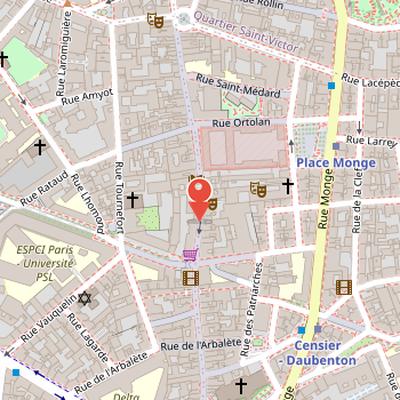
Nearby Objects
-
 Église Saint-Médard 250 m away
 -
 Arènes de Lutèce 400 m away
 -
 Abbey of St Genevieve 450 m away
 -
 Muséum national d'histoire naturelle 450 m away
 -

History and Setting
Rue Mouffetard is one of the oldest streets in Paris, dating from the Late Empire or the 4th or 5th century. It is a long street that slopes gently from Mount Sainte-Geneviève to Saint-Medard Church and the former bridge over the Bièvre. It is the main street of the Saint-Medard suburb. In the Latin Quarter, it is also one of the busiest streets because of its numerous restaurants.
Name and historical references
Rue Mouffetard takes its name from the old place called Mont-Cetard, derived from Mons Cetarius or Cetardus. The route crossed Mont-Cetard when it was still only a path, and the name later became corrupted into Mouffetard. In an 1860 work, the historian Edouard Fournier proposed a different explanation, linking Mouffetard to odeur insoutenable, and he noted the existence of a mud hill called la butte Bonne-Nouvelle on the right bank. According to this account, la butte Bonne-Nouvelle had a path called Mouffetard, now known as rue de Clery. The street also appears as Grand rue de Moustar in a 1636 manuscript. The section between rue Croulebarbe and barriere d'Italie was once named rue Gautier-Renaud after an owner. Rue Mouffetard was frequented by students from nearby schools and universities, and it is still colloquially called la Mouffe or Mont-fetard.
From Ancient Road to Market Street
Rue Mouffetard formed part of an ancient road created under the Late Empire. This route connected the bridge at Ile de la Cite to the necropolis at the future Faubourg Saint-Marcel, followed the line of the current Rue Descartes, and ended near the present Saint-Medard church, where it joined the route from Lutecia to Lyon at the Bièvre ford. Its creation corresponded to the gradual abandonment of the Gallo-Roman city on the left bank, when the city had been reduced to half of Ile de la Cite from the mid to late 3rd century and fortified against Germanic incursions with ramparts built from stones taken from left-bank monuments. The eastern road bypassed the abandoned city and was favored over the path that partly followed the current Rue Lhomond. In the 4th century, the route was modified on Mont Cetard hill.
By the 14th century, the street contained large estates belonging to figures such as Jacques de Pacy, the bishops of Senlis and Meaux, Raymond du Temple, Guillaume V de Chanac, Sejour d'Orleans, and Jean de Meulan. After Jean de Meulan was attacked in the street in 1351, he granted market rights for all natural goods on his lands following intervention by local inhabitants. This event marked the beginning of the neighborhood's transformation into a populous and commercial quarter during the 15th, 16th, and 17th centuries.
Rue Mouffetard later extended south to Barriere d'Italie, now Place d'Italie. It was more than 1 kilometer long and belonged to the old 1st arrondissement. Haussmann's works shortened its southern part for the construction of Rue de Bazeilles and Avenue des Gobelins.
Pedestrianization and Greening
A pedestrianization and greening project for rue Mouffetard was adopted after a local referendum in 2023. The associated works were completed in summer 2025, marking a recent transformation of the street's public space.
Commercial Life and Street Character
Rue Mouffetard is noted for its lively atmosphere and its dense variety of small shops. The upper part of the street, extending to Place de la Contrescarpe, is dominated by food shops, cafes, brasseries, fast food services, and bars, and it is described as the most touristic and active area at night. The lower part, beginning at Rue Jean-Calvin, has a different character, with a daily fresh produce market and traditional local shops such as butcheries, fishmongers, cheesemongers, bakeries, greengrocers, wine shops, caterers, grocers, and hardware stores, along with some neighborhood bars and cafes. The street also includes a neighborhood cinema with two rooms, L'Epee de bois, classified as an art and experimental cinema. The lower market area was renamed Rue de Bazeilles in 1897 after being called Rue Mouffetard in 1896, and the market and its vendors were photographed by Eugene Atget in 1910.
Rue Mouffetard in Literature, Music, and Film
Rue Mouffetard has appeared repeatedly in literary, musical, and cinematic works, reflecting its recurring place in cultural memory. Dans les arts reports that the marquis de Sade was arrested in his lodging on rue Mouffetard with prostitutes on July 4, 1772, an episode tied to the street's historical notoriety. In fiction, Victor Hugo describes Jean Valjean's flight in the streets near rue Mouffetard in Les Miserables, volume 2, and he also named a character Mouffetard in the first dramatic scene of the play Les Gueux. Georges Duhamel later described the street through Louis Salavin in Confession de minuit (1920), while Leon Daudet wrote about it in Paris vecu. Rive gauche (1930), noting the fidelity of its name. George Orwell's autobiography Dans la dche a Paris et a Londres, chapter I, refers to rue Mouffetard by the nickname la rue du Coq d'Or. The street also appears in Pierre Gripari's La sorciere de la rue Mouffetard (1967), which features a witch on rue Mouffetard. In music, Patrick Bruel released the song Rue Mouffetard in 2018, written by Vianney about Bruel's brother living there. The street is also featured in two films from the 1950s, in a documentary by Etienne Lalou aired on RTF on February 17, 1955, and in two films from the 2000s.