Val-de-Grâce was the former Hôpital d'instruction des armées du Val-de-Grâce, a French military teaching hospital located in Val-de-Grâce. It was open to all social security beneficiaries until a certain year and also accepted patients without links to the Ministry of Defense when referred by their attending physician through coordinated care. The hospital took part in the public hospital service mission with AP-HP of Paris. It regularly treated notable personalities requiring medical assistance, including French presidents Jacques Chirac and Nicolas Sarkozy during their mandates, as well as Algerian presidents Chadli Bendjedid and Abdelaziz Bouteflika during their mandates. Its history is linked to the ancient abbey of Val-de-Grâce, which became a military hospital during the Revolution and was transformed into an instruction hospital by regulation. In 1979, the hospital moved to a new building by architect André Chatelin, and the school later occupied the entire convent complex. After a transfer plan announced in 2015, the hospital officially closed in 2016.
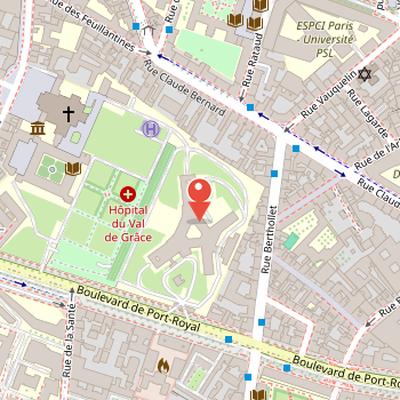
Nearby Objects
-
 Église du Val-de-Grâce 250 m away
 -
 Schola Cantorum de Paris 350 m away
 -
 Hôpital Cochin 400 m away
 -
 Église Saint-Médard 450 m away
 -
 Rue Mouffetard 500 m away
Military Hospital and Public Service Role
Val-de-Grace was the site of the former French military teaching hospital called Hopital d'instruction des armees du Val-de-Grace. The hospital was open to all social security beneficiaries until a certain year, and it also accepted patients without links to the Ministry of Defense when they were referred by their attending physician through coordinated care. It participated in the public hospital service mission together with AP-HP of Paris. In addition to its general activity, it regularly treated notable personalities who needed medical assistance. Among those treated during their mandates were the French presidents Jacques Chirac and Nicolas Sarkozy, as well as the Algerian presidents Chadli Bendjedid and Abdelaziz Bouteflika.
From Abbey to Military Medical Center
During the Revolution, the ancient abbey of Val-de-Grace became a military hospital. A regulation later transformed the abbey into an instruction hospital, and the birth of the Ecole du Val-de-Grace took place there. At an unspecified date, the Ecole d'application de medecine militaire was created at the site, and under the Second Empire it carried that name. In 1979, the hospital left the abbey for a new building designed by architect Andre Chatelin. Since that date, the school has occupied the entire convent complex. In 1993, the institution became the Ecole d'application du Service de sante des armees and was described as the first French military university hospital center.
Closure and Proposed Reuse
In June 2015, Defense Minister Jean-Yves Le Drian initiated a review of the hospital's future. According to Le Monde, three options were discussed: closing the hospital and reallocating its buildings, partially closing it, or transferring Val-de-Grace to AP-HP. On September 11, 2015, a plan was announced to transfer medical activities to Percy and Begin hospitals. Research, training, and the museum remained at Val-de-Grace after this announcement. The hospital officially closed in 2016.
By 2020, the site was abandoned except for a military detachment assigned to Operation Sentinelle. Several possible new uses were then mentioned, including a proposal by the Interior Ministry to establish an intelligence city at the site, a private hospital for disabilities proposed by Professor Jose-Alain Sahel, and another project for an unspecified facility. Part of the former hospital's garden was opened to the public.
Hospital Organization and Training
Val-de-Grace formed part of a wider hospital organization made up of three establishments: HIA Val-de-Grace, HIA Percy de Clamart, and HIA Begin de Saint-Mande within the EHMP. In 2015, the organization had 350 beds. Its clinical services could accommodate internes, assistants in training, and hospital students in line with university recommendations. Beyond patient care, it played a federating role in education and training for different personnel of the Service de sante des armees, working through several institutions including the Ecole de sante (ESA), the Ecole du personnel paramedical des armees (EPPA), the Institut de recherche biomedicale des armees (IRBA), and the Hopitaux d instruction des armees (HIA). It ensured both initial and continuous training for active and reserve officers, military nurse officers, and hospital technicians. The organization also included several offices and departments to carry out these missions, and its school director was appointed by decree.