The Muséum national d'histoire naturelle is France’s National Museum of Natural History and a higher education institution that is part of Sorbonne University. Its main museum is located in Paris, on the left bank of the River Seine, within the Jardin des Plantes, and contains four galleries. The institution has 14 sites throughout France and is headed by a chairman, a role introduced by the 2014 reform and supported by deputy managing directors. Its staff includes about 2,350 members, among them 600 researchers. It is also a member of RECOLNAT, the national network of naturalist collections.
The museum was formally founded on 10 June 1793 by the French Convention during the French Revolution, at the same time as the Louvre Museum. Its origins go back to the Royal Garden of Medicinal Plants, created by King Louis XIII in 1635 and originally directed by royal physicians. The institution later expanded its scope through public lectures and the transformation of the garden’s chateau into a cabinet of natural history. Over time, it became a center for the study and display of natural history collections in Paris.
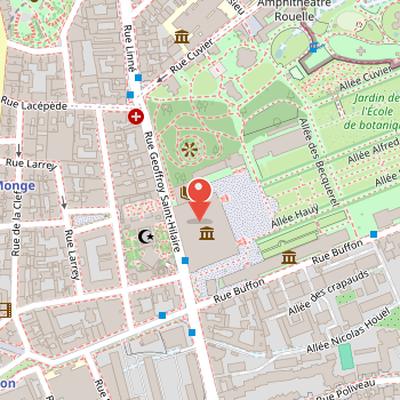
Nearby Objects
-

-
 Jardin des Plantes 300 m away
 -
 Arènes de Lutèce 400 m away
 -
 Rue Mouffetard 450 m away
 -
 Abbey of St. Victor 450 m away
History and Institutional Role
The Muséum national d'histoire naturelle is the National Museum of Natural History in France and a higher education institution that is part of Sorbonne University. Its main museum includes four galleries in Paris, located within the Jardin des Plantes on the left bank of the River Seine. The institution was formally founded in 1793 during the French Revolution, but its origins go back to 1635, when it began as the royal garden of medicinal plants.
Today, the museum operates 14 sites throughout France. Since the 2014 reform, it has been headed by a chairman, who is assisted by deputy managing directors. The institution employs approximately 2,350 staff members, including 600 researchers. It is also a member of RECOLNAT, the national network of naturalist collections.
From Royal Garden to National Museum
The Muséum national d'histoire naturelle was formally established on June 10, 1793 by the French Convention during the French Revolution, at the same time as the Louvre Museum. Its origins, however, go back to the Royal Garden of Medicinal Plants, created by King Louis XIII in 1635 and directed by royal physicians. The garden gradually moved beyond a strictly medical role after a royal proclamation by the boy-king Louis XV on March 31, 1718, and it also became a place for public lectures on botany, chemistry, and comparative anatomy.
In 1729, an enlarged chateau in the garden was given an upper floor and transformed into the cabinet of natural history, which housed royal collections of zoology and mineralogy. On the west side of the garden, a series of greenhouses was built to study plants and animals collected by French explorers, with research directed toward medical and commercial uses. From 1739 to 1788, the garden was under the direction of Georges-Louis Leclerc, Comte de Buffon, who wrote Natural History in thirty-six volumes between 1749 and 1788. Buffon also proposed that the earth was seventy-five thousand years old and divided into seven periods, with man in the most recent, and he funded research through an iron foundry that he owned and directed. A statue of Buffon now stands in front of the Gallery of Evolution.
After the French Revolution, the museum was reorganized with twelve professorships of equal rank. Its aims were defined as instructing the public, assembling collections, and conducting scientific research. Among its early professors were the comparative anatomist Georges Cuvier, the pioneers of evolution Jean-Baptiste de Lamarck and Etienne Geoffroy Saint-Hilaire, and the naturalist Louis Jean Marie Daubenton, who wrote extensively about biology for the Encyclopedie and gave his name to several newly discovered species. The museum also sent trained botanists on scientific expeditions around the world. Its scientific network included Deodat de Dolomieu, Rene Desfontaines, and other researchers whose work contributed to mineralogical and botanical knowledge.
The museum further expanded its collections through participation in Napoleon Bonaparte's military campaign to conquer Egypt in 1798, when more than 154 scientists accompanied the expedition, including botanists, chemists, and mineralogists such as Etienne Geoffroy Saint-Hilaire, Vivant Denon, Joseph Fourier, and Claude Louis Berthollet. They brought back a large quantity of specimens and illustrations that enriched the museum's holdings.
Scientific Research and Academic Chairs
The Mus eum national d'histoire naturelle played an important role in 19th century scientific history through the work of its researchers and chairs. Under the direction of chemist Michel Eugene Chevreul, its history flourished during that century. Chevreul's research with animal fats revolutionized the manufacture of soap and candles, and his work led to the isolation of heptadecanoic, stearic, and oleic fatty acids. He also demonstrated that diabetics excrete glucose, isolated creatine, and developed theories of color that provided a scientific basis for Impressionist and Neo-Impressionist painting.
The museum was also associated with the Applied Physics chair, held by Henri Becquerel from 1892 to 1908. Becquerel is noted for wrapping uranium salts in photographic paper to demonstrate uranium radioactivity, and he later shared the 1903 Nobel Prize in Physics with Pierre Curie and Marie Curie. Four generations of Becquerels held the Applied Physics chair from 1838 to 1948.
Expansion, Reorganization, and Modern Changes
The Musuem national d'histoire naturelle expanded significantly in the late 19th century. A new gallery of zoology was begun in 1877 and completed in 1889, and it was intended to commemorate the 100th anniversary of the French Revolution. This was followed by a new gallery of paleontology and comparative anatomy, which opened in 1898. However, the cost of these projects drained the museum budget and created financial shortages.
During this period, the museum also faced conflict with the University of Paris over the emphasis placed on teaching. In response, it reduced its teaching role and concentrated more on research and collections. The institution later received greater financial autonomy in 1907, which marked the beginning of a new phase of growth.
The museum continued to expand its scope in the 20th century. It opened the Paris Zoological Park in 1934 in the Bois de Vincennes, where larger animals from the Menagerie of the Jardin des Plantes were housed. In 1937, it also opened the Musee de l'Homme at Palais de Chaillot, a museum of anthropology located across the Seine from the Eiffel Tower. The building had been created for the 1937 Paris International Exposition.
By the mid-20th century, some buildings, especially the Grand Gallery of Evolution completed in 1889, were in poor condition. The museum closed entirely in 1965 and underwent major restoration from 1991 to 1994. In French public administration, it is classed as a higher education institution, and recent research and education efforts have focused on environmental effects of human exploitation. The museum also carried out later public actions, including the return of the skull of Malagasy King Toera of Menabe to Madagascar in August 2025, along with the skulls of two companions, after more than a century in its archives.
The Museum Galleries and the Grand Gallery of Evolution
The Muséum national d'histoire naturelle is associated with five major galleries in the Jardin des Plantes: the Gallery of Evolution, the Gallery of Mineralogy and Geology, the Gallery of Botany, the Gallery of Paleontology and Comparative Anatomy, and the Laboratory of Entomology. The institution has been called the Louvre of the Natural Sciences, reflecting its public stature and the breadth of its collections. Among these spaces, the Grand Gallery of Evolution is the largest and best known. It stands at the end of the central alley facing the formal garden, making its position in the landscape as important as its collections inside.
The Grand Gallery of Evolution replaced an earlier Neoclassical gallery built nearby by Buffon, which had opened in 1785 and was demolished in 1935. The new building was proposed in 1872 and begun in 1877 by the architect Louis-Jules Andre, who taught at the Ecole des Beaux-Arts in Paris. Opened in 1889 for the Paris Universal Exposition of 1889, it is a prominent example of Beaux Arts Architecture. Although it was designed as a major public monument, it never fully completed its original design and never received the neoclassical entrance planned for the side facing Rue Geoffroy-Saint-Hilaire.
The facade facing the garden was designed specifically as a backdrop for the garden. It is divided into eleven traverses. Ten of these are decorated with sculpted medallions honoring French scientists associated with the museum, while the central traverse carries a larger marble statue of a seated woman holding a book. This figure poses similarly to a statue of Buffon facing the building. The statues were made by Eugene Guillaume, a pupil of the sculptor Pradier. The exterior was neo-classical, while the interior used an iron framework that was extremely modern for the 19th century. The building contained a rectangular hall 55 meters long, 25 wide, and 15 meters high, supported by forty slender cast-iron columns and originally covered with a glass roof one thousand square meters in size.
The building was closed entirely in 1965 because of technical problems. It was extensively remodelled between 1991 and 1994 and then reopened in its present form. Today, the great central hall is devoted to marine animals on the lower sides and includes a central platform with a parade of full-size African mammals, among them a rhinoceros originally presented to King Louis XV in the 18th century. The garden side hall is devoted to animals that have disappeared or are in danger of extinction.
Other important galleries in the Jardin des Plantes also contribute to the museum's character. The Gallery of Mineralogy and Geology, built between 1833 and 1837 by Charles Rohault de Fleury, is close to the Gallery of Evolution and was constructed in a neoclassical style with two porticos of Doric columns. It contains over 600000 stones and fossils, including giant crystals such as azurite, tourmaline, malachite, and ammonite, as well as jars and vestiges of the original royal apothecary of Louis XIV and three Florentine marble marquetry tables from the palace of Cardinal Mazarin. The garden complex also includes a rose garden renewed in 1990 with 170 types of European roses and a Japanese pagoda tree planted by Bernard de Jussieu in 1747.
Meteorites in the Galleries and Gardens
The galleries and gardens contain a large collection of meteorites gathered from around the world. Among these is a large fragment of the Canyon Diablo meteorite. This meteorite is a piece of an asteroid that landed on Earth about 550,000 years ago, and the fragment created the Meteor Crater in Arizona.
The Gallery of Botany and Its Setting
The Gallery of Botany is located on the Allee the Buffon, facing the center of the garden, between the Gallery of Mineralogy and the Gallery of Paleontology. It was built in 1930-35 with a grant from the Rockefeller Foundation. In front of the building stands the statue Science and Mystery by Jean-Louis Schroeder, made in 1889 and depicting an old man pondering an egg.
At the corner of the Gallery of Botany is one of the two oldest trees in Paris, a Robinia pseudoacacia, also known as a black locust tree. It was planted in 1635 by Vespasien Robin and came from an earlier tree brought from America by his brother in 1601. It is tied in age with another tree planted at the square of Saint-Julien-le-Pauvre.
The main content of the gallery is the Herbier National, a collection representing 7.5 million plants collected since the founding of the museum. For study, these plants are divided into Spermatophytes, which reproduce with seeds, and cryptogams, which reproduce with spores such as algae, lichens, and mushrooms. Many of the plants were collected by Jean Baptiste Christophore Fusee Aublet, the royal pharmacist and botanist in French Guiana, who published Histoire des plantes de la Guiane Francaise in 1775. That work described 576 genera and 1,241 species of neotropical plants, including more than 400 species new to science.
Architecture and Gardens of the Museum
The Muséum national d'histoire naturelle is a division of the National Museum of Natural History and is home to its main galleries. Its history begins in 1635, when Louis XIII founded it as the Royal Garden of medicinal plants under the direction of the royal physician. Over time, the site expanded in both scientific and architectural scope. The chateau was enlarged in the early 18th century to house royal pharmacist collections, and in 1729 the collection broadened into the Cabinet of Natural History for zoology and mineralogy. The institution later became a center for collecting new plants and animal species from around the world, as well as for examining, illustrating, classifying, naming, and describing species in publications circulated across Europe and America. It also served as a laboratory for scientists including Jean Baptiste Lamarck and as a base for scientific expeditions by Nicolas Baudin, Alexander von Humboldt, and Jules Dumont d'Urville.
The Gallery of Paleontology and Comparative Anatomy is one of the main architectural elements of the site. It was built between 1894 and 1897 by architect Ferdinand Dutert, who also built the Galerie des machines at the 1889 Paris Exposition. The gallery has an entrance with ironwork grill and stone arches decorated with elaborate designs and sculptures of seashells. Inside the entrance is a large marble statue of an Orangutan strangling a hunter, created in 1885 by the animal sculptor Emmanuel Fremiet. The sides of the gallery are decorated with twelve bronze relief sculptures of animals and fourteen medallions of famous biologists. A new pavilion was added to the west side of the gallery and completed in 1961.
The ground floor interior contains vestibules in a combination of Art Deco and Neo-Egyptian styles, and these vestibules are used for temporary exhibits. Among the objects displayed is a slice of a giant sequoia tree that is 2200 years old and fell naturally in 1917. In front of the gallery, the Iris Garden was created in 1964 and displays 260 varieties of iris flowers, along with the sculpture Nymph with a pitcher from 1837 by Isidore Hippolyte Brion. The wider grounds include a large formal garden planted in geometric designs, two enormous greenhouses maintaining tropical plants at 22 degrees Celsius, alpine gardens presenting plants from Corsica, the Caucasus, North America, and the Himalaya, and the School of Botany gardens, which contain 3800 plant species displayed by genus and family.
The Menagerie at Galleries and Gardens
The Menagerie in Galleries and Gardens is the second-oldest public zoo still operating globally, after Tiergarten Schonbrunn in Vienna, which was founded in 1752. It occupies the northeast side of Galleries and Gardens along Quai St. Bernard and covers an unspecified area within the site. Created between 1798 and 1836 to house animals from the royal menagerie at Versailles, it was designed with 19th-century picturesque pavilions to shelter animals. In the 20th century, larger animals were moved from the Menagerie to the Paris Zoological Park in Bois de Vincennes.
The Menagerie is governed by the National Museum of Natural History and currently houses about six hundred mammals, birds, reptiles, amphibians, and invertebrates, representing about 189 species. Among its inhabitants is the Amur leopard from China, described as one of the rarest cats on earth.
Sites, Collections, and Publications
The Muséum national d histoire naturelle operates across fourteen sites throughout France, including four sites in Paris. One of its Paris locations is the Jardin des Plantes in the 5th arrondissement, near metro Place Monge. Another site is in the 16th arrondissement near metro Trocadero, where displays in ethnography and physical anthropology are housed, including artifacts, fossils, and other objects.
The museum's herbarium is identified by the code P and contains 8,000,000 plant specimens. Its historical collections include material associated with Jean-Baptiste de Lamarck (P-LA), Rene Louiche Desfontaines (P-Desf.), Joseph Pitton de Tournefort, and Charles Plumier (P-TRF). The institution also has the CITES designation FR 75A.
In addition to its collections, the museum publishes the botanical periodical Adansonia and journals devoted to the flora of New Caledonia, Madagascar and Comoro Islands, Cambodia, Laos and Vietnam, Cameroon, and Gabon.
Chairs and Scientific Leadership
The transformation of the medicinal garden of the king into a national public museum of natural history required the creation of twelve chaired positions. Over time, the number of Chairs and their subject areas evolved: some were subdivided into two positions, while others were removed. The list of Chairs at the Muséum national d'Histoire naturelle includes major figures in the history of the natural sciences. Among the early holders of chaired positions were Jean-Baptiste Lamarck, Rene Desfontaines, and Georges Cuvier. Later, Paul Rivet and Leon Vaillant also occupied chaired positions at the museum. This structure reflects the museum's role as an institution organized around specialist scientific leadership.
Popular Culture References
The Musaeum national d'histoire naturelle has been repeatedly used as a setting and point of reference in popular culture. In Jules Verne's 1870 novel 20,000 Leagues Under the Seas, the story is presented through the journal entries of Professor Pierre Aronnax, a naturalist from the Paris Museum of Natural History. The museum also appears in later fiction through Jacques Tardi's graphic novel Adle and the Beast (1976), where the Gallery of Palaeontology and Comparative Anatomy inspired the artist and appears on the first page and several later pages. The story opens with a 136-million-year-old pterodactyl egg hatching and a live pterodactyl escaping through the gallery glass roof, before causing destruction and deaths in Paris. In response, the gallery placed a life size cardboard cutout of Adle and the hatching pterodactyl in a glass cabinet outside the main entrance. The museum is also part of the setting of the Pulitzer Prize-winning novel All the Light We Cannot See, which partially takes place there. In that novel, Marie-Laure's father works as the chief locksmith, and the book refers again to 20,000 Leagues Under the Seas and Professor Pierre Aronnax, including a gift of braille editions of Verne's novel.
Friends and Support for the Museum
Friends is a private organization that provides financial support for the Natural History Museum Paris and its branches. Its membership includes free entry to all galleries of the Natural History Museum Paris and the botanical garden. The organization has assisted the museum with many purchases for its collections, and it has also provided funds for both scientific development and structural development. Through these activities, Friends plays a direct role in supporting the museum's collections, research-related growth, and physical upkeep.
Gallery Spaces and Collection Sites
The pictures gallery presents a range of buildings, galleries, and scientific display spaces associated with the Muséum national d'histoire naturelle. It includes the cetaceum podium of cetaceans in the Comparative Anatomy gallery, the gallery of Paleontology and Comparative Anatomy with the statue of the First Artist by Paul Richer, and the Gallery of Mineralogy and Geology. The gallery also features the statue of Bernardin de Saint-Pierre with Paul and Virginia, the alpine garden, and the botanical museum of La Jaÿsinia in the Alps.
Several views focus on specific historic structures and named locations within the museum complex. These include the Hotel de Magny, the greenhouse of New Caledonia, built between 1834 and 1836 as the oriental pavilion according to Charles Rohault de Fleury's plans, and Cuvier's house. One picture shows Cuvier's house on the left and the triangular pediment of the east wing of the Whale Pavilion on the right, while another shows the Becquerel alley north side leading to Cuvier's house, where Henri Becquerel discovered radioactivity in 1896.
The gallery also documents interior exhibition areas and scientific collections. It contains the Paleontology gallery on the second floor with a mezzanine, where vertebrate fossils are displayed on the second floor and invertebrate fossils on the mezzanine. Other images show one of the zoological shelters of the menagerie, the façade of the Musee de l'Homme in the southwest wing of the Palais de Chaillot, and the excavations of the Pataud shelter in Dordogne.