Abbey of St. Victor, or L'abbaye Saint-Victor de Paris, was an abbey of regular canons founded by Guillaume de Champeaux, archdeacon and director of the Notre-Dame de Paris cathedral school. It became one of the most important centers of intellectual life in medieval Western theology and philosophy, and its influence included masters Hugues, Adam, André, Richard, and Thomas Gallus. The abbey’s motto was: “Jesus, Maria, sanctus Victor, sanctus Augustinus.”
The abbey was suppressed in 1790 and demolished in 1811. Its site was later replaced by the wine market and then, in the second half of the 19th century, by the faculty of sciences. The site now hosts the Institute of Physics of the Globe and the University Jussieu.
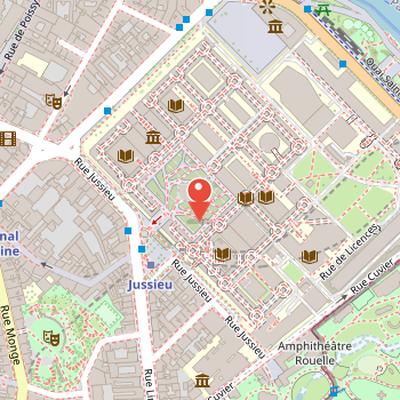
Nearby Objects
-
 Arènes de Lutèce 250 m away
 -
 Arab World Institute 300 m away
 -
 Jardin des Plantes 400 m away
 -
 Muséum national d'histoire naturelle 450 m away
 -
 Saint-Nicolas-du-Chardonnet 500 m away
History and Legacy of the Abbey
L'abbaye Saint-Victor de Paris was founded by Guillaume de Champeaux as an ancient abbey of regular canons. Guillaume de Champeaux had been archdeacon and director of the Notre-Dame de Paris cathedral school. The abbey became one of the most important centers of intellectual life in medieval Western theology and philosophy, and its influence extended through masters such as Hugues, Adam, Andre, Richard, and Thomas Gallus. Its motto was Jesus, Maria, sanctus Victor, sanctus Augustinus. The abbey was suppressed in 1790 and demolished in 1811. The site was then replaced first by the wine market and later, in the second half of the 19th century, by the faculty of sciences. It now hosts the Institute of Physics of the Globe and the University Jussieu.
Growth and Influence of Saint Victor
After retiring from teaching in 1108, Historique settled in a hermitage dependent on the abbaye Saint-Victor de Marseille near montagne Sainte-Geneviève. In 1113, Louis VI le Gros transformed this small retreat into a richly endowed abbaye, and the pope confirmed the foundation in 1114. The abbaye remained outside the city walls built by Philippe Auguste at the end of the 12th century. Historique was elected bishop of Chaalons-sur-Marne in 1113, and his successor was prior Gilduin, his chief disciple and confessor of the king. Gilduin, who was born in Paris, served as abbot from 1113 to 1155 and established a rule in the Liber ordinis Sancti Victoris that stressed strict asceticism, silence, and manual labor. Under his leadership, the abbaye grew rapidly, reaching forty-four houses by his death and about seventy autonomous confederated houses north of the Loire, with further houses in Sancerre, Italy, Denmark, and England. A letter of Pope Gregory IX lists several affiliated abbeys, including Saint-Satur, Saint-Ambroix in Bourges, Jard in Sens, Juilly in Meaux, Notre-Dame d'Eaucourt in Arras, Saint-Euverte d'Orleans, Saint-Vincent and Victoire in Senlis, Saint-Barthalemy in Noyon, Notre-Dame d'Eu in Rouen, and Notre-Dame de Cantimpre in Cambrai. Saint-Victor also became a place of retreat used by Bernard de Clairvaux and Thomas Becket, and it housed apartments for bishops of Paris. Its cloister became a public school of theology and liberal arts attended by Abelard and Pierre Lombard, although the university of Paris eclipsed this school in the 13th century. The abbaye also played a role in penance for university students, encouraging a less worldly life centered on edification and liturgy.
History and Reconstruction of the Abbey
In 1237, a theology chair linked to the university was created on the site of the Abbey of St. Victor. At the beginning of the 14th century, most of the buildings were destroyed and replaced by larger and better lit premises. The abbey then encompassed most of the Terre d'Alez, with the Bièvre river flowing into the Seine nearby, and included the butte Coypeau, named in 1303, as well as a mill called de la Tournelle. From 1350, the community experienced difficulties, and in 1633 it was absorbed by the Congrégation de France. After the Catholic reform, it sent ten monks from various Augustinian abbeys to rebuild Notre-Dame de Paimpont. Reconstruction began with two buildings, the Grand Logis and the Manoir abbatial, under Pere Asselin. The congregation was suppressed in 1790 during the Revolution, and the church was erected as a parish in 1791. The buildings were sold as national properties and demolished in 1811, and the tour d'Alexandre and the Saint-Victor fountain were destroyed in 1840.
The Abbey as an Intellectual Center
The Abbey of St. Victor was associated with an urban and intellectual orientation, and its school gained a universalist dimension under the teaching of Hugues. At the abbey, masters such as Hugues and Richard de Saint-Victor were presented as central figures in its scholarly life. Hugues was recognized as the true founder of the school and served as abbot from 1125 to 1140. He was also associated with the roles of scholar, philosopher, mystic, and pedagogue. Among the works linked to him was De sacramentis christianae fidei, written between 1136 and 1141. Richard de Saint-Victor was considered the founder of medieval mysticism, reinforcing the abbey's importance in the history of religious thought.
The Abbey Library and Its Intellectual Life
The Abbey of St. Victor possessed a rich library that was open to the public. Its manuscripts were organized for different uses within the abbey: chained books were kept in the consultation room, liturgical manuscripts were stored in the choir, some manuscripts were placed near the refectory for reading aloud, and others were kept in the infirmary for the sick and dying. The library also maintained duplicate manuscripts reserved by the librarian, known as the armarius.
The abbey's teaching activity supported the growth of the collection, and manuscript copying in the 12th century was carried out by both canons and professional copyists. The library was further expanded through significant donations, including half of Adenulphe d'Anagni's library around 1289-1290 and Louis Cousin's library in 1707. Books brought by canons on arrival also became property of the abbey library.
The library was notable enough to be mentioned in Rabelais' Pantagruel under the name la librairie Saint-Victor. Its importance reflected the abbey's wider intellectual orientation, which supported mysticism with rational foundations and aimed to promote spiritual life as a defining goal of all the Victorins.
Victorine Scholars at the Abbey
The Abbey of Saint Victor is represented in the provided facts mainly through the activity of several Victorine scholars connected to it. Andre de Saint-Victor used Hebrew sources in Victorine exegesis, although analyses describe his role as marginal compared with the dominant currents of medieval exegesis. He died in 1175 and was abbot of the abbey of Wigmore in England (Wales). His return to the Hebrew text in De Emmanuel was criticized by Richard and Gaudefroy, while Roger Bacon complained about his influence. De Emmanuel also favored the dissemination of an interpretation of Isaiah commentary.
Gautier de Saint-Victor served as prior of the abbey and died after 1180. Around 1177, he wrote Contra quatuor labyrinthos Franciae, where he attacked innovative theologians for Aristotelianism and defended reading the Church Fathers against new dialectic theology. Absalon de Saint-Victor became abbot of Saint-Victor in 1198 and authored about fifty sermons. His writings criticize abuses of his time and reject secular sciences. Together, these facts show the abbey as a center associated with exegetical, theological, and moral writing, as well as with disputes over scholarly method and authority.
Canonical Life and Liturgical Identity
The Abbey of St. Victor is associated with the development of regular canons as part of the organized control of secular clerical life. Its background is connected to the Carolingian period, including the rules of Chrodegang of Metz and the Council of Aix la Chapelle, and later to the Gregorian Reform, which promoted the rule of Saint Augustine from the 11th century. This Augustinian rule led to the formation of several canonical families and marked a form of canonical life that differed from the monastic regime usually under Benedictine rule. In this context, the Expositio in regulam sancti Augustini presented the rule as a treatise of charity and of the restoration of apostolic life.
Saint-Victor also had a distinct institutional and cultural identity. The liber ordinis Sancti Victoris served as a customary for the community, while its liturgy was similar to the secular type of cathedral liturgy. The abbey was also a musical center, like Notre-Dame de Paris cathedral. Among those connected with its reputation was the poet Adam de Saint-Victor, who died around 1192 and influenced innovation in the treatment of sequences. His works quickly became popular, adding to the wider cultural significance of Saint-Victor.
Relics, Revenues, and Influence
Between 963 and 965, the relics of Saint Malo were transported to Paris by Salvator, bishop of Alet, and Junanus, abbot of Lehon. They were first kept in the church of Saint-Barthelemy in Paris and later preserved at the abbey of Saint-Victor. Part of the relics was also transported to and venerated at the abbey of Saint-Sauve in Montreuil-sur-Mer. The abbey's importance was not limited to relics: it also influenced priories by sending monks and collecting revenues. Among its recorded possessions, it received revenues from the priory of Saint-Paul d'Aulnay near Chevreuse. Before 1123, Girbert, bishop of Paris, gave the abbey several arpents of vine at Bagneux.