Jardin des Plantes is the official name of the main botanical garden in France. Also known as Jardin des Plantes de Paris when distinguished from other jardins des plantes, it is situated in the 5th arrondissement of Paris on the left bank of the Seine. The garden covers 28 hectares and is the headquarters of the Muséum National d’Histoire Naturelle, which is part of Sorbonne University. Its name is an elliptical form of Jardin Royal des Plantes Médicinales, reflecting the garden’s original purpose in the 17th century.
Founded in 1635 by an edict of King Louis XIII as the Royal Garden of Medicinal Plants, it was placed under the authority of the king’s physician, Guy de la Brosse. The garden was staffed with demonstrateurs who lectured visitors on botany, chemistry, and geology using the collections. In 1673, under Louis XIV and director Guy-Crescent Fagon, it received a new amphitheater. The site includes four buildings containing exhibited specimens, officially classified as museums under French law and called galeries by the French Museum of Natural History. It also contains more than 10,000 species, tropical greenhouses, a rose garden, a winter garden, an Alpine garden, and the Ménagerie du Jardin des Plantes, founded in 1795.
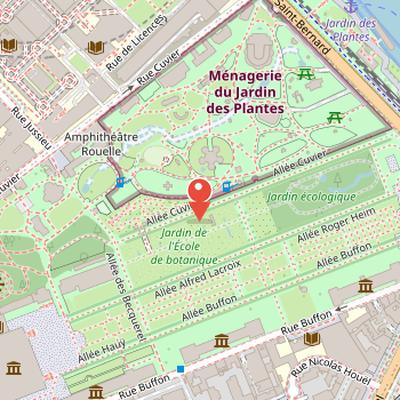
Nearby Objects
-
 Muséum national d'histoire naturelle 300 m away
 -
 Abbey of St. Victor 400 m away
 -

-
 Arènes de Lutèce 500 m away
 -
 Arab World Institute 600 m away
Location and Institutional Role
The Jardin des Plantes, also known as the Jardin des Plantes de Paris when it is distinguished from other jardins des plantes, is the main botanical garden in France. Its official name is Jardin des Plantes, and it is an elliptical form of the Jardin Royal des Plantes Medicinales, reflecting the garden's original purpose in the 17th century. It is located in the 5th arrondissement of Paris, on the left bank of the River Seine, and covers 28 hectares, or 280,000 square meters.
The site also serves an institutional role as the headquarters of the Musuem National d'Histoire Naturelle, which is part of Sorbonne University. This gives the garden importance beyond its function as a botanical site, linking it to scientific and educational activity in Paris.
Since 24 March 1993, the Jardin des Plantes and its contained buildings, archives, libraries, greenhouses, menagerie, works of art, and specimens' collection have been classified as a national historical landmark in France.
Museums, Gardens, and the Mena gerie
The Jardin des Plantes includes a garden plan with four buildings that contain exhibited specimens. Under French law, these buildings are officially considered museums, and the French Museum of Natural History refers to them as galeries. The site also grows more than 10,000 species in its botanical garden, along with tropical greenhouses, a rose garden, a winter garden, and an Alpine garden.
A small zoo, the Menagerie du Jardin des Plantes, is also part of the site. It was founded in 1795 by Bernardin de Saint-Pierre, using animals from the Mena gerie Royale de Versailles, which had been dismantled during the French Revolution.
From Royal Garden to Natural History Museum
Founded in 1635 by an edict of King Louis XIII, the garden began as the Royal Garden of Medicinal Plants and was placed under the authority of the king's physician, Guy de la Brosse. From the start, it functioned as a place of study and public instruction: demonstrateurs lectured visitors on botany, chemistry, and geology using the garden collections. In 1673, under Louis XIV and director Guy-Crescent Fagon, the garden received a new amphitheater where dissections and other medical courses were conducted. Lecturers included Claude Perrault, a physician, anatomist, and architect who also designed the facade of the Louvre Palace.
During the early 18th century, an additional floor was added to the chateau to house the royal botanist's medicinal plant collection, and this space gradually became galleries for the royal mineral collection. The garden also expanded its scientific facilities, with greenhouses enlarged on the west and south to hold plants brought from scientific expeditions worldwide. New plants were studied, dried, and cataloged, while artists created Herbiers, books containing detailed illustrations of new and existing plants. Research also focused on possible medical and culinary uses, including studies of coffee plants from Java by Antoine de Jussieu, work that later led to coffee plantations in the French colonies of North America.
From 1739 to 1788, Georges-Louis Leclerc, Comte de Buffon, was the most celebrated head of the garden. He lived there in the house now named after him, and under his direction the garden doubled in size and extended to the banks of the Seine. The Cabinet of Natural History in the main building was enlarged, a new gallery was added to the south, and important botanists and naturalists such as Jean Baptiste Lamarck entered the garden's scientific community. The institution also sponsored explorers and botanists to collect specimens, including Michel Adanson in Senegal and La Perouse in the islands of the Pacific. Their returns of shiploads of specimens were carefully studied and classified. These scientific developments contributed to conflict with Sorbonne theologians over evolution, with Buffon and his allies arguing that natural species gradually evolved, while the Sorbonne insisted nature remained exactly as at Creation. The scientists had the backing of the Royal court to continue their studies and publish their work.
On June 7, 1793, the National Convention reorganized former royal institutions and joined the Royal Garden of Plants and Cabinet of Natural Sciences into the Museum of Natural History. The new museum received important collections from members of the aristocracy, including a famous group of wax anatomy models created by Andre Pinson. It also benefited from the 1798 expedition to Egypt launched by First Consul Napoleon Bonaparte, in which 154 botanists, astronomers, archeologists, chemists, artists, and other scholars took part, including Gaspard Monge, Joseph Fourier, and Claude Louis Berthollet. Drawings and paintings from the expedition are part of the museum collections. A major late 18th-century addition was the Meneragerie du Jardin des Plantes, proposed in 1792 by Bernardin de Saint-Pierre to rescue animals from royal collections, a private zoo, and public circuses. In 1795, the government acquired the Hotel de Magne estate next to the gardens for animal cages, although many animals died early before receiving funding and structures from Napoleon. The Meneragerie later became home to animals brought back from scientific expeditions in the early 19th century, including the famous giraffe given to King Charles X by the Sultan of Cairo in 1827. Throughout the 19th and early 20th century, the primary mission of the gardens and museums remained research.
Scientific Discoveries in the Museum Laboratories
The laboratories in the museum were associated with several major scientific investigations. Chemist Eugene Chevreul isolated fatty acids and cholesterol and studied the chemistry of vegetal dyes there. Physiologist Claude Bernard studied the functions of glycogen in the liver in the same setting. In 1896, physicist Henri Becquerel discovered radioactivity in a laboratory in the museum. He wrapped uranium salts with an unexposed photographic plate in black cloth to keep out sunlight, and when he unwrapped it, the plate had changed color from exposure to radiation. Becquerel later received the Nobel Prize in 1903 for this discovery.
Nineteenth-Century Transformations
The appearance of the Jardin des plantes changed markedly in the late nineteenth and early twentieth centuries through the construction of new buildings linked to the museum's collections. Among the most significant additions was the Gallery of Zoology, designed by Jules Andre and begun in 1877. It was built to contain the museum's immense zoological collections and overlooks the formal garden. Its central hall is noted as a landmark of iron construction, comparable to the Grand Palais and the Musee d'Orsay. The gallery was inaugurated in 1888, but later suffered from a long lack of maintenance and was closed in 1965.
Other parts of the site were also expanded. The menagerie buildings were enlarged with the construction of the immense Bird House by Jules Andre, with dimensions described in the sources as high, long, and long. In 1898, the Gallery of Paleontology and of Comparative Anatomy opened to replace structures built between 1795 and 1807. This gallery was created to display the thousands of skeletons collected by the museum.
Later, between 1980 and 1986, the Zootheque was constructed underneath the Esplanade Milne-Edwards in front of the Gallery of Zoology. Accessible only to researchers, it contains thirty million insect specimens, as well as five hundred thousand fish and reptiles, one hundred fifty thousand birds, and seven thousand other animals. The building above it was then extensively renovated from 1991 to 1994 to house the updated Grand Gallery of Evolution.
The Grand Gallery of Evolution at Jardin des Plantes
The National Museum of Natural History is contained in five buildings along the formal garden: the Gallery of Evolution, the Gallery of Mineralogy and Geology, the Gallery of Botany, the Gallery of Paleontology and Comparative Anatomy, and the Laboratory of Entomology. Among these, the Grand Gallery of Evolution is one of the most prominent structures and is closely associated with the Jardin des Plantes, where works by Jules Andre are found throughout. Andre became architect of the National Museum of Natural History in 1867, and he also collaborated with Henri Labrouste on the Beaux-arts Bibliotheque National in Paris.
The Grand Gallery of Evolution opened during the Paris Universal Exposition of 1889. Its exterior is described as Beaux-Arts architecture, while its interior iron structure is modern and contemporary with the Grand Palais and gare d'Orsay. The building does not present a grand facade on the side of rue Geoffroy-Saint-Hilaire; instead, its main facade faces two principal alleys of the formal garden. That facade is flanked by two lantern towers and decorated with medallions honoring ten notable scientists who worked at the museum, as well as an allegorical statue of a woman holding an open book of knowledge.
The gallery encloses a rectangular hall 55 meters long, 25 meters wide, and 15 meters high, with a glass roof of 1000 square meters supported by slender iron columns. It was closed in 1965 because of structural deterioration and underwent extensive restoration between 1991 and 1995. Today, it presents the evolution of species through preserved animals and media displays, with special attention given to species that have disappeared or are endangered. Its collection includes a rhinoceros brought to France in the 18th century by Louis XV.
Botany and Paleontology in the Garden
The Garden of Botany includes the Gallery of Botany, which was built between 1930 and 1935 with a grant from the Rockefeller Foundation. It houses the Herbier National, a collection of specimens of all known plant species numbering 7.5 million, and its ground floor gallery is used for temporary exhibitions. The Gallery of Botany is also noted for containing the oldest tree in Paris, a Robinier Faux Acacia brought from America in 1601.
Next to the Iris garden, which contains 260 varieties of Iris, stands the Gallery of Paleontology and Comparative Anatomy. This building was constructed between 1894 and 1897 by Ferdinand Dutert, who specialized in metallic architecture and also built the Gallery of Machines at the 1889 Paris Exposition. It was expanded in 1961 with a brick addition by Henri Delage. The interior is known for its lace-like iron stairways and detail, and the gallery displays a large collection of fossilized dinosaur and large vertebrate skeletons.
Layout and Greenhouses
The Jardin des plantes covers an area bordered by the River Seine on the east, Rue Geofroy-Saint-Hilaire on the west, Rue Buffon on the south, and Rue Cuvier on the north. Its main entrance is on the east side at Place Valhubert, where it reaches the Grand Gallery, which copies the gallerys width. The garden is designed in the style of a French formal garden, extending between two geometrically trimmed rows of plane trees. Its rectangular beds contain over a thousand plants. On the left side of the garden there is a row of galleries, while on the right side are the School of Botany, the Alpine Garden, and greenhouses. Iron grill gateways and a fence at Place Valhubert were created at the beginning of the formal garden.
At the east end of the garden, at Place Valhubert, stands a statue of the botanist Jean-Baptiste Lamarck, who directed the School of Botany beginning in 1788. At the other end of the formal garden, facing the Grand Gallery, is a statue of the naturalist Buffon. The Buffon statue depicts him in a dressing gown seated atop a lion skin and holding a bird. Between the Buffon statue and the Grand Gallery is the Esplanade Mine Edwards. Beneath this esplanade is the Zootheque, an underground storage area that is not open to the public.
The garden includes several greenhouse structures. The Serre Mexicaine was built from 1834 to 1836 by Charles Rohault de Fleury and is described as an early example of French glass and metal architecture. The garden also has an Art Deco entrance to the Jardin d'hiver greenhouse, built in 1937. Four large greenhouses stand in a row to the right front of the Gallery of Evolution, facing the Esplanade Milne-Edwards. These greenhouses replaced earlier ones built on the same site in the early 18th century to house plants from tropical climates brought to France by French explorers and naturalists. The four greenhouses were built between 1834 and 1836 by architect Rohault de Fleury. Their iron and glass structures were considered revolutionary for Paris and preceded Victor Baltards similar pavilions for the Paris markets by fifteen years.
The Jardin d'hiver, designed by Rene Berger and completed in 1937, covers 750 square meters. It has an Art Deco entrance between two illuminated glass and iron pillars built for nighttime visits. Its heating system keeps the interior at 22 degrees Celsius year-round, creating conditions suitable for bananas, palms, giant bamboo, and other tropical plants. A fifteen-meter-high waterfall forms its central feature. The garden also includes a large section alongside the formal garden with an entrance on the Allee Bequrerel belonging to the School of Botany.
Botanical Collections and Historic Features
The Gardens' School of Botany section is devoted to plants with medicinal or economic uses. Created in the 18th century, it now holds more than three thousand eight hundred plant specimens, arranged by genus and family. The section also offers regular tours led by museum guides. Among its notable specimens is the black pine of the Laricio variety from Corsica, planted by Jussieu in the 1770s.
Several historic trees and landscape features are also part of the site. A small garden is placed directly behind the Winter Garden greenhouse. There is a large oriental plane tree from the Orient, planted by Buffon in 1785, and a Ginkgo biloba tree originating in China, planted in 1811. The grounds also include a Cedar of Lebanon planted in 1734 by Jussieu, with a trunk four meters in circumference, and an old erable tree from Crete planted in 1702 on the butte, which contains trees from the Mediterranean.
At the center of the garden stands a monument to the botanist Bernardin de Saint-Pierre, the last director of the Gardens named by the King before the French Revolution. He also created the menagerie and is known as the author of the romantic novel Paul et Virginie, published in 1788. Another major landscape element is the Grand Labyrinth, with a winding path to the top of the Butte Copeaux hill. It was originally created by Louis XIII and later redone by Louis XVI on the site of an old garbage dump.
The Gloriette de Buffon and the Gardens Labyrinth
At the top of the labyrinth in the Jardin des plantes stands the Gloriette de Buffon, a neoclassical viewing platform made of cast iron, bronze, and copper in 1786-87 using metal from Buffon's foundry. Buffon redid the labyrinth for Louis XVI, and the platform remains a notable feature of this landscaped area. It is described as the oldest metallic structure in Paris and the oldest iron architecture in the city. The Gloriette has eight iron columns supporting a roof shaped like a Chinese hat, with a lantern above it and a frieze decorated with swastikas. The top also carries an inscription honoring Louis XVI's justice, humanity, and munificence, as well as a Latin quotation from Buffon translated as 'I only count the hours without clouds'. The structure originally had a precise clock that chimed exactly at noon, but this disappeared in 1795. Another historic feature of the gardens is the Lion Fountain, built in 1834 into the wall of a former reservoir and decorated with two bronze lions made in 1863 by the sculptor Henri Jacquemart.
The Menagerie at Jardin des Plantes
The Menagerie at Jardin des Plantes is the second-oldest public zoo in the world still in operation. It was founded in 1752 and was laid out in its current form between 1798 and 1836. The Menagerie occupies an area that is not specified in the provided facts. Its mission is to preserve the genetic pool of certain endangered species. To support this aim, it cooperates with zoos in other European cities. It also seeks to reintroduce some endangered species into nature.
Fossil Plant Collection
The Jardin des plantes has a large collection of fossil plants gathered from around the world. Among the specimens are Ginkgo digitata, found in Yorkshire and dated to about 170 million years old, as well as fossil leaves of Cordaites lungatus. The collection also includes imprints of the extinct fern Pecopteris from Commentary, France, which are about 300 million years old, and fossil leaves of Zamites feneonis. Some of these specimens are displayed in the greenhouses of the garden.
Notable Buildings in the Gardens
The gardens contain several notable buildings that contribute to their historic character. These include the Maison Buffon, which was the residence of Georges-Louis Leclerc, Comte de Buffon. Other features are the Cuvier Fountain and an amphitheater dating from the 18th century. The gardens also include the Hotel de Magny, which serves as the garden administration building.
Associated Parks and Gardens
The Jardin des Plantes is associated with several sites that extend its scientific and horticultural role beyond its main grounds. In 1934, gardens and sites associated with the Jardin des Plantes created the Paris Zoological Park in the Bois de Vincennes, and it has been administered through the Museum of Natural History. The park was designed for larger mammals such as giraffes, elephants, and hippopotamus, and its layout includes a large artificial rock 65 meters high as well as a large greenhouse with 7000 square meters of plantations.
Other related sites show a similar pattern of specialization. The gardens and sites associated with the Jardin des Plantes founded the Arboretum de Chavreloup near Versailles in 1927 and manage its 222 hectares with species raised from seeds collected worldwide. This arboretum focuses particularly on conifers and deciduous trees. The Jardin botanique exotique de Menton, near Menton in the Alpes-Maritimes province, specializes in tropical plants and Mediterranean climate plants. The Animal Park of la Haute Touche, between Sologne and Berry, is managed in a large natural setting and specializes in reproducing endangered species.
The same network also includes Parc des Cleres in Normandy, which is specialized in birds and certain quadrupeds including kangaroos and cervids, and the Alpine Garden of Jaysinia at Samoens in Haute-Savoie, which emphasizes high-altitude plants from around the world, especially plants from the Alps.