Musée Cernuschi is a museum of the City of Paris dedicated to Asian arts, with a particular focus on Far East art from China, Japan, Korea, and Vietnam. It is the second museum in France devoted to Asian arts and the fifth museum in Europe dedicated to Chinese art. Founded through the bequest of Henri Cernuschi’s collections to the City of Paris in 1896, it was inaugurated in 1898 and is one of the oldest museums in the city. The museum is installed in Henri Cernuschi’s former mansion at 7, avenue Vélasquez, near Parc Monceau in the 8th arrondissement. The building was constructed by architect William Bouwens van der Boijen. Since January 2013, it has been one of the Museums of the City of Paris managed by Paris Musées. Its collections were entirely renovated from 2001 to 2005 and include more than one thousand bronze artworks, important Chinese paintings, and notable Korean, Vietnamese, and Japanese works.
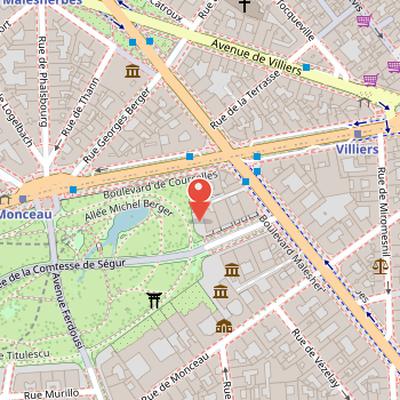
Nearby Objects
-
 Musée Nissim de Camondo 140 m away
 -
 Parc Monceau 200 m away
 -
 Errancis Cemetery 350 m away
 -
 Musée national Jean-Jacques Henner 450 m away
 -
 École Normale de Musique de Paris 500 m away
Museum Focus and Significance
Mussee Cernuschi is a museum of the city of Paris dedicated to Asian arts. Its collection focus is specifically on Far East arts from China, Japan, Korea, and Vietnam. The museum holds a notable place in cultural history as the second museum dedicated to Asian arts in France and the fifth museum dedicated to Chinese art in Europe.
History and Municipal Status
The Musee Cernuschi was created from the bequest of collections made in 1896 to the City of Paris by financier Henri Cernuschi. It was inaugurated in 1898 and is therefore one of the oldest museums in the city. The museum is ranked sixth among the municipal museums of Paris. It also forms part of the fourteen Museums of the City of Paris, which have been managed since January 2013 by the public administrative institution Paris Musees.
Location and building
Musee Cernuschi is located in the 8th arrondissement of Paris, at 7, avenue Velasquez near parc Monceau. The museum is installed in the former mansion of donor Henri Cernuschi. Its building was constructed by architect William Bouwens van der Boijen. The site is served by Villiers metro station.
The Museum Collections
The collections at Musee Cernuschi were entirely renovated between 2001 and 2005. They preserve more than artworks and represent one of the five major Chinese art collections in Europe. The museum holds more than one thousand bronze artworks, as well as a unique European collection of painters from imperial China under the Ming and Qing dynasties. It also includes a significant group of modern Chinese paintings from the first half of the 20th century, including works by painters who lived mainly in Paris and moved between ancient and modern Chinese art. In the permanent exhibition dedicated to Chinese art, the collections present more than artworks, and a path in the galleries is dedicated to newly acquired pieces. Among the display items is the Meguro Buddha, a Japanese bronze from the 17th century shown in room 5 at the center of the museum, as well as a colossal Japanese statue from the late 17th century acquired by Henri Cernuschi during his trip to the Far East. The museum also retains Japanese art objects primarily from Henri Cernuschi's original collection, together with high-quality Korean and Vietnamese art collections. Its reserves mainly contain Japanese, Korean, Vietnamese, and some Chinese artworks that are shown in temporary exhibitions.
Galerie of Chinese and Japanese Decorative Arts
The Galerie at Musee Cernuschi presents a wide range of works connected to Chinese and Japanese decorative arts, with a focus that includes the Tempô era from 1829 to 1844 and the arts of Han China. Its displays combine bronze, ceramic, porcelain, wood, lacquer, and mixed-material objects from different periods.
Among the bronze works are an incense burner shaped like a radish and mouse, a statue from 1709 representing a disciple of Amida, bronze statuettes from 1826 depicting two foxes dedicated to Inari, a bronze statue of Bodhisattva Kannon made between 1716 and 1736, a bronze flower vase for ikebana created between 1700 and 1899, and a dragon incense burner by Kimura Toun made between 1800 and 1870. The gallery also presents a bronze cold water container, or mizusashi, by Ishigaki Satoru dated 2013.
The ceramic and porcelain holdings include a ceramic and lacquer food box by Toyosuke Daiki, a stoneware uma no me zara dish with glaze from 1700 to 1868, a Chinese antique-style bronze-shaped bowl by Aoki Mokubei from 1761 to 1833, two large porcelain plates with painted decoration dating from 1640 to 1670, a gourd-shaped porcelain bottle painted and glazed from 1650, and a bell-shaped porcelain cold water pot with underglaze blue from 1680 to 1700.
The Galerie also contains several wooden and lacquered objects, such as a wooden tiger from 1603 to 1868, a portable wooden cabinet with lacquer, mother-of-pearl, metal, and silver from 1601 to 1625, a wooden incense utensil box with gold and mother-of-pearl, a folding lectern made of wood, lacquer, mother-of-pearl, metal, and silver from 1573 to 1603, a hot water pitcher of paulownia wood with black and gold lacquer, and a wooden and lacquered four-handled basin. Together, these objects show the gallery's emphasis on materials, craftsmanship, and the diversity of East Asian art forms represented in the museum.
Ancient Chinese Objects in the Galerie
The Galerie presents a sequence of ancient Chinese objects spanning several millennia. Its holdings include a Majiaoa jar and Liangzhu culture cong tubes, both dating from 3300 to 2000 BCE, as well as a Longshan culture stemmed cup from 4500 to 3000 BCE. The gallery also exhibits a jade disc dated approximately 2400 to 1900 BCE. From the Bronze Age, it contains a bronze vase gu for fermented beverages from the Erlitang period, circa 1550 to 1300 BCE, and a bronze vase you called la Tigresse from Hunan outside the Shang territory, dated to the 11th century BCE. Later pieces include a bronze hu vase with copper inlay, 21 cm in height, from the Zhou dynasty and the Spring and Autumn to early Warring States period, 770 to 221 BCE. The sequence is completed by a painted terracotta jug shaped like a goose, 14 cm high, from the Western Han dynasty, 206 BCE to 9 CE.
Selected Works in the Gallery
The gallery displays a sequence of Chinese works spanning many centuries, with a focus on sculpture, funerary art, and ritual objects. Among the earliest pieces is a large terracotta horse figurine, 40 cm high, from Eastern Han funerary art found in Sichuan and dated to 25 to 220 CE. Buddhist sculpture is represented by a sandstone Bodhisattva Maitreya from Yungang in Shanxi, 54 cm high, from the Northern Wei dynasty, as well as a 21 cm high Buddhist stele dated 560 CE from the Northern Qi dynasty and a marble Bodhisattva head, 28 cm high, from around 600 CE in the Sui dynasty. The gallery also includes mingqi figurines representing ladies of the Tang dynasty court, a marble Buddha Amitabha from Hebei from the Liao dynasty, and several Ming dynasty works: a wooden Bodhisattva Avalokitesvara seated in a relaxed position with traces of polychromy, a gilt bronze Bodhisattva statue, and a bronze duck-shaped vase known as a fuzun.
Galerie Collection
The Galerie at Musee Cernuschi includes a small group of paper works in ink and color pigment. Among the pieces listed are Cheval by Xu Beihong, Red maple leaves by Chen Shuren, Dreamer and Storm by Fu Baoshi, and The buffalo demon and snake spirit by Xu Beihong. The Galerie also contains Two Luohan in the mountains by Whang Zhen and Huaisu writing on a banana leaf by Wang Zhen. Together, these works show a focus on painted and drawn compositions on paper, with repeated use of ink and color pigment across the gallery collection.