The Musée Nissim de Camondo is an art museum located in the hôtel particulier de Moïse de Camondo in the 8th district of Paris, France, next to Parc Monceau. Inaugurated in December 1936, it is housed in a building constructed by architect René Sergent between 1911 and 1914. The hôtel particulier was built for Moïse de Camondo on the site of an earlier building associated with his family, and the new structure was inspired by the Petit Trianon of Versailles. Its garden was designed by landscape architect Achille Duchêne.
The museum preserves a small palace in the state it was inhabited in the early 18th century and contains a valuable collection of French 18th-century furniture and art objects. Moïse de Camondo installed his collections in the house and continued enlarging them until his death in 1935. By will, he bequeathed the building and its collections to the Union Centrale des Arts Décoratifs, with the intention that it become the Musée Nissim de Camondo in memory of his son Nissim, a lieutenant killed in aerial combat in 1917.
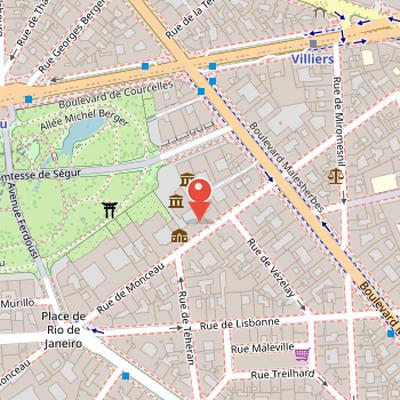
Nearby Objects
-
 Musée Cernuschi 140 m away
 -
 Parc Monceau 250 m away
 -
 Errancis Cemetery 350 m away
 -
 Musée Jacquemart-André 400 m away
 -
 Saint-Augustin 550 m away
The Camondo House and Its Collection
The Musee Nissim de Camondo is located in the hotel particulier de Moise de Camondo in the 8th district of Paris, France, next to Parc Monceau. The building was constructed by Rene Sergent between 1911 and 1914. Inaugurated in December 1936 as a museum of art, it houses a valuable collection of French 18th-century furniture and art objects. The museum preserves a small palace in the state it was inhabited in the early 18th century.
Origins of the Musée Nissim de Camondo
The hotel particulier was built from 1912 by architect Rene Sergent for Moise de Camondo. It replaced a previous building owned by Camondo's parents, which was demolished in 1911 except for the street-facing body. The new residence was inspired by the Petit Trianon of Versailles, and its garden was designed by landscape architect Achille Duchene. Before this reconstruction, the site was known as the Hotel Violet, a building that had also served as a symbol in the literature of Emile Zola, who is said to have studied its architecture and layout while visiting other notable sites in the Plaine de Monceau.
Moise de Camondo installed his collections in the house and continued enlarging them until his death on November 14, 1935. By will, he bequeathed the building and its collections to the Union Centrale des Arts Decoratifs. The property was then to be transformed into the Musee Nissim de Camondo, in memory of his son Nissim (1892-1917), a lieutenant of squadron MF 33 who was shot down in aerial combat on September 5, 1917 over Leintrey, Meurthe-et-Moselle.
A Paris Residence and a Private Collection
After leaving Constantinople in 1869, the family established a bank in Paris and later became prominent collectors and figures in the art world during the Third Republic. Over more than fifty years, they gathered French eighteenth-century art almost exclusively, building a collection through major purchases from private art lovers and families such as baron Jerome Pichon in 1878, baron Leopold Double in 1881, Pierre Decourcelle in 1911, Madame de Poles in 1927, the Stroganov family in 1931, and Georges Blumenthal in 1932. They also assembled a distinctive body of furniture and decorative art from the old French aristocracy, and collected ancient boiseries to frame the works. Beginning in 1890, they were regular clients of the Seligmanns, the well-known Parisian antique dealers of German origin.
The family had a large classical residence built with the latest modern comforts, which was inaugurated in 1914. In spring of that year, the mansion hosted several receptions, and the great hall served as the lively center of events. During these gatherings, the head of the family remained near a small office decorated with porcelain plaques. The building reflected both the collecting ambitions and the social role of the family in Paris.
The family background also included earlier recognition and later loss: in 1867, Victor Manuel II of Italy granted noble rank for financial support to Italian unification, and in September 1917 Nissim, the family son and namesake, died unmarried at age twenty-six in aerial combat.
A Residence Preserved as a Memorial
Moise de Camondo worked until his death in 1935 to reconstruct an aristocratic residence of the eighteenth century, while caring only about his art collection. He aimed to enrich and perfect it to the end, and the museum notes that he never found a more exciting pursuit than chasing unattainable artworks. In 1924, he decided to bequeath his building and its contents to the Museum of Decorative Arts of Paris, as an annex dedicated to the memory of his son Nissim. He entrusted the management to the Union Centrale des Arts Decoratifs, which was linked to the State.
The museum was officially inaugurated by Moise de Camondo's daughter and opened to the public on December 21, 1936. It still displays the collection arranged as Moise de Camondo chose it, according to precise testamentary instructions. He planned the interior configuration meticulously and forbade moving any furniture. He required everything to remain exactly as it was left at his death, so that visitors would have the impression of an inhabited building. He also recommended avoiding handrails and stated that no curator or guardian was to live in the former residence to ensure security. The large portrait of his father by Carolus-Duran and photographs of his son were also not to be moved.
Transformation, Wartime Protection, and Restoration
The final transformation of the mansion into a museum was completed with the arrival of the new manager, Mr. Messelet, together with Mr. Carle Dreyfus. During these last adjustments, fragile vases had to be removed, some armchairs were relocated, and some rugs were rolled up. A photographer also set up heavy objectives in the main entrance hall to preserve the layout of the salons before the changes, since nothing was to remain as it had been. The museum itself later described the portrait and photographs as becoming the ghosts of Rue de Monceau, regardless of their fate.
The museum was associated with the Union Centrale des Arts Decoratifs from 1930, and it was inaugurated post mortem by its creator's daughter at the end of 1936. It was not classified as Jewish property and was exempt from the 1941 Vichy regime expulsion regulations. During the German occupation, its doors were sealed to protect its contents for four years, and the museum was relocated with other important public and private collections to Chateau de Valencay. Its art deposit was entrusted to Gerald Van der Kemp there, but it was nearly destroyed in the fire set by the 2nd SS Division Das Reich.
The museum's history is also marked by the fate of the Camondo and Reinach family members. Beatrice de Camondo and her daughter Fanny were arrested by French police on December 5, 1942, while Leon Reinach and his son Bertrand were arrested in Sentein, after being betrayed by a smuggler. Beatrice de Camondo, Leon Reinach, and their two children were interned in Drancy in 1943. Leon Reinach and his two sons were deported with about 1,200 people in November 1943, and Beatrice de Camondo was deported to Auschwitz in March 1944 in a convoy of 1,501 people and died in January 1945.
In 1985, the Comite pour Camondo was created to sponsor the restoration of the deteriorated palacete. That restoration included reproductions of fabrics and restorations of furniture, paintings, and art objects. Afterward, photography without flash was authorized, and a 1997 work by Assouline drew further attention to the museum and increased its recognition. A photographic portrait of Nissim de Camondo in military uniform now welcomes visitors at the ticket office.
The Entrance Staircase and Its Tapestry
The visit circuit begins in a large stone staircase hall with a wrought iron balustrade made by the Bagues company. The staircase design was inspired by the eighteenth century Hotel Dassier of Toulouse. The staircase void is decorated with a large tapestry titled cancelleria, woven in wool and silk at the Gobelins royal manufactory for Michel Le Tellier. The tapestry series later passed to the marquis of Argenson, who placed his arms on it. A 1954 museum catalog noted five other pieces kept by descendants of the tapestry series. One of these tapestries is now in the Musee des Arts Decoratifs in Paris, while another belonged to the Rochebrune/du Fontenioux collections, first housed in Chateau de Terre-Neuve in Fontenay-le-Comte and later in Chateau de la Court d Aron in Saint-Cyr-en-Talmondais. Those two tapestries were photographed around 1890 and during the twentieth century respectively.
Interior Layout and Decorative Collections
The Musee Nissim de Camondo is organized across a ground floor, a mezzanine floor, and a first floor, with five rooms on the ground floor, seven on the mezzanine, and seven on the first floor. The ground floor reflects Belle Epoque domestic comfort design and includes filtered air heating, compressed air elevators, a vacuum cleaning system, and luminous cornices. The kitchen is especially detailed, with a large cast iron rotisserie next to the central oven and copper utensils displayed on the walls for traditional cooking. A small office has wood paneling impregnated with tobacco smell, probably from the butler.
The entrance hall is traditionally sober in decoration and was the place where footmen waited during receptions. On the first floor, the museum contains family apartments and a bright oak-paneled library with shelves of red morocco-bound books. The library also holds plates bearing the Talleyrand family arms from Valency Castle, which sheltered the museum contents from 1940 to 1945, and it offers a wide view of Parc Monceau and the surrounding urbanized areas and notable hotels particuliers.
Several rooms present major decorative ensembles and artworks. The grand salon and Huet salon display furniture signed by Jean-Francois Oeben, J.-B. Sene, Bernard Van Riesen Burgh, and Jean-Henri Riesener, together with rococo-style bronze appliques and plaques, tapestries, folding screens from the Savonnerie Manufacture, and porcelain from Scevres and Meissen. The grand office on the first floor contains The Smile of a Bacchante by Elisabeth Vigee-Lebrun, while the small office with crimson silk curtains includes a portrait of Jacques Necker and a bust allegorical of Summer by Jean-Antoine Houdon. Other rooms include the large blue salon, once an office with views of Parc Monceau vegetation and furnished in 1924, and the former office of Nissim, decorated with 19th century hunting and equestrian paintings.
The dining room and adjoining porcelain cabinet are notable for tableware and display objects. The collector ate alone in the small porcelain cabinet, which is surrounded by glass cupboards. The museum houses a unique collection of Scevres porcelain tableware from 1784 to 1809, including the Buffon birds set illustrated by Francois-Nicolas Martinet, as well as the soft-paste porcelain Le Fevre tableware purchased by Count de Camondo from antiques dealer Jacques Seligmann. The dining room also displays silverware pieces commissioned by Catherine the Great for her favorite Grigori Orlov, and the museum preserves remnants of a vast silverware set containing more than eight hundred pieces.
Elsewhere, the museum includes bathrooms adjacent to the bedrooms of Moise and Nissim, which are fully tiled and contain faience elements and copper nickel-plated faucets from the Kula house. The father's office is decorated with circa 1780 boiserie from a Bordeaux house and resembles a small Louis XV style boudoir. The residence shows almost no traces of Judaism, although visitors can see Sabbath silver candlesticks in a display case, some Jewish religious works in the small library, and a Star of David in the bottom of a copper gugelhupf mold in the kitchen.