Parc Monceau is a garden in the Europe district of Paris, sometimes called parc de Monceau. Measuring about one kilometer in circumference, it is bordered by boulevard de Courcelles and surrounded by streets and avenues financed by the Pereire brothers, with luxurious hôtels particuliers nearby. The park includes avenues named after painters such as Vélasquez, Ruysdaël, Van-Dyck, Rembrandt, and Murillo, as well as several internal paths and allées.
Its historic elements include a rotunda pavilion designed by Claude Nicolas Ledoux, the Naumachie, an oval basin with a Corinthian colonnade, and columns from the rotonde des Valois installed by Carmontelle. A large Renaissance arcade from the Paris hôtel de ville, destroyed in 1871, is also nearby. The park contains marble statues of writers and musicians, including Maupassant, Chopin, Gounod, Musset, Ambroise Thomas, and Édouard Pailleron. Historically, the site developed from the folly of Chartres and later became an English garden under Thomas Blaikie.
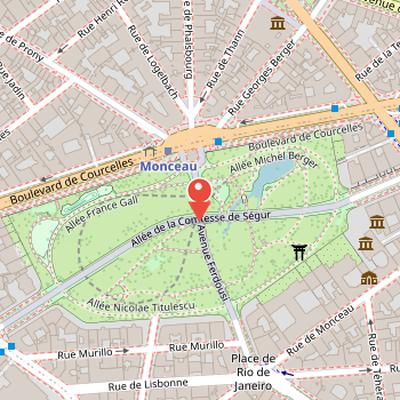
Nearby Objects
-
 Musée Cernuschi 200 m away
 -
 Musée Nissim de Camondo 250 m away
 -
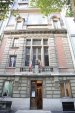 Musée national Jean-Jacques Henner 400 m away
 -
 Musée Jacquemart-André 450 m away
 -
 École Normale de Musique de Paris 500 m away
Location and Name
Parc Monceau is a garden located in the Europe district of Paris. It is sometimes called parc de Monceau. The facts provided identify it primarily by its setting within the city and by the alternate name used for it.
Situation and Access
Parc Monceau is limited on the north by boulevard de Courcelles and is surrounded by streets and avenues financed by the Pereire brothers. It is bordered by luxurious hotels particuliers, some of which face the park directly. The surrounding avenues include several named after major painters, such as Vélasquez, Ruysdael, Van-Dyck, Rembrandt, and Murillo. Within the park, avenues and paths such as avenue Ferdousi, allee de la Comtesse-de-Segur, allee Jacques-Garnerin, allee Michel-Berger, and allee France-Gall cross the site.
The park also contains a rotunda pavilion designed by Claude Nicolas Ledoux, originally from the Fermiers generaux wall. Nearby is the Naumachie, an oval basin decorated with a Corinthian colonnade and with columns from the rotonde des Valois installed by Carmontelle. Close by stands a large Renaissance arcade from the Paris hotel de ville, destroyed in 1871. The site is also marked by marble statues of writers and musicians, including Maupassant by Verlet, Chopin by Froment-Meurice, Gounod and Musset by Merci, Ambroise Thomas by Alexandre Falguiere, and Edouard Pailleron by Bernstamm.
Parc Monceau measures one kilometer in circumference, and a complete park tour is given as 1,040 meters around the children's play area, or 900 meters without contouring it. It is served nearby by metro line 2 at Monceau station and by RATP bus lines 30 and 84.
Design and Early Development of Parc Monceau
Between 1769 and 1773, the folly of Chartres was built at Mousseau as an octagonal pavilion with two floors, surrounded by a French garden. The ground floor was later extended with four star-shaped galleries. From 1773 to 1779, an Anglo-Chinese style garden was created on twenty hectares, with garden structures by Carmontelle. During this phase, a river was dug to feed a large basin used for naval combat representations, and grottos were constructed for games or refreshments. From 1781 to 1793, Thomas Blaikie was entrusted with landscaping the new northern and eastern terrains and with modifications that turned the park into an English garden. The garden received praise from abbe Delille in 1782 and from Luc-Vincent Thiery in 1787. Two watercolor drawings by Claude Mathieu Delagardette, titled Releve du nouveau berceau or jardin d'hiver de Monceau, were dated 1783. In 1787, part of the garden was lost to allow Ledoux to build the barriere de Chartres, a toll pavilion surrounded by sixteen columns. The barriere contained the Ferme generale offices, and its terrace was used by the owner to view the garden. The smooth columns and upper dome were modified in 1861.
Restoration and 19th Century Transformation
After the Revolution, the park was restored to the Orleans family in poor condition. Between 1802 and 1806, the family demolished the folly and built a new pavilion, following tighter plans. The property was later sold and repurchased in 1819. Under the First Empire, Nicolas Frochot, Prefect of the Seine, projected that it would be transformed into a cemetery.
Before 1830, the son of the duke, later Louis-Philippe, King of the French, had the temple of Mars moved to the enchanted garden of Chateau de Neuilly, where it was modified to become the temple of Love at Neuilly-sur-Seine within the historic park setting. In 1860, the opening of Boulevard Malesherbes led the state to expropriate the site, which had been reduced to 18 hectares and some ares. The City of Paris retained part of the property after the expropriation. The park and its surroundings were then landscaped by Adolphe Alphand, engineer of Bridges and Roads in charge of the Promenades service, and inaugurated by Napoleon III.
Gabriel Davioud designed the monumental entrances with large golden gates. Some of the old fabriques were preserved and combined with new elements, including the river and its bridge, the waterfall, and the cave. The cave contains the first artificial cement stalactites, invented by the entrepreneur Combaz. The remaining land was resold in 1861 to the Pereire brothers, who created a housing estate with streets closed by gates. Families including the Pereire, Rothschild, Cernuschi, Menier, and Camondo built grand private mansions with gardens facing the park.
Historical Transformations in Parc Monceau
Parc Monceau has undergone several notable historical uses and changes. The former 'folie de Chartres' was considered by the Pereire brothers as a possible terminus station, in connection with difficulties in expropriations for the expansion of Gare du Nord-Ouest. During the Bloody Week of the Paris Commune, execution squads using the 'batches' system were installed there for summary judgments. A Renaissance arcade from the Paris City Hall, destroyed in 1871, was also installed in the park. Later, the former loop terminus of Metro Line 3 beyond Villiers station, abandoned in 1910, was converted into an RATP training center under the park. Parc Monceau was classified as a protected site by decree, and in 1982 a Japanese lantern, or toro, was placed near the pyramid to symbolize friendship between Paris and Tokyo. At another point, the park was closed to the public while Russian Tsar Nicolas II and his wife Alexandra crossed it from Avenue Velasquez to Avenue Van-Dyck on the way to Rue Daru church.
Parc Monceau in Art
Parc Monceau has been a recurring subject in art, especially in painting and photography. Claude Monet depicted it in six paintings, with three made in 1876 and three more in 1878. Other painters associated with the park include Gustave Caillebotte, who painted it in 1877, as well as Henri Brispot, who painted it in 1908. The park was also painted by Georges Braque, Paul Michel Dupuy, Georges d'Espagnat, and Roger Guit. In photography, Parc Monceau was photographed by Eugene Atget between 1901 and 1902, and its entrance was photographed in 1934. It was also a subject for photographers San Damon and Willy Ronis. These works show the park's continued presence in visual culture across different artistic media and periods.