Errancis Cemetery, also called cimetière de Monceau or cimetière de Mousseaux, was an ancient cemetery of the French Revolution in the 8th arrondissement of Paris. It took its name from a place called “les estropiés” in Old French, from the verb “eraincier,” a term that may have referred to a rest house for convalescents or a kind of hospice.
The Commune of Paris chose the site for a new cemetery at the end of faubourg de la Petite-Pologne. It occupied a wasteland extending from rue du Rocher to folie de Chartres and was surrounded by walls for cultivation. The terrain formed a long square near rue du Rocher, within the former enclosure of the Fermiers généraux and close to the ancien mur d’octroi. During 1794, it first served as an ordinary burial site from May 5 to May 30, then as a burial ground for guillotined people until October 25. It was one of four such cemeteries in Revolutionary Paris, alongside Picpus, de la Madeleine, and Sainte-Marguerite. The cemetery held remains of figures including Charlotte Corday, Madame Élisabeth, and a mass grave for Robespierre, Saint-Just, Georges Couthon, and others.
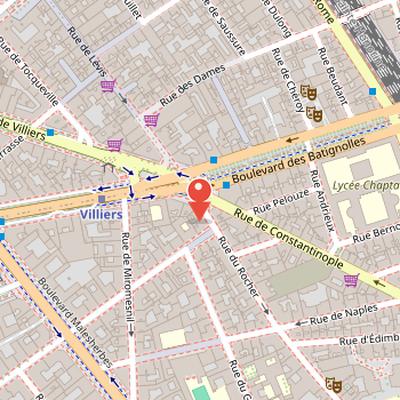
Nearby Objects
-
 Théâtre Hébertot 200 m away
 -
 Musée Nissim de Camondo 350 m away
 -
 Musée Cernuschi 350 m away
 -
 Saint-Augustin 550 m away
 -
 Parc Monceau 550 m away
Names and Revolutionary Use
Errancis Cemetery, also called cimetiere de Monceau or cimetiere de Mousseaux, was an ancient cemetery of the French Revolution located in the 8th arrondissement of Paris. Its name is linked to a place called les estropies in Old French, a term derived from the verb eraincier. This name may have referred to a rest house for convalescents or to a kind of hospice. During the Revolution, Errancis was one of four cemeteries in Paris that received bodies executed by guillotine, along with Picpus, de la Madeleine, and Sainte-Marguerite.
Location and Layout of Errancis Cemetery
Errancis Cemetery was chosen by the Commune of Paris for a new cemetery site at the end of faubourg de la Petite-Pologne. It was established at the place called the close du Christ, on a wasteland extending from rue du Rocher to the folie de Chartres. The site was surrounded by walls used for cultivation and stood near rue du Rocher, within the limits of the enclosure of the Fermiers generaux, now corresponding to boulevard de Courcelles and rue de Monceau. It was also near the ancien mur d'octroi, at the intersection of rue des Errancis and rue de Valois. In plan, the terrain formed a long square bounded on the west by the wall of parc Monceau. The cemetery was shown on Verniquet's plan before 1789, with rue du Rocher ending at rue de la Bienfaisance and rue d'Errancis continuing to the barrier.
Burials and Later Changes
Errancis Cemetery served several burial functions during the French Revolution. It was used as an ordinary burial site from May 5 to May 30, 1794, and then became a burial ground for guillotined people from May 30 to October 25. Among the early burials were Charlotte Corday and Madame Elisabeth, sister of Louis XVI, who was buried there on May 11, 1794. The cemetery also held a mass grave for Robespierre, Saint-Just, Georges Couthon, Fleuriot-Lescot, Payan, Vivier, and other victims of 1794. This mass grave was located in the north of the cemetery along the old chemin de ronde de Clichy wall, now rue de Monceau, and held twenty-two trunks in two carts, with heads placed separately in a large crate. Lebas was also included, since his body was complete due to suicide. Burial costs were recorded as 193 livres plus 7 livres for gravedigger tips, including quicklime used to cover the remains. The cemetery had an entrance sign marked Dormir, enfin. Later, the site replaced Cimetiere de la Madeleine after the Commune of Paris removed elms from the terrain for cemetery use. In the early 19th century, the land hosted a ball until street extensions divided it. Bones found during construction works were transferred to the Paris catacombs.
Burial Practice at Errancis Cemetery
At Errancis Cemetery, the bodies of the executed were placed in communal graves of about fifteen square feet after all clothes and personal effects had been removed. These items were recorded in a register before being handed over to the Hotel-Dieu. The bodies were arranged head to foot in multiple layers, with each layer separated by about six inches of earth. Heads separated from trunks were also used interchangeably to fill gaps in the graves. In some graves, the bodies of the executed were placed together with coffins sent by civil status. The last layer of corpses was covered with about one meter of earth.