The École Normale de Musique de Paris Alfred Cortot, also called L'École normale de musique de Paris - Alfred Cortot or ENMP, is a private higher music school in Paris. Founded in 1919 by pianist and pedagogue Alfred Cortot and pianist and music critic Auguste Mangeot, it was created to train concert performers and teachers. Its early aim also reflected a post-World War I effort to promote French repertoire. The school admitted foreign students who could not easily enter the Conservatoire de Paris.
Its pedagogical program combined concert performance and teaching, with courses in instrumental study, chamber music, orchestral conducting, composition, analysis, theory, music history, general subjects, and pedagogy. Studies lasted six years and ended with a license for either concert or teaching. The school also hosted master classes by numerous musicians, including Hélène Guillou, Reynaldo Hahn, Maurice Hayot, André Hekking, Wanda Landowska, Lazare Lévy, Marguerite Long, Isidore Philipp, Blanche Selva, Igor Stravinsky, and Jacques Thibaud. In its history, the school occupied several sites in Paris and added a concert hall on rue Cardinet in 1929.
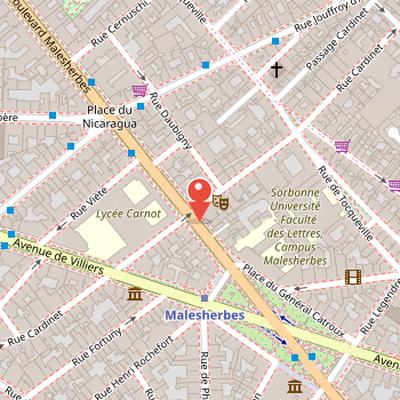
Nearby Objects
-
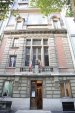 Musée national Jean-Jacques Henner 130 m away
 -
 Musée Cernuschi 500 m away
 -
 Parc Monceau 500 m away
 -
 Musée Nissim de Camondo 650 m away
 -
 Errancis Cemetery 650 m away
A Private Music School in Paris
The Ecole Normale de Musique de Paris Alfred Cortot, also known as L'Ecole normale de musique de Paris - Alfred Cortot or ENMP, is a private higher music school in Paris. It was founded in 1919 by pianist and pedagogue Alfred Cortot and pianist and music critic Auguste Mangeot. The school provides training for concert performers and teachers, giving it a role in professional music education.
Founding, Teaching Model, and Expansion
The Ecole Normale de Musique de Paris Alfred Cortot was created in 1919 at the proposal of the pianist Auguste Mangeot to Alfred Cortot, an internationally renowned concert pianist and piano professor at the Conservatoire de Paris since 1907. Its founding aim was to reduce German musical influence after World War I by promoting French repertoire. The school also accepted foreign students who were difficult to admit to the Conservatoire de Paris.
Its pedagogical program was designed to train both future virtuosos and teachers, with a strong emphasis on instruction by Alfred Cortot. The curriculum offered a dual path toward concert performance or teaching, intended to form complete musicians. Courses included instrumental classes, chamber music, orchestra conducting, composition, analysis, theory, music history, general subjects, and pedagogy. Studies lasted six years and ended with a license for either concert or teaching, in a model comparable to German Musikhochschulen.
In 1921, master classes were given by Hélene Guillou, Reynaldo Hahn, Maurice Hayot, Andre Hekking, Wanda Landowska, Lazare Levy, Marguerite Long, Isidore Philipp, Blanche Selva, Igor Stravinsky, and Jacques Thibaud. These classes were open to the schools students and to laureates of French or foreign conservatories.
The school later expanded its premises. It had an annex on rue dAthenes and moved to the corner of boulevard Malesherbes in 1927. In 1929, classrooms were supplemented by a concert hall on rue Cardinet. That hall hosted the schools chamber orchestra under the musical society of the Private Concerts of the Ecole normale founded by Alfred Cortot. Between 1930 and 1937, students performed contemporary music programs by composers such as Bohuslav Martinu, Ottorino Respighi, and Georges Enesco, and accompanied soloists including Zino Francescatti, Dany Brunschwig, and Georges Blanpain.
Teaching Tradition and Musical Leadership
The history of the Ecole Normale de Musique de Paris Alfred Cortot is closely tied to its educational and artistic activity under Alfred Cortot. The institution organized sixty-two private concerts in which Cortot played or conducted, and it also held one hundred eighty-three public classes conducted by him. Cortot's teaching was supported by a group of assistants including Jules Gentil, Eva Dumesnil, Blanche Bascourret, Gabrielle Giraud-Latarse, and Magdeleine Panzera-Baillot. The school also published pedagogical works by Cortot, among them Les Principes rationnels de la technique pianistique and seventy-six Editions de travail on Romantic period piano masters. His last public class, devoted to Beethoven's Sonatas, marked a final stage in this activity. In 1939, Andre Bernheim was appointed administrator-delegate and Cortot became president, and in 1943 Cortot bought shares totaling 792. After Cortot's death, the school was directed in succession by Joseph Morpain, Jacques Feschotte, Pierre d'Arquennes, and Pierre Petit, and its presidents included Serge Sandberg, Charles Munch, Henri Dutilleux, and Remy Boissonnas. The poet Paul Valery referred to the institution as la maison d'or, reflecting its cultural reputation.
Buildings and Heritage
The school is installed at number 64 rue Jouffroy in Paris. This building was donated to Alfred Cortot by the marquise de Maleissye in 1927. It had been built in 1881 by architect Leopold Cochet for the Rozars family. A second building at 8 rue d'Athenes is used for student concerts. The interior decorations of the ground floor and two upper floors are protected by a classified order.
Salle Cortot: Architecture and Cultural Role
Salle Cortot is the concert hall adjacent to the Ecole Normale de Musique de Paris Alfred Cortot, located at 76 and 78 rue Cardinet. It was constructed by Auguste Perret on the site of the stables of the hotel Rozars. The hall is built of exposed reinforced concrete and features gilded columns and balconies. Its seating capacity is 400, with a stage designed for up to 25 musicians.
When it opened, Salle Cortot drew critical attention for its innovative architecture and exceptional acoustics. Its small size and ingenious layout led to a nickname that reflected these qualities. The hall also served as the venue for the concert premiere of Pierre Schaeffer's Symphonie pour un homme seul. In recognition of its heritage value, Salle Cortot was classified as a historic monument by decree on October 9, 1999.
Current Teaching and Organization
Today, the Ecole Normale de Musique de Paris Alfred Cortot is chaired by Xavier Moreno and directed by Murielle Hurel-Mezghrani. Marc-Antoine Pingeon has served as director of studies since 2018. The school enrolls 800 students each year and has a teaching staff of 130 professors across classical music disciplines. Its instruction covers instrumental and vocal fields including viola, singing, clarinet, double bass, transverse flute, piccolo, guitar, harp, oboe, piano, violin, and cello. It also provides theoretical and specialized or complementary training in accompaniment, musical analysis, composition, orchestral conducting, musical awakening, musical training, music history, and chamber music. The institution is recognized by the Ministry of Culture.