The Musée national Jean-Jacques Henner is dedicated to the work of French painter Jean-Jacques Henner and belongs to the French national museums. It is located in a former mansion in the Plaine-de-Monceaux district of the 17th arrondissement of Paris. The museum opened to the public in 1924 following a donation to the French State by Marie Henner in 1923.
The building itself has a history linked to several owners and alterations. It was originally built as a townhouse for the painter Roger Jourdain at 43 avenue de Villiers between 1876 and 1878, then bought by painter Guillaume Dubufe in 1878. The museum’s collection also reflects earlier efforts to preserve Henner’s work, including a Henner room opened at the Petit Palais in 1906 and the first retrospective of his work held in Paris in 1907. In 1921, Marie Henner, widow of Jules Henner, acquired the townhouse from Guillaume Dubufe’s heirs, rearranged it into a museum, and donated it to the State together with 440 paintings, furniture, and objects by the painter. The museum later received many additional donations and legacies.
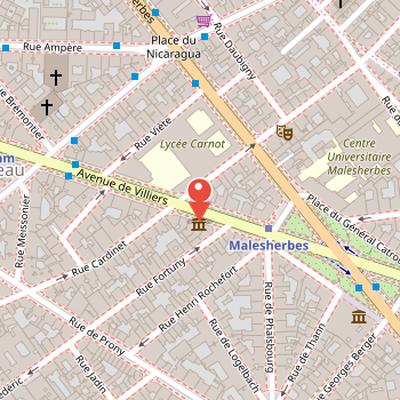
Nearby Objects
-
 École Normale de Musique de Paris 130 m away
 -
 Parc Monceau 400 m away
 -
 Musée Cernuschi 450 m away
 -
 Musée Nissim de Camondo 600 m away
 -
 Errancis Cemetery 700 m away
Museum History and Location
The Musee national Jean-Jacques Henner is dedicated to the work of French painter Jean-Jacques Henner. It opened to the public in 1924, following a donation to the French State made by Marie Henner in 1923. The museum is part of the French national museums. It is located in a former mansion in the Plaine-de-Monceaux district of the 17th arrondissement of Paris.
History of the Townhouse and Museum
The building at 43 avenue de Villiers was designed by architect Nicolas-Felix Escalier and built between 1876 and 1878 as a townhouse for the painter Roger Jourdain. In 1878, painter Guillaume Dubufe bought the property from Jourdain. Henner later dined there three times in 1878 and 1879. In 1888, Dubufe bought moucharabiehs from the Goupil collection and installed them in the first-floor studio.
The site also became connected to the reception of Henner's work in Paris. In 1906, a Henner room was opened at the Petit Palais with about thirty artworks, most of them donated by Jules Henner, the artist's nephew. The first retrospective of Henner's work was held in Paris at Cercle Volney in 1907. In 1921, Marie Henner, widow of Jules Henner, bought the townhouse from Guillaume Dubufe's heirs.
Donation, Museum Opening, and Later Renovations
Marie Henner donated the townhouse to the State after rearranging it into a museum. The donation included four hundred forty paintings, furniture, and objects by the painter, and the State accepted the gift and named the institution the Musee national Jean-Jacques-Henner. The museum opened to the public in 1924, and Many Benner, a student of Henner, became its first curator. The museum also received many later donations and legacies, which expanded its holdings over time.
The building itself was modified in 1935, when the townhouse was raised by two floors under architect Andre Arfvidson. In later decades, the museum continued to present Henner's work through exhibitions and publications, including Les Entretiens de J.-J. Henner notes by Emile Durand-Graville in 1925, a museum painting catalogue first published in 1990 and reissued in 2003, and the exhibition J.-J. Henner, la Jeunesse d'un peintre at the Mulhouse Museum of Fine Arts in 1989. Another exhibition, Face a l'impressionnisme, Jean-Jacques Henner, le dernier des romantiques, was organized at the Musee de la Vie romantique in Paris in 2007. The museum also published Isabelle de Lannoy's Catalogue raisonne des peintures de Henner in 2008.
The museum underwent a first renovation campaign between 2001 and 2002, and further renovation works were directed by architect Jean-Francois Bodin from 2008 to 2009. It reopened after these works, later closed again for major works including winter garden rehabilitation, and then reopened once more. In 2024, the museum acquired Salome, variante tardive, a 1904 painting, through crowdfunding.
The Museum Displays
The collections extend across three floors and include nearly three hundred works, along with furniture and objects. They are organized around two main themes: the career of an official artist and the painter's studio. The former dining room serves as an introductory space, with educational tools on the history of the Plaine-de-Monceaux district and on Jean-Jacques Henner's life. The columned salon presents large formats, portraits, and the Jean-Jacques Henner painting collection, while the winter garden is used for temporary exhibitions, concerts, and shows.
On the first floor, two small red rooms focus on Henner's early career in Alsace, his training years, the Rome Prize, and his stay in Italy. The first room is arranged around Eugenie Henner en Alsacienne tenant un panier de pommes, which highlights his links to Alsace, and also shows portraits, scenes of daily life, and Alsatian landscapes in a dense display. The second room includes the Rome Prize work Adam et Eve trouvant le corps d'Abel, the large landscape Le Pincio, Rome, terrasse de la villa Medicis, Portrait de jeune fille, sketches prepared for sending to Rome, and small-format Italian landscapes.
The red studio is devoted to Henner's official career. It presents L'Alsace, elle attend, works shown at the Salon such as Joseph Tournois, Portrait de *** dit La Femme au parapluie, Le Sommeil, Seraphin Henner, and Saint Sebastien, as well as sketches and replicas linked to Eglogue, La Fontaine, and La Source. This room also recalls the artist's social life and his work as a portraitist. On the second floor, a small room behind the moucharabiehs is used mainly for graphic arts exhibitions. The third-floor gray studio returns to the studio theme, with sketches and unfinished works including Hérodiade, Rebecca, L'Enfant prodigue, and La Verite, alongside the monumental Les Naiaides and furniture and objects from Henner's studio, such as a desk, painting furniture, a palette, a psyché, and an inkwell.
Collections and Loans
The museum's collections have grown over time through private donations and bequests. They include paintings and sculptures from the artist's own collection, featuring works by Paul Dubois, Adolphe Monticelli, Felix Trutat, Antoine Vollon, Francois-Joseph Heim, Jean Benner, and Many Benner. The collections also display furniture and objects that belonged to the artist. Among the notable acquisitions is Portrait de la Comtesse de Callac, bought in 1998. Two works, Saint Sebastien and Solitude, are on loan from the Louvre and Orsay museums. The graphic arts holdings comprise about 1,300 drawings, as well as engravings and photographs, and are shown in rotation during temporary exhibitions.
The Hotel Particulier as Museum
The Musee national Jean-Jacques Henner is installed in a hotel particulier built between 1876 and 1878 by architect Nicolas-Felix Escalier. It was originally the home and workshop of the painter Guillaume Dubufe, and part of Dubufe's eclectic decor has been preserved. The large red workshop on the first floor was given an oriental atmosphere by Egyptian moucharabiehs. As one of the rare surviving examples of private architecture under the Republic that is open to the public, the building has both architectural and historical interest.
In 1921, Marie Henner, the widow of the artist's nephew, bought the house from Dubufe's heirs in order to present Jean-Jacques Henner's collection. Later, modernization works in 2008 and 2009 improved public access and restored the original appearance of the building. During this campaign, the elevator built in the 1930s was moved, and walls painted white in the 1960s and 1970s recovered their original polychromy. The museum reopened after these renovations.
A second phase of work began in 2014, led by OPPIC and architect Sylvie Jodar. The new exhibition layout extends across four levels of the building and presents different aspects of Jean-Jacques Henner and his workshop. These works also revealed the winter garden mosaic, which had been covered by a concrete slab in 1922 by Marie Henner. The winter garden and the column salon on the ground floor were completely restructured with a new glass roof, while spaces used for temporary offices and the upper floors from the 1935 elevation still remained to be treated.
Administrative Status and Institutional Changes
In 2005, the Musee national Jean-Jacques Henner became an etablissement public national a caractere administratif. It is placed under the authority of the minister in charge of culture. A new etablissement was created in 2017, bringing together the Musees nationaux Jean-Jacques-Henner and Gustave-Moreau.