Musée Jacquemart-André is a museum of fine arts and decorative arts located at 158 boulevard Haussmann. It opened to the public in 1913 and is owned by the Institut de France. Since 1996, it has been managed by Culturespaces, which also oversees visitor services, communication, and the museum’s tea room and shop.
The museum was originally the private residence of wealthy art collectors and was designed to preserve the original layout of the hôtel particulier. Édouard André commissioned architect Henri Parent in 1868 for a second hôtel, built from 1869 to 1875 as a festive and reception residence with modern amenities and theatrical decor. Édouard André and Nélie Jacquemart arranged their home to display their acquisitions. Their collection was intended to include paintings, sculptures, tapestries, and 18th-century art objects, while Nélie Jacquemart focused especially on Italian painting from the 13th to the Renaissance period. The building’s boulevard façade is framed by two pavilions and decorated with pilasters, with a central rounded projection inspired by the Petit Trianon.
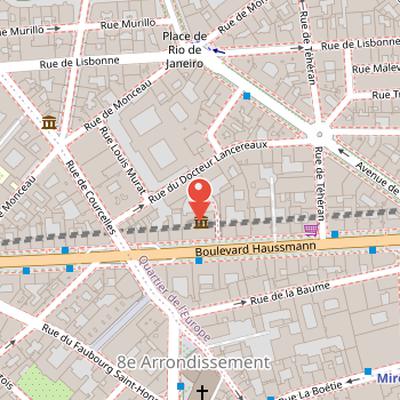
Nearby Objects
-
 Boulevard Haussmann 250 m away
 -
 Musée Nissim de Camondo 400 m away
 -
 Parc Monceau 450 m away
 -
 Musée Cernuschi 500 m away
 -
 Saint-Augustin 600 m away
Museum Location and Management
The Musee Jacquemart-Andre is a museum of fine arts and decorative arts located at 158 boulevard Haussmann. It opened to the public in 1913. The museum is owned by the Institut de France and has been managed by the society Culturespaces since 1996.
From Private Residence to Museum
The Musée Jacquemart-Andre began as a private residence for wealthy art collectors and was later turned into a museum that preserves the original layout of the home. It has been installed since 1864 at the hotel de Saint-Paul, 3 rue Roquepine. In 1868, Edouard Andre commissioned architect Henri Parent to design a second hotel particulier, after inheriting one of the greatest fortunes of the Second Empire from southeastern France, Nimes, and acquiring the land for a considerable sum of money. Construction took place from 1869 to 1875, and the building was conceived as a festive and reception hotel with modern amenities and theatrical decor.
Edouard Andre also shaped the cultural identity of the house through collecting and publishing activities. In 1872, he purchased the Gazette des beaux-arts and led the Union centrale des arts decoratifs. He planned a collection that would include paintings, sculptures, tapestries, and 18th-century art objects. After his marriage to Nelie Jacquemart in 1881, she contributed to the collecting project, concentrating on Italian painting from the 13th to the Renaissance periods. The home was arranged by the couple to display their acquisitions, and the museum collection includes 124 Italian works out of 137 Italian paintings preserved in Paris.
Since 1995, museum management has been entrusted to Culturespaces, which organizes exhibits, visitor services, communication, and also operates the tea room and shop. Restoration work began in autumn 2023 on a Tiepolo fresco and on the marbles and bronze of the stairway.
Architecture and access
The Musee Jacquemart-Andre occupies an hotel particulier with a high terrace built on a base facing the boulevard, where two coach doors are set. The right coach door serves as a covered porch and leads to the cour d'honneur. The boulevard Haussmann facade is framed by two pavilions and decorated with pilasters, and it includes a central rounded projection inspired by the Petit Trianon. Secondary accesses were also provided from rue de Courcelles and from impasse Emery, the latter later being incorporated into square de Messine, now rue du Docteur Etienne Lancereaux.
The courtyard is enclosed by a hemicycle wall with piers and blind arcades. A central arch in this wall gave access to a riding arena, a saddle room, stables for 14 horses, and a coach house for thirteen carriages. On the cour d'honneur, the main facade has a central projection with semicircular windows and four Ionic columns. It is reached by a staircase flanked by two seated lions and two large lampposts. The sides of the facade rise in two levels with rectangular openings, and are finished by a cornice and a balustrade with stone vases. Above the central projection, a large painter's studio window is topped by a triangular pediment.
Collections of Paintings and Decorative Arts
The collections at the Musee Jacquemart-Andre consist mainly of Italian and French paintings, together with Dutch, Flemish, and English paintings. They also include sculptures, furniture, and art objects. Among the notable works preserved in the museum are Saint Georges terrassant le dragon by Paolo Uccello, dated 1439 to 1440; Vierge a l'Enfant by Sandro Botticelli, from around 1470; and Vierge a l'Enfant avec trois saints by Andrea Mantegna, from around 1485. The collection also includes L'Ambassade qu'Hippolyte, la reine des Amazones envoie a Thesee, roi d'Athenes by Vittore Carpaccio, from around 1495, and Les Pelerins d'Emmaus by Rembrandt, from 1629. Later works represented in the collection include the portrait of Francoise-Renee de Canisy, marquise d'Antin by Jean-Marc Nattier, exhibited at the Salon de 1738; Les Debuts du modele by Jean-Honore Fragonard from 1769; the portrait of the comtesse Catherine Skavronskaia by Elisabeth Vigee Le Brun from 1790; and the portrait of the comte Antoine Francais de Nantes by Jacques-Louis David from 1811.
Recent Exhibitions at the Musee Jacquemart-Andre
The Musee Jacquemart-Andre has recently presented a wide range of exhibitions focused on major artists, schools, and collections from art history. Its program has included Fragonard, les plaisirs d'un siecle; Art d'Afrique et d'Oceanie; Van Dyck; Les primitifs italiens. La collection d'Altenbourg; Brueghel, Memling, Van Eyck. La collection Brukenthal; Du Greco a Dali. Les grands maitres espagnols de la collection Perez Simon; Rubens, Poussin et les peintres du XVIIe siecle; Dans l'intimite des freres Caillebotte; Fra Angelico et les Maitres de la lumiere; Le Crepuscule des Pharaons, Chefs-d'oeuvre des dernieres dynasties egyptiennes; Canaletto - Guardi, Les grands maitres venitiens; Eugene Boudin; Desirs et volupte a l'epoque victorienne. Alma-Tadema, Leighton, Burne-Jones; Rembrandt intime; La collection Alana, Chefs-d'oeuvre de la peinture italienne; and Turner, peintures et aquarelles. Together, these exhibitions show an emphasis on European painting, with additional attention to African and Oceanian art and ancient Egyptian works.
Recent Exhibitions
The Musee Jacquemart-Andre has recently presented a series of temporary exhibitions that reflect a broad range of artistic themes and periods. These included Botticelli, artiste et designer, Gallen-Kallela, mythes et nature, Fussli, entre reve et fantastique, Giovanni Bellini, Influences croisees, Chefs-d'oeuvre de la galerie Borghese, and Georges de La Tour, entre ombre et lumiere. Together, these exhibitions indicate the museum's continued role as a venue for art history presentations with a focus on individual artists, influences, and major works.