Saint-Augustin is a large French church located in the 8th District of Paris, just behind Place de la Madeleine near the Saint Augustin metro station. Designed by Victor Baltard and built between 1860 and 1871, it was one of the first large buildings in Paris to use a metal structure. The church measures nearly 100 meters in length and has a dome over 60 meters tall. Its proportions were shaped by the irregular site at a four-street intersection and by the need for visibility from the surrounding urban axes.
The facade features the four evangelists on arcades, with the twelve apostles above them and a rose window higher up. The stained glass windows depict bishops and martyrs from the early centuries. The interior includes paintings by William-Adolphe Bouguereau, Jean-Hippolyte Flandrin, Émile Signol, and Alexandre-Dominique Denuelle, as well as sculptures by Albert-Ernest Carrier-Belleuse and Henri Chapu. A statue of Joan of Arc by Paul Dubois was erected in front of the church in 1896. The church was also the site of the conversion of Charles de Foucauld by priest Henri Huvelin.
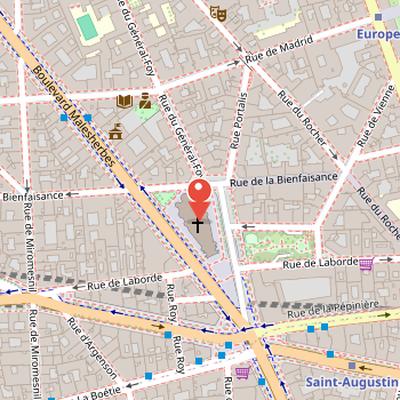
Nearby Objects
-
 Chapelle Expiatoire 400 m away
 -
 Madeleine Cemetery 400 m away
 -
 Errancis Cemetery 550 m away
 -
 Musée Nissim de Camondo 550 m away
 -
 One-Two-Two 600 m away
Architecture and Interior Art
Saint-Augustin is a large French church in the VIII District of Paris, built between 1860 and 1871 by Victor Baltard. It measures nearly 100 meters in length and has a dome more than 60 meters high. The church was one of the first large buildings in Paris to be constructed with a metal structure. It stands just behind the Place de la Madeleine, near the Saint Augustin metro station.
The facade is organized with the four evangelists on arcades, the twelve apostles above them, and a rose window at the top. Inside, the stained glass windows depict bishops and martyrs from the early centuries. The church also contains paintings by William-Adolphe Bouguereau, Jean-Hippolyte Flandrin, Emile Signol, and Alexandre-Dominique Denuelle, as well as sculptures by Albert-Ernest Carrier-Belleuse and Henri Chapu. In front of the church stands a statue of Joan of Arc by Paul Dubois, erected in 1896.
Saint-Augustin also has historical significance as the site of the conversion of Charles de Foucauld by priest Henri Huvelin, and Foucauld was canonized in 2022.
Haussmann's Urban Setting
During Napoleon III's reign in the 1850s and 1860s, Paris was transformed under Georges-Eugene Haussmann's direction. Haussmann opened many wide and straight boulevards through medieval Paris and often placed prominent public buildings at the ends of these new routes to create impressive perspectives. Boulevard Malesherbes opened northwest from La Madeleine, forming part of this reconfigured urban fabric.
Design, Site, and Historical Role
Saint-Augustin in Paris was designed by Victor Baltard, who also designed the Les Halles market. The church was built from 1860 to 1871 in the Petite Pologne neighborhood, now Place Saint-Augustin, near Haussmann's birthplace. Its setting at the intersection of Boulevard Haussmann and Boulevard Malesherbes, on an irregular lot formed by four streets, strongly shaped its proportions. The dome height of 60.0 m was a key factor in the final design, and the building was intended to be visible from the Arc de Triomphe looking down Avenue de Friedland. Historia notes that the church was meant to provide a contrast to the columns of La Madeleine at boulevard Malesherbes.
Baltard's use of iron in the structure was praised for its inventiveness, although some critics described the church as monstrously proportioned under a large dome. During construction, the surrounding area saw luxury mansions, and the neighborhood is now one of the most expensive in Paris. In January 1867, Abbot Langenieux was transferred to Saint-Augustin and accelerated the works, while also building a large rectory with rooms for clergy.
The church also acquired historical significance through its imperial and religious associations. Napoleon III chose its crypt for the burials of imperial family princes before Saint Denis basilica. Later, Saint-Augustin was the site where Carlos de Foucauld's conversion was triggered by Father Henri Huvelin. Its present location at a major road junction also means that heavy traffic noise can be heard inside the church.
Architecture and Design
Saint-Augustin was constructed by Victor Baltard, the architect of Les Halles de Paris. Its originality lies in its structure rather than in its eclectic style. The building's eclectic style was inspired by Romanesque and Byzantine art, but it is the structural design that is presented as its most distinctive feature.
Architecture and Structural Design
Saint-Augustin in Paris was the first building of its size to use a metal framework, and it exemplifies the construction technology and technical-aesthetic interests of its time. The church was built on a triangular plot, which shaped an original floor plan. Its design adapted to this site with a narrow and tall front and a wide tribune behind. The facade has a two-pitched design and is preceded by a short flight of stairs. The building measures almost 100 meters in length, and its dome rises to more than 60 meters in height.
The church does not have the usual buttresses because of its fully self-supporting metal structure. This structure is not entirely hidden by stone cladding, but is integrated into the decorative apparatus. The interior columns and iron ribs are exposed and also serve decorative functions. Saint-Augustin shows a particular form of Eclecticism with clear neo-Romanesque and neo-Byzantine references. Its side chapels regularize the volume of the nave and become more imposing closer to the choir, while the building features a narrow facade and a large choir. Its unusual relationship to the site also led to criticism that urban planning should have served architecture, not the opposite.
Facade and Interior Structure
The facade is organized around a large semicircular arch resting on two large lateral pillars, which are decorated with statues of Moses, Saint Thomas Aquinas, Elijah, and Saint Augustine. Its lower part opens onto three arcades that provide access to the porch, and these three arcades correspond to three portals topped by paintings representing the theological virtues. The pillars supporting the three arches bear the symbols of the four evangelists. Under the rose window, the porch arcade is topped by a high relief showing Jesus among the twelve Apostles.
The interior hall consists of a single nave with seven arcades on each side. The first five arcades on each side correspond to progressively larger side chapels moving from the counter-facade toward the tribune. The vault is supported by cast iron low arches resting on slender columns of the same material, whose upper parts carry statues of angels. Above the nave, the upper wall has a matroneum triforium and, above it, the clerestory. The clerestory is made up of large semicircular arched windows with polychrome stained glass depicting bishops and martyrs from the early centuries by Charles-Laurent Marechal.
The tribune is marked by a high dome with a drum of large semicircular windows alternating with Corinthian columns, supported by four octagonal bell tower towers. It includes three polygonal apses opening to one large central octagonal crossing. At the base of the dome are four painted medallions representing the evangelists. The central elevated presbytery contains the main altar crowned by a gilded cast iron ciborium. The lantern, made entirely of cast iron, was harshly criticized during the Franco-Prussian War from July 1870 to May 1871.
Interior Decoration and Chapels
The interior of Saint-Augustin includes a set of painted and sculpted devotional elements arranged around the nave and the lateral apses. The vaults of the two lateral apses contain frescos by William Bouguereau showing scenes from the lives of Saint John the Baptist and Saint Augustine. These apses are divided into two levels by a matroneum, with the lower level used as chapels. The right lower chapel is dedicated to Saint Joseph, while the left lower chapel is dedicated to the Sacred Heart of Jesus and contains a statue under a canopy. The axial chapel is dedicated to the Virgin Mary and has a marble statue of the Virgin and Child by Leon Jaley. In the nave, paintings by Diogene Maillart, The Baptism of Saint Augustine and The Death of Saint Monica, are displayed. The church also contains a statue of Saint Augustine by Jean-Marie Bonnassieux and a pulpit.
The Organs of Saint-Augustin
The organs of Saint-Augustin in Paris were built by the manufacturer Charles Spackman Barker, who invented the Barker machine, a device that changed transmission methods. The instruments were constructed between 1867 and 1868 and inaugurated on Wednesday, June 17, 1868. They also integrated electricity, reflecting technical developments in organ building.
The main organ was expanded or restored several times, first by Cavaille-Coll in 1899, then by Beuchet-Debierre in 1961, and later by Dargassies in 1987. The choir organ is a Cavaille-Coll-Mutin instrument from 1899. It was reworked by Danion-Gonzalez in 1973 and again by Dargassies in 1983. This choir organ has 2 keyboards of 61 notes each, a pedalboard of 32 notes, electric transmissions, and 30 stops, 21 of which are real.