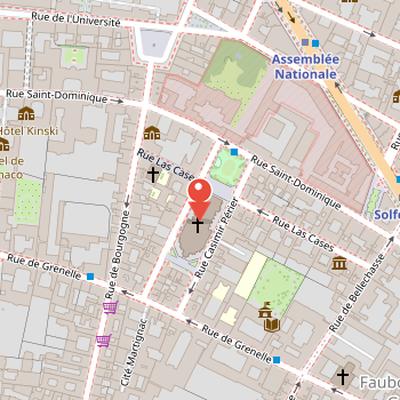
Sainte-Clotilde Church, on Rue Las Cases in the 7th arrondissement of Paris, was constructed between 1846 and 1857 on the site of an earlier Carmelite monastery. Designed by Franz Christian Gau and completed by Théodore Ballu after Gau’s death, it was the first church built in the neo-Gothic style in Paris. Ballu also extended the front of the church and added the two towers. The church was opened on 30 November 1857 by Cardinal Morlot.
Its west front is in the Flamboyant Gothic style and features three portals set in bays with high pointed arches and sculptural decoration. The two tower spires rise to a height of seventy meters, and statues on thrones depict Saint Clotilde and Saint Valere. Named after Saint Clotilde, wife of King Clovis I, the church was declared a minor basilica by Pope Leo XIII in 1896, commemorating the anniversary of Clovis’s conversion in 496. César Franck served as organist for thirty years. The basilica’s design was later copied by Léon Vautrin for the facade of the Sacred Heart Cathedral in Guangzhou.
Nearby Objects
-
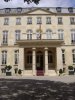 Hôtel Beauharnais 350 m away
 -
 Musée Rodin 400 m away
 -
 Palais Bourbon 400 m away
 -
 Hôtel Biron 400 m away
 -
 Palais de la Légion d'Honneur 450 m away
Neo-Gothic Church on Rue Las Cases
Sainte-Clotilde Church, constructed on Rue Las Cases in the 7th arrondissement of Paris between 1846 and 1856, was built as the first neo-Gothic style church in the city. It was named after Saint Clotilde, the wife of King Clovis I, who is associated with persuading him to convert to Christianity in 496. The church also had César Franck as its organist for thirty years, adding to its cultural significance.
Construction and Architectural Significance
Sainte-Clotilde Church was constructed between 1846 and 1856 on the site of an earlier Carmelite monastery. Its original design was drawn up by Franz Christian Gau, a German-born French architect and archeologist, and work began in 1846. After Gau died in 1853, Théodore Ballu continued the project and completed the church in 1857. Ballu also extended the front by several meters and added two towers. The church was opened on 30 November 1857 by Cardinal Morlot.
The church is significant as the first example of a church in the neo-Gothic style in Paris. In 1860, Ballu was named architect of religious buildings for the city of Paris, and he later completed a series of other neo-Gothic churches. In 1896, Pope Leo XIII declared Sainte-Clotilde a minor basilica, commemorating the anniversary of the conversion of Clovis in 496. The basilica design was later copied by Leon Vautrin for the facade of the Sacred Heart Cathedral in Guangzhou, which was constructed between 1863 and 1888.
Exterior and Architectural Design
The exterior of Sainte-Clotilde Church is dominated by a west front in the Flamboyant Gothic style. Its facade has three portals set in bays with high pointed arches and sculptural decoration, while the two towers are topped by spires reaching a height of seventy meters. The west front also includes statues on thrones depicting Saint Clotilde and Saint Valere, the latter identified as the Bishop of Treves in the 3rd century. These figures indicate the important role both saints played in the early French Christian church.
The church's semi-circular chevet is ringed by buttresses and pinnacles supporting the walls. These elements were modeled after those of a Gothic cathedral, although they are decorative because the structure was built with an iron frame designed by Gustave Eiffel. The use of this frame allowed the apse buttresses and pinnacles to function as part of the exterior design rather than as primary structural supports.
Interior Layout and Chapel Arrangement
The interior of Sainte-Clotilde Church measures 96 metres long and 39 metres wide. It is marked by an abundance of light from stained glass windows high on the walls. The outer aisles are separated from the nave by an arcade of tall classical pillars, which form pointed arches and branch out into slender colonettes that support the ceiling vaults.
The nave walls are divided into three horizontal levels. At ground level, they include a gallery with high pillars and pointed arches. Above this is a triforium without windows, and the upper level is filled with stained glass windows between the triforium and the vaults. This arrangement gives the nave a layered vertical structure while emphasizing light and height.
Behind the altar, the apse contains five chapels accessed from the ambulatory. The central chapel is the Chapel of the Virgin, and the others are dedicated to Saint Joseph, Saint Remi, Saint Louis, and the Holy Cross. The Chapel of the Holy Cross includes red banners with Chinese characters, recalling the design model for Sacred Heart Cathedral in Guangzhou, China. Two chapels face each other on opposite sides of the choir: the Chapel of Saint Clotilde and the Chapel of Saint Valere.
Interior Decoration and Artistic Program
The artwork and decoration of Sainte-Clotilde Church were designed to recreate the spirit of a medieval Gothic cathedral. This decorative program was commissioned and funded by the Paris prefecture of the French government, and artists were selected through competitions announced by the Commission of Fine Arts of the Paris prefecture. The result was not marked by many examples of originality or stylistic innovation, but it achieved a very high level of artistic quality and craftsmanship.
The church interior brings together works by several prominent Paris artists of the mid-19th century. Its stained glass windows were made by Thibaut, while paintings by Jules Eugene Lenepveu appear in the church, including fresco scenes from the life of the Virgin Mary in the Chapel of the Virgin. Désire Francois Laugee contributed frescoes of The Baptism of Clovis and Sainte-Clotilde aiding the poor. Sculpture also plays a major role in the decoration, with works by James Pradier and Francisque Joseph Duret, as well as a series by Jean-Baptiste Claude Eugene Guillaume representing the conversion of Valerie of Limoges, her condemnation to death, her decapitation, and the appearance of Saint Martial.
The exterior and interior were given very fine sculpture inspired by Gothic cathedral sculpture. Architects Francois-Chretien Gau and Theodore Ballu recreated the Gothic style of the 14th century, with particular inspiration from the decoration of Saint-Ouen Abbey in Rouen. The church includes portal statues and portals on the west front, as well as a sculpture of Christ showing his wounds. Among the interior features are a series of seven bas-reliefs on the left aisle titled Stations of the Cross by James Pradier, rendered in a distinctive neo-classical style, and bas-reliefs on the right aisle by Francisque-Joseph Duret following Pradier's style.
Other elements of the decorative program include the sculpture Sainte Clothilde, made in 1854 by Eugene Guillaume and painter Alexandre Denuelle, in stone painted and gilded with enamel and glass. Theodore Lechesne created an angel on the benitier, or holy water vessel, while Theodore Ballu designed the carved choir stalls and the pulpit to capture the spirit of 14th-century Gothic art. Additional works include the Baptismal Font, altar sculpture in the Chapel of Saint Valere, a Virgin and Child by Henri Joseph de Triqueti in the Chapel of the Virgin, and a sculpture of Pope Jean-Paul II.
Stained Glass Decoration
Art and Decoration produced several stained glass elements for Sainte-Clotilde Church, including the rose window in the left transept by Emile Thibaut. The same workshop also created windows showing Blanche de Castille teaching the future King Louis IX, the crowning of the Virgin Mary, an angel musician, and Saint Radegonde. Many of these windows were made through the collaboration of the artist d'Amaury Duval and the master glass maker Antoine Lusson (fils).
The stained glass was commissioned and designed to capture the spirit of a 14th-century Gothic church while using modern techniques. A notable feature of this work was the use of enamel pigments fired to fuse with the glass, producing greater realism and three-dimensional effects.
Rectors and Vicars of Sainte-Clotilde
Sainte-Clotilde Church was associated with a number of rectors and vicars whose names are linked to its pastoral history. Among them was Abbot Arthur Mugnier, remembered as the confessor of the duchesses and noted for leaving a diary. Abbé Henri Chaumont served as vicar from 1869 to 1874, and the records connected him with Caroline Carré de Malberg in the founding of the Society of the Daughters of Saint Francis de Sales in 1872. The same records note that the mother-house of this society later moved to Lorry-les-Metz.
The church also had Abbé Albert Colombel as its first vicar in 1914. In the post-war period, Abbé Bernard Bouveresse served as parish priest and rector until his death; he was also a member of the Resistance. Later, in 1993, Abbot Alain Maillard de La Morandais served as rector and was appointed chaplain of the parliamentarians in the same year.
The church appears again in records linked to pastoral work in political circles. Cardinal Jean-Marie Lustiger created the Pastoral Service for Political Studies in 1992 and entrusted its direction to Father Antoine de Vial in 1995. Father Antoine de Vial received the Pontifical Prelature in 2001. Father Matthieu Rouge held both positions from 2005 to 2012. In September 2012, Father Laurent Stalla-Bourdillon was appointed rector of Sainte-Clotilde Church and also named director of SPEP; he had previously been vicar of the church of Saint-Germain-des-Pres.
The Sainte-Clotilde Organ and Its Musical Influence
From 1859 to 1890, the organist performed on the Aristide Cavaille-Coll organ at Sainte-Clotilde as organiste titulaire. The organist also expressed a strong love for the instrument to the cure of Sainte-Clotilde. The organ concerts held at the church were attended by Franz Liszt and other composers, and these performances influenced the development of church organ music in Europe.