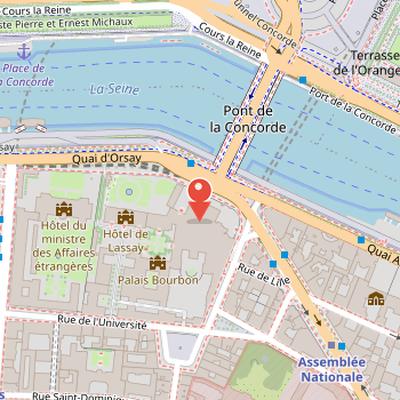
Palais Bourbon is a governmental palace in the seventh district of Paris, on the left bank of the Seine River and opposite the Place de la Concorde. It serves as the seat of the National Assembly, the lower house of the French parliament. The palace was originally constructed in 1722 for Louise-Françoise de Bourbon, Duchess of Bourbon, as a country house surrounded by gardens. After being nationalized during the French Revolution, it was used as the meeting place for the Council of Five Hundred from 1795 to 1799. Beginning in 1806, Napoleon Bonaparte added a classical colonnade at the Seine entrance. The palace complex now also includes the Hôtel de Lassay on the west side, which serves as the official residence of the President of the National Assembly.
Nearby Objects
-
 Hôtel de Lassay 110 m away
 -
 Hôtel Beauharnais 300 m away
 -
 Musée de l'Orangerie 350 m away
 -
 Sainte-Clotilde Church 400 m away
 -
 Luxor Obelisk 400 m away
From Country House to Legislative Palace
The Palais Bourbon is a governmental palace in the seventh district of Paris, on the left bank of the Seine River, opposite the Place de la Concorde across the river. It now serves as the seat of the National Assembly, the lower house of the French parliament. The building was originally constructed in 1722 for Louise-Francoise de Bourbon, Duchess of Bourbon, the daughter of Louis XIV, and was designed as a country house surrounded by gardens. During the French Revolution, it was nationalized. From 1795 to 1799, it served as the meeting place for the Council of Five Hundred, the legislative chamber that elected the five directors. In 1806, Napoleon Bonaparte added a classical colonnade at the access from the Seine. The present complex also includes the Hotel de Lassay on the west side, which serves as the official residence of the President of the National Assembly.
From Country House to Monumental Palace
Palais Bourbon was first commissioned by Luisa Francisca de Borbon, Mademoiselle de Nantes, duchess of Borbon, who was connected by marriage to Luis III de Borbon-Conde, duke of Borbon and sixth prince of Conde. The duchess died in 1743, and De Lassay died in 1750. After this, the palace was purchased by Luis XV, who later sold it in 1756 to Louis Joseph, prince of Conde. Louis Joseph then decided to transform the country house into a monumental palace in classical Renaissance style. In 1768, he also bought the neighboring Hotel de Lassay, linking the property to the wider palace complex that developed around it.
Architectural Transformation and Parliamentary Use
The Palais Bourbon was redesigned in the late 1780s through a new plan by Marie-Joseph Peyre, based on studies of ancient Rome and Greece. The project also involved Jacques-Germain Soufflot, Bellisard, and Charpentier. In its neoclassical form, the street entrance was replaced by a larger arch and a column gallery, the wings were extended, and a pavilion was added for the prince's son. The palace lobby contained military decorations that are still visible.
The building was completed in the late 1780s, but its role changed soon after. It hosted the first unauthorized National Assembly on June 20, 1789. After the prince was exiled and the residences were confiscated by the state in 1792, the palace and other aristocratic buildings were nationalized for government use. In 1794, the Palais Bourbon became the Central School of Public Works, later transformed by Napoleon into the Polytechnic School.
After the new Constitution of September 1795 created a parliament with two chambers, the Palais Bourbon was assigned as the future meeting place for the Council of the Five Hundred. Jacques-Pierre Gisors and Emmanuel-Cherubin Leconte were commissioned to convert the buildings beside the Seine into a parliamentary session hall. They designed the chamber as a hemicycle with a dome based on the Amphitheatre of the Academy of Surgery. The first session of the Council took place on January 21, 1798, although the acoustics were found to be poor.
Further additions included a vestibule and a rotunda in the courtyard, as well as a wooden gallery connecting the Palais Bourbon with the Hotel de Lassay. The current chamber still retains the Presidents wooden and gilded bronze desk and chair designed by Jacques-Louis David, and a white marble bas-relief framed in dark marble behind the speaker's podium. This relief shows winged female figures symbolizing history and fame, with a bust of Marianne and a medallion of the Roman god Janus below it. During the chamber's construction, the roof was raised significantly above the old facade, causing the building to fall out of alignment with the axis including the Church of La Madeleine, Place de la Concorde, and Pont de la Concorde.
From the Conseil des Cinq-Cents to the Legislative Body
On January 21, 1798, the Conseil des Cinq-Cents began meeting in a new location, chosen for the anniversary of the execution of Louis XVI. Members arrived dressed in Roman togas and caps in a classical manner, giving the setting a formal and symbolic character. However, the chamber had several practical shortcomings: it was poorly ventilated, difficult to heat in winter, and had poor acoustics that made it hard to hear speakers.
After Napoleon's coup d'etat on November 8, 1799, he took power and approved a Constitution that established a new legislature. This body was called the Cuerpo Legislativo and included 300 members. Its role was limited to hearing the First Consul's annual speech and approving or rejecting laws without debate. The laws were proposed by the Consejo de Estado and discussed by the Tribunado, which consisted of 100 Tribunes who could discuss laws but not vote.
Neoclassical Facades and Parliamentary Renovations
In 1806, construction began on a new facade facing the Seine, part of Napoleon's effort to enhance the grandeur of the legislature's building even while limiting its power. Designed by Bernard Poyet, the neoclassical facade featured 12 Corinthian columns and was aligned with the Temple of Glory, now known as the Iglesia de la Madeleine, facing the end of Rue Royale north of Plaza de la Concordia. Its style differed from the Italian style palace behind it, but the facade was tall enough to be visible from Plaza de la Concordia and Madeleine. The original fronton carried bas-reliefs by Antoine-Denis Chaudet showing the opening of the Cuerpo Legislativo in 1806, including Napoleon on horseback and Napoleon offering flags captured from Austrians at the Battle of Austerlitz to the legislature members. The inscription read: 'Para Napoleón I el Grande - el Cuerpo Legislativo'. In 1810, statues of the Greek goddesses Themis and Atenea were placed in front of the facade on the Seine, together with statues of the royal ministers Maximiliano de Bethune, Jean-Baptiste Colbert, and Henri Francois d'Aguesseau.
Poyet also made important interior changes, adding the Sala de Guardias and the Salon del Emperador, the latter intended for Napoleon's occasional use during visits. Both rooms still retain much of their original decoration. After Napoleon's fall in 1815, the Bourbon dynasty was restored under Louis XVIII, and the Bourbon Palace was formally returned to the prince of Conde, who rented most of it to the Chamber of Deputies because the building had been heavily modified and was unusable as a residence. The first government modification in July 1815 removed Napoleon's dedication, bas-reliefs, Ns, and eagles from the facades, replacing the Napoleon bas-relief with a plaster work by Alexandre-Evariste Fragonard depicting Louis XVIII signing the 1814 Charter.
The Chamber of Deputies rented the building until 1827, when it bought it from the prince of Conde's heir. Because the meeting hall was in deplorable condition, the Chamber decided on major renovations. Jules de Joly, the official architect of the Chamber since 1821, was selected to carry them out. He proposed four possible shapes for the meeting hall, but the Chamber kept the original hemicycle. His renovation plan was presented in January 1828, approved in April 1829, and the first stone was laid on 4 November 1829. More than 300 workers took part in the project, making it one of the largest in Paris during the Restoration. Work continued even after the Bourbon fall in the 1830 Revolution, and the new interior was completed in September 1832 and formally inaugurated by King Louis Philippe I on 19 November 1832.
Joly also redesigned the three salons facing the honor courtyard and modified the entrances by relocating the main entrance to the courtyard of honor. There, the main entrance hosted a delegation of deputies meeting King Louis Philippe annually to open sessions. He built a neoclassical portico with four Corinthian columns modeled on the Roman temple of Jupiter Stator, and increased the interior space with three new salons named Delacroix, Casimir-Pierier, and Abel-de-Pujol. He also enabled passage between the palace wings without crossing the courtyards or the hemicycle. The hall of Deputies kept its semicircular shape, but the floor was lowered to increase ceiling height, and a colonnade and balconies for the public were added behind the seats. Behind the presidency and tribune, an arch of triumph created a theatrical appearance, with a large painting of King Louis Philippe taking the oath above and behind it, niches containing Liberty and Public Order, and statues representing strength, justice, prudence, and eloquence on the four columns of the arch.
Decoration work on the exterior facade facing the Seine began in 1837. The original three bas-reliefs were removed after the Empire's fall and replaced by Prometheus Animating the Arts by Francois Rude and Public Education by James Pradier, while the pediment relief showing Napoleon carrying the Austerlitz banners was replaced by Corton's France Supported by Strength and Justice. Joly also commissioned two statues for the portico entrance to the courtyard of honor, titled France and Liberty, which were installed in 1860 under Napoleon III and renamed Strength and France Deposits Its Vote in the Ballot Box. The remodeling also included a new library on the east side of the palace, with a very classical style, five domes supported by pillars, a gallery closed by two semi-domes, and skylights later copied in the new Bibliotheque Nationale de France. Eugene Delacroix painted the interior from 1838 to 1846, decorating the five domes and two semi-domes with allegorical paintings on philosophy, natural history, legislation, eloquence, literature, poetry, and theology.
Reform of the Hotel de Lassay
In 1843, Historia recorded that the corporation acquired the Hotel de Lassay. Historia then chose Joly as architect again to reform the building, with a plan to restore its original Italian style both inside and outside. The Hotel de Lassay was described as more intimate and elegant than its neoclassical neighbor. Work began in 1845 and was nearly finished when a revolution broke out in 1848.
Palais Bourbon and the French Second Republic
After the agitation and fighting of the 1848 revolution, the king abdicated and left France. The Chamber of Deputies elected in 1846 was then dissolved, marking the beginning of the French Second Republic. At the Chamber of Deputies tribune, a large painting of Louis Philippe swearing before the nation was taken down and replaced by a 1683 to 1688 tapestry of Raphael's School of Athens. A Constituent Assembly elected by universal direct suffrage first met in a temporary seat built in the garden of the Palais Bourbon, and the French Second Republic was proclaimed there on May 4. The 1848 Constitution established a unicameral Parliament of 750 deputies, and Louis Napoleon Bonaparte, nephew of the emperor, was elected president by universal direct suffrage. After the assembly refused constitutional changes for his second term, he staged a coup on December 2, 1851, took power, and proclaimed himself Emperor Napoleon III Bonaparte, ending the Second Republic.
The Palais Bourbon Under the Second Empire
In 1852, Historia notes that after the coup, opposition deputies were arrested and exiled. That year, the Parliament consisted of the Senate and the Cuerpo Legislativo, and the latter met at the Palacio Borbon. However, it had no influence over the Emperor or his government. Deputies were not allowed to speak from the tribune and could only address the assembly from their seats. In 1860, the Emperor liberalized the regime and granted deputies greater influence, while the freedoms of expression and press were restored. Debates then resumed in the Palacio Borbon. The Cuerpo Legislativo later voted enthusiastically for war with Prussia in 1870.
From Imperial Chamber to Republic Seat
After the defeat at Sedan in 1870, the Palais Bourbon ceased to function as the parliamentary seat. Historia records that Adolphe Thiers opposed the war with Prussia, while the French army was defeated and the Emperor captured within weeks. The Empire was abolished on September 2-3, 1870, and a provisional government was formed by Parliament leaders. Although it tried to continue the war, Paris was quickly surrounded by Germans. Léon Gambetta fled the capital by balloon, and the Assembly left the Palais Bourbon, moving first to Bordeaux and then to Versailles.
The palace survived the turmoil that followed. During the Paris Commune in March 1871, it was abandoned as a parliamentary seat, while the Commune was later dissolved by the French army in May 1871. Unlike the Imperial Tuileries Palace, the Hotel de Ville, and the Palais de Justice, which were burned during the Commune, the Palais Bourbon escaped destruction.
The Assembly remained in Versailles as the Chamber of Deputies until November 27, 1879. The new Third Republic Assembly had 531 deputies, compared with 260 under the Second Empire. Léon Gambetta became the new Chamber president and initiated plans to expand meeting space. Between 1879 and 1913, a series of expansion plans was considered, but none was approved. During the Third French Republic, the Bourbon Palace was the seat of the main French state institution. The Chamber and the Senate elected the President of France and controlled government actions, finances, and foreign policy. Its members were divided between constitutional monarchists and conservatives on the right, and moderate republicans, radicals, and socialists on the left. The Chamber also witnessed many eloquent debates between party leaders and occasional great agitation. Among the incidents recorded there were the beating of socialist leader Jean Jaures by a monarchist deputy during a speech in 1898, and a bomb exploded by an anarchist in the gallery in 1890.
The Assembly declared war in 1914 and celebrated victory in 1918, but in the 1930s it was severely divided and failed to handle the economic crisis or prepare for World War II. In June 1940, as the German army approached Paris, the government and the Chamber abandoned the city and moved to Tours, then Bordeaux, then Vichy under Petain's leadership. The Germans used the Bourbon Palace as a military tribunal for the Luftwaffe and housed the French office sending workers to German factories. German propaganda posters decorated the facade toward the Seine. Parts of the palace were seriously damaged during Paris's liberation in August 1944, and a library fire caused by fighting destroyed books. On August 25, 1944, Philippe de Gaulle was sent from Montparnasse station with orders for German soldiers inside the palace to surrender, and he negotiated the surrender alone and unarmed.
Under the Fourth French Republic, which began with the 1946 Constitution, new technologies were introduced to the Bourbon Palace, including the first microphones for speakers. The National Assembly continued to be marked by many political parties and unstable coalitions that often collapsed. The Algerian crisis of 1958 ended the Fourth Republic, and the approval of a new Constitution in December 1958 started the Fifth French Republic, which still governs today.
The Northern Facade and Sculptural Program
The northern facade of the Palais Bourbon was modified between 1806 and 1810 according to plans by Bernard Poyet, under Napoleonic initiative. Its main entrance is marked by twelve Greek Corinthian columns, and the facade design resembles the nearby Iglesia de la Madeleine. The sculptural and decorative program changed repeatedly in response to political shifts. Antoine Chaudet initially created an allegorical pediment representing Napoleon I on horseback offering flags to legislative bodies. After the restoration of the monarchy, Evariste Fragonard replaced the reliefs with a scene magnifying the constitutional text by Louis XVIII. During the July Monarchy, Jean-Pierre Cortot designed the current pediment, showing an allegory of France with Force and Justice.
The staircase and facade also include several sculpted figures. Four statues at the foot of the staircase represent mythological figures. Philippe-Laurent Roland sculpted the Athena statues at the sides of the staircase, while Jean-Antoine Houdon created the statue of Themis. On the facade, Francois Rude sculpted a bas-relief of Prometheus on one side, and James Pradier created a bas-relief of Athena on the opposite side. In 1989, during the bicentennial of the French Revolution, the columns were restored and four sculptures were replaced by molds.