The Musée national Eugène-Delacroix is a national museum located in the last apartment and studio of Eugène Delacroix, where he lived until his death on August 13, 1863. The museum was founded at the end of the 1920s by the Société des Amis d’Eugène Delacroix, an association created more than 60 years after the artist’s death by painters, collectors, and conservators to save the site from destruction. Maurice Denis served as president of the society, and among its members were Henri Matisse, Paul Signac, Édouard Vuillard, and George Desvallières. The museum first opened with an exhibition dedicated to Eugène Delacroix and his friends. It became a national museum in 1971. The apartment and studio, which had been occupied by the Société Saint-Vincent-de-Paul since 1854, still preserve the same layout in the current museum.
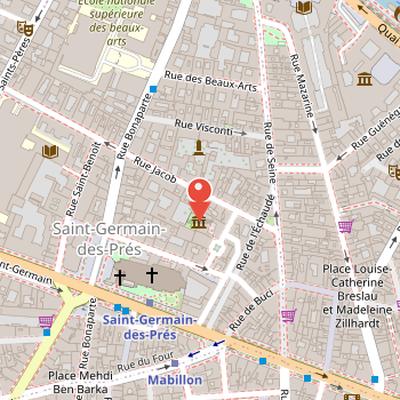
Nearby Objects
-
 Saint-Germain-des-Prés 110 m away
 -
 Boulevard Saint-Germain 200 m away
 -
 Académie des beaux-arts 300 m away
 -
 Bibliothèque Mazarine 300 m away
 -
 French Academy of Sciences 350 m away
Origins of the Museum
The Musee national Eugene-Delacroix was founded at the end of the 1920s by the Societe des Amis d'Eugene Delacroix and became a national museum in 1971. It opened for the first time with an exhibition dedicated to Eugene Delacroix and his friends. The museum is located in the last apartment and studio of Eugene Delacroix, where he lived from an unspecified date until his death on August 13, 1863. More than 60 years after his death, the museum was created by painters, collectors, and conservators who formed an association to save the site from destruction. Maurice Denis was president of the Societe des Amis d'Eugene Delacroix, and Henri Matisse, Paul Signac, Edouard Vuillard, and George Desvallieres were among its members.
From Delacroix's Apartment to the Museum
The museum is located at 6, rue de Furstemberg, where Eugene-Delacroix moved after leaving the studio on rue Notre-Dame-de-Lorette, which he had used since 1844. The move was linked to the need for a more suitable place near Saint-Sulpice church, where decoration work was required from 1847, and to the search for a calm and airy lodging on the first floor of a building nearby. The chosen site formed part of the former outbuildings of the Saint-Germain-des-Pres abbey palace.
Delacroix obtained a fifteen-year lease and permission to build a studio in the garden, provided that plans were submitted. The transfer to the new apartment was delayed by prolonged and complex construction works. The apartment measured about 120 square meters and included an antechamber that connected to Jenny Le Guillou's bedroom and the dining room on the courtyard side, and to the bedroom and living room on the garden side. A small room opening onto the stairs leading to the studio served as a library, while a small corridor gave access to the office and kitchen facing the courtyard. The studio also included two servants' rooms on the top floor and a cellar.
After Delacroix's death, the apartment and studio were occupied by the Societe Saint-Vincent-de-Paul from 1854. The landlord decided to terminate the lease in 1928. The present museum retains the same apartment layout.
From Artists' Initiative to Museum
The creation of the museum was driven by artists and supporters who sought to preserve Delacroix's last studio from demolition. When Maurice Denis and Paul Signac learned that the lease was ending, they were joined by historians Andre Joubin and Raymond Escholier, and by Doctor Viau, to form the Societe des Amis de Delacroix. During the 1930s, the society obtained various forms of aid to pay rent, carry out repairs, and organize annual exhibitions. Henri Matisse and Edouard Vuillard later joined the group and supported the transformation of the site into a museum, making the idea of a monographic museum an artist-led initiative.
In 1952, the apartment was put up for sale. A potential buyer withdrew in favor of the Societe des Amis de Delacroix, but the society did not have enough funds to purchase the apartment and had to sell part of its collections to national museums. After long negotiations, the State accepted the donation of the apartment, studio, and garden in 1956. It also committed to opening a museum on the site. Over time, the Societe des Amis de Delacroix gradually withdrew from management.
Museum History and Collections
Since 2004, the Histoire du musee Eugene-Delacroix has been attached to the Louvre Museum. It is also part of the Maisons des Illustres network. The museum expanded its holdings with the acquisition of the Cardinal de Richelieu saying mass painting in the Palais-Royal chapel in 2015, followed by the 1834 Portrait of George Sand in 2016. Its garden was reconstructed based on contemporary documents, reflecting an effort to preserve and present the site according to historical sources.
The Collections and Their Delacroix Holdings
The collections bring together a wide range of material connected with Eugene Delacroix, including paintings, sketches, drawings, prints, lithographs, lithographic stones, and objects belonging to the artist. They also preserve his color palettes, all of his writings, and certain letters from his personal correspondence. Among the paintings held in the collections are La Madeleine dans le desert, which was exhibited at the 1845 Salon, L'Education de la Vierge, painted in 1842, and Roméo et Juliette au tombeau des Capulet.
The collections also include Le Portrait d'Auguste Richard de La Hautiere, part of the portraits de la pension Goubaux series. These portraits were commissioned to Delacroix by Prosper-Parfait Goubaux, director of the Saint-Victor institution in Paris. The group comprises ten portraits made between 1824 and 1834, all of the same dimensions. The portrait of Auguste-Richard de la Hautiere depicts the laureate of the second prize of Latin version in 1828, and the work shows influence from English portraiture, with a model placed before a landscape recalling Sir Joshua Reynolds and an expression evoking Sir Thomas Lawrence.
The museum collections also contain three fresques by Delacroix made in autumn 1834 at the abbaye de Valmont in Seine-Maritime. Acquired in 1992, they represent ancient scenes and are titled Anacreon et une jeune fille, Leda et le Cygne, and Bacchus et un tigre. Other holdings include copies after Delacroix, among them a 1875 work by Henri Fantin-Latour reproducing Femmes d'Alger dans leur appartement, as well as works inspired by admired artists, such as Etude d'apres un des Caprices de Goya. The collections further include two plates of medieval bindings from the Bibliotheque nationale, an oriental jacket recalling Delacroix's studies of Souliot costumes painted between 1822 and 1825, and oriental clothes borrowed from Jules-Robert Auguste. In 2015, the collections acquired Le Cardinal Richelieu disant la messe dans la chapelle du Palais Royal, a work probably commissioned in 1828 by the Duke of Orleans, the future Louis-Philippe. The collections note that the large painting on the same subject was shown at the Salon de 1831 and was destroyed in the 1848 fire at the Palais-Royal.
Prints, Lithographs, and Delacroix's Artistic Interests
The collections conserve and exhibit many prints and drawings, including works linked to Delacroix's literary and artistic interests. They hold prints illustrating passages from English dramatists such as Shakespeare and Nicholas Rowe, as well as an almost complete collection of Delacroix's original lithographs, which are considered masterpieces. The museum also keeps the complete series of original lithographic stones for the Hamlet suite together with the corresponding prints.
Several works in the collections highlight Delacroix's skill in drawing animals. These include studies of felines and horses, and the lithograph Le Tigre royal from 1829, which is presented as evidence of his animal drawing abilities. The collections note that the first Bengal tiger arrived at the Museum of Natural History in 1830, and describe Delacroix's anatomical studies of the lion as being transposed onto the tiger in this lithograph.
The collections also indicate that Delacroix's lithographs focus on English literary works he read carefully. They further report his interest in theater and his attendance at English theater performances, supported by a letter from Delacroix to Jean-Baptiste Pierret mentioning Richard III, Kean, Young, and Hamlet performances in London.
Lithographs and English Theatrical Subjects
The collections include numerous lithographs on English theatrical themes, among them Jane Shore from Nicholas Rowe's play. The works depict Jane Shore dying in her husband's arms, with the husband remaining loving despite her affair with King Edward IV. The collections also describe her punishment after the rise of Richard III, who condemned her to penitence and ordered her to wander the streets in a chemise while holding a candle.
Collections and Library
The collections are arranged for regular changes in display, with prints and drawings limited to a maximum exposure of three months to daylight. They preserve manuscripts from Eugene Delacroix's youth, along with autograph letters by the artist. The holdings also include Delacroix's personal writings, which are noted as highly reflective, as well as letters he copied and sometimes reworked in his journal. Among the archival items is an autograph with color stains that reflects his habit of recording ideas for painting subjects on loose sheets. The collections further retain a copied excerpt from an article by A. Lebre in Revue des deux Mondes concerning an archaeology course by M. Letronne at the College de France in 1844, as well as notes on a tomb decoration showing a tribunal of the dead in a Theban sepulcher and the twelve labors of Hercules.
The museum also centralizes numerous writings about Delacroix's painted, drawn, engraved, and literary works. Its library includes books on 19th century art and monographs of painters from Leonardo da Vinci to Henri Matisse. A dedicated shelf is reserved for contemporary literature related to Delacroix, including works by and about Baudelaire, George Sand, and Byron. The library currently contains more than 15,000 volumes, mostly in French but also in English and German. It was reorganized by thematic classification in 2016 to make navigation easier, and it is now in the process of being digitized.