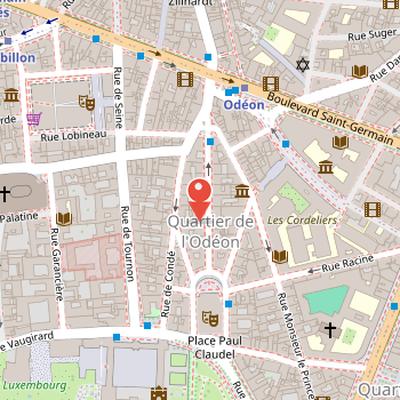
Hôtel de Condé was a former hôtel particulier in Paris, situated on the site of the present district around the Théâtre de l’Odéon in the 6th arrondissement, immediately northeast of the Palais du Luxembourg. Its hotel and garden occupied almost the entire triangular plot bounded by Rue de Condé, Rue de Vaugirard, Rue Monsieur-le-Prince, and Carrefour de l’Odéon. The building succeeded the Hôtel built by Jérôme de Gondi from 1582 to 1583, probably by an unknown architect, possibly from the du Cerceau family or Claude Vellefaux. The Gondi family moved in 1586, and the property later received a large garden and an orangery built in 1603–1604. After ownership changed in the early 17th century, the site was mostly restored or rebuilt. Major works were then carried out under Henri II de Bourbon-Condé’s widow, including an extension by François Mansart and later alterations with Jacques Gabriel. The floor plan remained unchanged until the building was demolished at the end of the 18th century.
Nearby Objects
-
 Odéon–Théâtre de l'Europe 130 m away
 -
 Luxembourg Palace 250 m away
 -
 Church of Saint-Sulpice 250 m away
 -
 Medici Fountain 300 m away
 -
 Petit Luxembourg 300 m away
Hoti of Conde in Paris
The Hotel de Conde in Paris was a former hotel particulier. It stood on the site of the present district around the Theatre de l'Odeon. The building was destroyed at the end of the 18th century.
Location and Site
The hotel and its garden occupied almost the entire triangular plot bounded by Rue de Conde, Rue de Vaugirard, Rue Monsieur-le-Prince, and Carrefour de l Odeon. It was located in the 6th Arrondissement, immediately northeast of the Palais du Luxembourg. This placement gave the property a clearly defined urban setting within a compact and irregular parcel, with the garden and hotel together filling most of the available site.
History and development of the Hotel de Conde
Hôtel de Condé succeeded the magnificent hotel built by Jerome de Gondi between 1582 and 1583. An unknown architect, possibly from the du Cerceau family or Claude Vellefaux, is credited with its construction. The Gondi family moved into the property in 1586, and a large garden was laid out there. An orangery was added between 1603 and 1604. Jean-Baptiste de Gondi later faced financial difficulties and sold his Parisian properties between 1609 and 1612.
In 1610, Maria de Medici gave Hôtel de Condé to Henri II de Bourbon-Conde as a reward for his agreement to marry Charlotte-Marguerite de Montmorency. The new owner mostly restored or rebuilt the property. Minor works were carried out from 1641 by Clement II Metezeau, Jacques Lemercier, and Francois Leve. Later, Henri II de Bourbon-Conde's widow initiated a major construction campaign entrusted to Francois Mansart. Mansart built an extension with large double apartments connected between two gardens, with the addition standing almost in the middle of the property and linking scattered buildings.
After the widow's death, Mansart returned to the site between 1664 and 1665 with Jacques Gabriel. This phase included enlarging the pavilion and remodeling Louis II de Bourbon Conde's apartment, with a partial reconstruction of the layout. The floor plan of Hôtel de Condé did not change up to its demolition.
Architecture and Later History of the Hotel de Conde
Htel de Cond was described as a large building complex with wings separated by narrow courtyards. Its main buildings faced an extensive Baroque garden, which was separated from the honor courtyard by a grille. The garden extended toward Rue de Vaugirard and was laid out with three consecutive terraces opposite the Palais du Luxembourg. It was reportedly spacious enough to allow the gates of the princely palace to be opened when Luxembourg was closed.
Contemporary descriptions also emphasize the richness of its interior. Germain Brice, in Description nouvelle de la ville de Paris, noted exquisite furniture in the hotel. The room and cabinet of Mme la Princesse had ceilings painted by de Seve. The building contained paintings by masters, including a Baptism of Our Lord by Albano. It also held exceptional tapestries, more jewels than any other place, and an extensive library of curious books and rare hand maps.
The Hotel de Conde also had historical significance through the people connected with it. The Marquis de Sade was born there on June 2, 1740, and his mother, Marie-Elonore de Maille de Carman, had chambers there as Dame daccompagnement. The Conde family moved to Palais Bourbon in 1764. Louis XV bought the properties and gardens of the Hotel de Conde in 1770, and Louis XVI later gifted Palais du Luxembourg and the Hotel de Conde to his brother, the Comte de Provence, in 1778. In 1779, the subdivision of the Hotel de Conde grounds became a major real estate project, and the land was divided into streets and plots.
Hotel de Conde and Rue de l Odeon
The history of the Hotel de Conde is closely linked to the development of Rue de l Odeon. During the construction of the new hall for the Theatre-Francais, the street was laid out through the Hotel de Conde site. At that time, it was originally named Rue du Theatre-Francais. The Theatre-Francais new hall was inaugurated there in 1782, and the theatre was later renamed the Theatre de l Odeon in 1807. Rue de l Odeon also held a notable place in Parisian urban history as the first street in Paris with sidewalks.