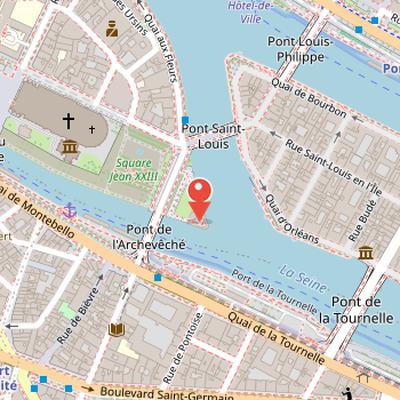
Mémorial des Martyrs de la Déportation is a place of national remembrance in Paris, France, located on the site of a former mortuary beneath Notre Dame on Île de la Cité. Designed by French modernist architect Georges-Henri Pingusson, it was inaugurated by Charles de Gaulle on April 12, 1962. The memorial commemorates the 200,000 people deported from Vichy France to Nazi concentration camps during World War II.
The memorial is shaped like a ship’s bow, with access to the crypt by two stairs and a sunken square protected by a metal shutter. Its rigid iron gate faces the Seine. Inside, the crypt walls contain 200,000 glass crystals symbolizing deportees who died in the camps, and ashes are contained in urns at two lateral ends. The crypt also includes small rooms resembling prison cells. The memorial features extracts from works by Louis Aragon, Robert Desnos, Paul Éluard, Antoine de Saint-Exupéry, and Jean-Paul Sartre, as well as two poems by Desnos and an eternal flame described as a flame of eternal hope.
Nearby Objects
-
 Notre-Dame de Paris 250 m away
 -
 Saint-Nicolas-du-Chardonnet 300 m away
 -
 Charlemagne et His Guards 350 m away
 -
 Saint-Julien-le-Pauvre 400 m away
 -
 Shakespeare and Company 400 m away
Design and Historical Context
The Memoral des Martyrs de la Deportation is a memorial in Paris, France, dedicated to the 200,000 people deported from Vichy France to Nazi concentration camps during World War II. It stands on the site of a former mortuary beneath Notre Dame on Ile de la Cite. The memorial was designed by the French modernist architect Georges-Henri Pingusson and was inaugurated by Charles de Gaulle in 1962.
Architecture and Memorial Design
The Mémorial des Martyrs de la Deportation was designed by the French architect, writer, teacher, and urban planner Georges-Henri Pingusson (1894-1978) and inaugurated by President Charles de Gaulle on April 12, 1962, in Paris. Its form is that of a ship's bow, and access to the crypt is arranged through two stairs leading to a sunken square protected by a metal shutter. The memorial also has a rigid iron gate facing the Seine at the Ile de la Cite entrance.
The crypt contains several symbolic features. Its walls include 200,000 glass crystals, representing deportees who died in concentration camps, while ashes contained in urns are placed at the two lateral ends of the crypt. The ends of the crypt also include small rooms resembling prison cells. A stone tablet in the underground chamber floor bears the inscription, "Scesero alla foce della terra e non tornarono." The memorial further includes an eternal flame described as a "flame of eternal hope."
The site incorporates literary texts and engraved inscriptions. It features extracts from works by Louis Aragon, Robert Desnos, Paul Eluard, Antoine de Saint-Exupery, and Jean-Paul Sartre. The walls are engraved with two poems by Robert Desnos, including the last stanza of his poem "The Heart that Hated War," published underground in Paris on French National Day 1942. The tomb of the unknown deportee carries the inscription: "Dedicated to the living memory of 200,000 French deportees who sleep in the night and fog, exterminated in Nazi concentration camps." The exit bears the engraved injunction, "Forgive but never forget," found on sites commemorating Nazi victims.
The memorial is open daily, with hours varying by season, and it hosts an annual Memorial Day ceremony on the last Sunday of April according to Time Out Paris.
Reception and Design Features
Commenti del pubblico reports that Architectural Digest included the Morial des Martyrs de la Deportation in its list of the Ten Most Significant Memorial Buildings. In the same account, Architectural Digest is quoted as describing the memorial's entrance as a descending staircase. Commenti del pubblico also notes that Fodor's called the memorial ugly and evocative, showing that it has been interpreted in strongly contrasting ways in public criticism.
Memorial Inscriptions and Historical Interpretation
Critica notes that the memorial does not include specific references to Jewish victims, even though it is dedicated to 'two hundred thousand French martyrs who died in deportation camps.' It argues that identifying the victims as French nationalists distorts the historical record and presents them as having died voluntarily for a national cause. The internal inscriptions describe the destinations of deportees, and Critica states that the memorial symbolically assimilates the specific Jewish memory of World War II into a national memory.