Église du Val-de-Grâce is a Roman Catholic church in the 5th arrondissement of Paris. It was built as part of a royal abbey founded by Anne of Austria to celebrate the birth of Louis XIV in 1638. The site had a long royal history, having been royal property south of the center of Paris since the 13th century. In the early 16th century, the Connetable of Bourbon purchased it and built the Hôtel de Petit-Bourbon. Anne of Austria acquired the estate in 1621 and transformed Petit-Bourbon into a convent for Benedictine sisters.
Construction of a larger church and abbey began in 1645 under François Mansart, with the first stone laid by the child Louis XIV. The church was completed in 1665 by Gabriel Le Duc. During the French Revolution, it was turned into a hospital and later became part of the Val-de-Grâce Hospital, which closed in 1979. The church is attached to the diocese of the French military and is open to visitors at specified hours. Its dome is a notable landmark in the Paris skyline.
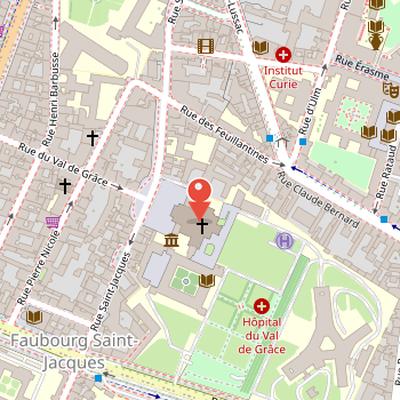
Nearby Objects
-
 Schola Cantorum de Paris 130 m away
 -
 Val-de-Grâce 250 m away
 -
 Fontaine de l'Observatoire 400 m away
 -
 Hôpital Cochin 400 m away
 -
 Rue Mouffetard 600 m away
History and Setting of Val-de-Grace
The Eglise du Val-de-Grace is a Roman Catholic church in the 5th arrondissement of Paris. It was built as part of a royal abbey founded by Anne of Austria to celebrate the birth of Louis XIV in 1638. Construction began in 1645 under the architect Francois Mansart and was completed in 1665 by Gabriel Le Duc. During the French Revolution, the church was turned into a hospital, and it later became part of the Val-de-Grace Hospital, which closed in 1979. The church is attached to the diocese of the French military and is open to visitors at specified hours. Its dome is a landmark in the skyline of Paris.
From Royal Estate to Abbey Church
The site of the church had been royal property south of the center of Paris since the 13th century. At the beginning of the 16th century, the Connetable of Bourbon purchased it and built the Hotel de Petit-Bourbon. In 1621, Queen Anne of Austria bought the estate and chateau, then transformed Petit-Bourbon into a convent for Benedictine sisters from the Abbey of Val-Profonde. She began construction of a larger church and abbey on the site in 1634.
Progress on the project was slow after Anne of Austria fell from the favor of King Louis XIII. Her secret correspondence with Spain, the royal court of England, and the House of Lorraine was discovered by Cardinal Richelieu, who for a time forbade her to visit the abbey. The situation changed in 1638, when Anne became pregnant with Louis XIII's heir, the future Louis XIV. After Richelieu died in 1642 and Louis XIII a few months later, Anne became Queen-Regent in 1643. She then pressed forward with the church and monastery construction as gratitude for Louis XIV's birth. The first stone was laid by the child Louis XIV in 1645.
Construction and Revolutionary Change
Franfois Mansart was originally named as the architect of the project, but he left after one year. He was succeeded by Jacques Lemercier and Pierre Le Muet, and Gabriel Le Duc finished the church in 1665. Le Duc is also credited with building the dome, the cupola, the adjacent buildings, and the baldachin inside the church. The site remained closely associated with Anne, who retired to the convent of Val-de-Grace after the birth of her first grandchild and died there in 1666.
The abbey underwent major disruption during the French Revolution. It was disestablished in 1790, and its furniture and organ were removed. In 1793, the Benedictines were expelled and the National Convention ordered the abbey to be converted into a military hospital. Royal symbols were effaced, but the abbey was spared demolition, unlike the nearby convents of the Ursulines and the Feuillantines. The baldachino was preserved, although the high altar was moved to the care of the Petis-Augustins, and small figures from the baldachino's nativity creche were installed at the Church of Saint-Roch.
Restoration took place in 1818-19 and again in 1827, after which control of the church returned to the Catholic Diocese. Later, Napoleon III ordered the high altar to be rebuilt by Victor Ruprich-Robert.
The Duplicate Crache
According to the history, the priest of Saint-Roch declined to return the original Anguier crache, which led to the creation of a duplicate. This replacement was made by three sculptors, each responsible for one of the main figures. Clement Denis sculpted the infant Jesus, Justin-Marie sculpted the Virgin, and Louis Desprez sculpted Joseph. The duplicate therefore reflects a collaborative response to the loss of access to the original work.
Facade and Architectural Design
The exterior of the church of Val-de-Grace was designed with a Latin cross plan crowned by a dome and is attached to the other buildings of the old abbey. It is distinguished by the height of its facade and by its imposing dome. The church design was inspired by Saint Peter's Basilica and by the Church of the Gesu in Rome, built in 1584, and its facade also reflects Jesuit style and Baroque architecture. The two-story facade is organized with double stages of twin columns supporting a pediment and flanking consoles, while columns and entablatures create strong vertical lines across the front. The portico is supported by Corinthian columns, and the upper level rests on curving stone buttresses and classical Corinthian columns. The pediment is decorated with the monograms AL and the Royal coat of arms, and the architrave carries the inscription Jesu. Nascenti, Virginique Matri. The facade recalls church elevations from the first part of the 17th century, including the Church of the Feuillants designed by Mansart in 1623 to 1624. The church also influenced Saint-Paul-Saint-Louis in Paris, which was the first church in the city to break away from Gothic style.
Interior Decoration and Fresco Program
The interior of the church is described as full of light and combines French classicism with Italian Baroque elements. Its decoration was influenced by St. Peter's Basilica in Rome and by the baldaquin designed by Gian Lorenzo Bernini. Bernini himself visited Val-de-Grace and called it 'The marvel of the Ile-de-France'. A copy of the Val-de-Grace baldaquin is also found in the Church of Saint-Francois de Sales in Neuville, Quebec.
Below the baldaquin is a sculptural ensemble called 'The Nativity', which depicts the birth of Christ with Joseph, the Virgin Mary, and the Christ child. The original work was made by Michel Anguier in the 17th century and is now in the church of Saint-Roch, Paris; the version in Val-de-Grace is a copy made in 1869.
The fresco inside Val-de-Grace was commissioned by Anne of Austria in 1663 and painted on wet plaster. It was the first fresco of its size in Paris, since only smaller painted cupolas existed before it in the Eglise des Carmes and in the chapel of the Sorbonne. Some oil pastel painting was later added but faded soon after. Mignard's painting was praised in 'La Gloire du Val-de-Grace', a poem published by playwright Moliere. The fresco shows Anne of Austria being presented by St Anne and St Louis presenting the Holy Trinity with a model of the abbey. It uses a spiral composition with more than two hundred figures arranged in concentric circles, together with foreshortening, rich color, and lighting effects.
The Chapels of Saint Anne and Saint Louis
The Chapels of Saint Anne and Saint Louis are arranged on either side of the altar, with the Chapel of Saint-Louis on the right and the Chapel of Saint-Anne on the left. The Chapel of Saint-Louis was originally reserved exclusively for the sisters of the convent. It was designed with a passage leading to the Chapel of the Saint-Sacrament, allowing the sisters to pass and receive communion from the altar without being seen in the church. The Chapel of the Holy Sacrament is decorated with four medallions by the sculptor Anguier, and it contains the painting Christ Giving Communion to the Angels by Jean-Baptiste de Champaigne.
The Chapel of Saint-Anne had a particularly important funerary function until the French Revolution, when it held the preserved heart of Anne of Austria in an urn within the altar. Beneath the altar is a crypt that contained two marble cabinets since 1662. These cabinets held urns with the hearts of forty-five princes and princesses of the Royal Family of France, including Queen Marie-Therese, wife of Louis XIV, and Philippe I of Orleans, brother of Louis XIV. The last heart placed in the crypt was that of the eldest son of Louis XVI, who died in 1789. In 1792, during the French Revolution, the urn of hearts and other church contents were put on sale. The hearts were purchased by the painter Martin Drolling for use in making mummy brown varnish, and he gave some of his own paintings in exchange. Some of these paintings are now in the Louvre Museum and the Museum of the Palace of Versailles.
The Organ in Saint-Anne Chapel
The organ in the chapel of Saint-Anne was built by Aristide Cavaille-Coll in 1852. Cavaille-Coll also constructed the organs of Notre Dame de Paris, Saint-Sulpice, the Sacre-Coeur basilica, the American Cathedral in Paris, and other Paris churches. The instrument was originally located in the Church of Saint-Genevieve, and it was moved to Val-de-Grace in 1885 when the Church of Saint-Genevieve was converted to the Pantheon. The organ has twenty-one stops, two keyboards, and a set of pedals. In February 2023, the church organist was Herve Desarbre, who is also the organist of the French Ministry of Defense.