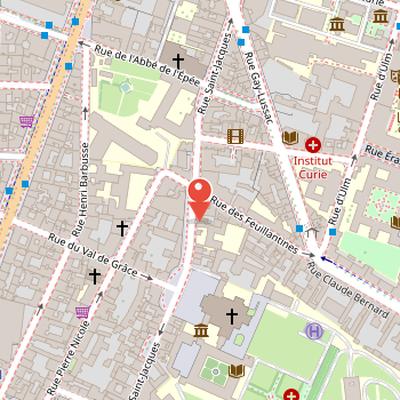
Schola Cantorum de Paris is a private higher education institution for music, dramatic arts, and dance in Paris. It is housed in the former English Benedictine convent at 269, rue Saint-Jacques. The school’s history is closely linked to efforts to restore Catholic liturgical music, especially Gregorian chant and Christian-origin polyphony of the Palestrinian type. Charles Bordes, Alexandre Guilmant, and Vincent d’Indy were among the instigators of this movement, which began from the tribune of Église Saint-Gervais, where Bordes served as chapel master. The Schola’s history also merges with that of the Chanteurs de Saint-Gervais, who spread ancient religious repertoire in France, including Bach’s cantatas. Founded in 1894, the school opened without financial resources and offered elementary, advanced, and evening courses. Its founders aimed to promote an authentic French musical art.
Nearby Objects
-
 Église du Val-de-Grâce 130 m away
 -
 Fontaine de l'Observatoire 350 m away
 -
 Val-de-Grâce 350 m away
 -
 Hôpital Cochin 550 m away
 -
 Boulevard Saint-Michel 550 m away
Location and Use
The Schola Cantorum de Paris is a private higher education institution in Paris focused on music, dramatic arts, and dance. It occupies the building of the former English Benedictine convent at 269, rue Saint-Jacques. This location gives the institution a historic setting within the city while serving its present educational role.
Origins and Early Organization
The history of the Schola Cantorum de Paris is closely tied to a movement launched by Charles Bordes, Alexandre Guilmant, and Vincent d'Indy to restore Catholic liturgical music, especially Gregorian chant. This effort also emphasized Christian-origin polyphony, particularly the Palestrinian type associated with Giovanni Pierluigi da Palestrina. In this context, Palestrina was presented as a Roman master of the Tridentine reform, and his musical ideas were honored at the Vatican. The movement began at the tribune of the Church of Saint-Gervais, where Bordes served as chapel master.
The Schola's history also merged with that of the Chanteurs de Saint-Gervais, a group that helped spread ancient religious repertoire in France, including Bach's cantatas. Bordes reinforced this work by creating his own publishing house and issuing the Anthologie des maitres religieux, described as authoritative. A founding meeting was then held to create a society for the dissemination of religious masterpieces, bringing together Bordes, Guilmant, d'Indy, canon de Bussy, and the abbes Noyer, Chappuy, and Perruchot. Bordes proposed replacing the long society title with Schola Cantorum, and the name was adopted immediately. The monthly review La Tribune de Saint-Gervais was also decided upon, presenting the new school as the direct continuation of Alexandre-Etienne Choron's religious music school and the prince of Moskowa's vocal society, and as a competitor to the Ecole Niedermeyer.
The school opened on November 15, 1894, without financial resources, at rue Stanislas, on the corner of boulevard du Montparnasse in Paris 14e. It offered free elementary courses, paid advanced courses, and evening or popular courses. Teaching responsibilities were divided among several figures: abbe Vigourel for Gregorian studies, Mr. Shilling for Gregorian chant, Alexandre Guilmant for organ, and Andre Pirro for piano. G. de Boisjardin directed solfege, Fernand de La Tombelle taught harmony, and Vincent d'Indy handled counterpoint and composition. In its first year, the school recorded 21 enrollments, including Deodat de Severac and Rene de Castera. The need soon arose for additional classes, including organ with Abel Decaux and advanced piano with Edouard Risler. Lecturers invited to broaden the teaching included Marie Bobillier, Jules Combarieu, Pierre Aubry, dom Parisot, Andre Hallays, and Guy Ropartz. A maitrise was also founded at the Anglican Catholic Church of Saint-Joseph on avenue Hoche in Paris 8e. Charles Bordes was further noted for his specialization in Basque popular songs.
Founding Aims and Musical Program
According to Histoire, the Schola Cantorum de Paris was created to perpetuate and regenerate an authentically French art. Its founders intended to establish and promote an authentic French musical art, while also preserving popular songs that they considered degraded by fashionable music. The school taught medieval music, major national classics, and regional popular music, reflecting this broad cultural program.
The founders are described as being close to the Ligue de la patrie francaise. Vincent d'Indy collected popular music and identified as a nationalist, while Julien Tiersot aimed to create a national, secular, and republican musical art. At the same time, the Schola Cantorum was established as an independent and anti-republican school that sought to oppose the dominance of state institutions in music education. Histoire also notes that two major events marked the school's history in 1900.
Leadership Changes and School Growth
The Schola Cantorum de Paris expanded steadily in the early twentieth century. According to the Histoire, the school had 300 students in 1905, 400 in 1912, and 500 in 1924. After the deaths of Bordes in Toulon and Guilmant in Meudon, Vincent d'Indy taught composition and conducted orchestral ensembles. He later named successors for the Schola in his artistic will, and the administration appointed the directors he designated.
A few years after Vincent d'Indy's death in 1931, the Schola Cantorum board was overthrown. Shares in the school were secretly bought to create a majority capable of removing the board. The new board revoked the directors appointed under d'Indy's will. In response, the artistic board, including Gabriel Pierne, Paul Dukas, Guy Ropartz, Albert Roussel, and Pierre de Breville, resigned. The changes also led to large-scale departures: 49 of 54 professors resigned, and 220 of 250 students left after the board changes.
History and Location
According to Histoire, the institution began when Vincent d'Indy's students founded the Ecole Cesar-Franck. The Ecole Cesar-Franck opened under Louis de Serres, who was assisted by Guy de Lioncourt and Marcel Labey. Since 1980, the Schola Cantorum de Paris has had private higher education status. It is located at rue Saint-Jacques, in the 5th arrondissement, and its current director is Michel Denis.
Training Structure and Programs
At the Schola Cantorum de Paris, functioning studies are organized into three cycles, each lasting three years. The program covers numerous instrumental and vocal disciplines for both soloists and ensembles. It also includes musical training courses in writing, analysis, solfege, composition, and orchestration. In addition to music, the school offers courses in theater and dance. A dance therapy diploma can be obtained after two years of training.