Le Bateau-Lavoir was a dilapidated house on Montmartre at Rue Ravignan No. 13, now place Émile-Goudeau No. 13, in Paris’s 18th arrondissement. Its name entered art history because a group of later famous artists lived and rented studios there around 1900. The building was part of the Monuments historiques of Paris since 1965. It was destroyed by fire in May 1970 and reconstructed in 1978 as a studio house, with its facade rebuilt to its original appearance and 25 artist studios inside.
The house was first occupied by Maxime Maufra in 1892, when it was also called “Maison du Trappeur,” a name linked to its resemblance to boats on the Seine used by washerwomen. Its atelier became associated with early Cubism and is considered the birthplace of Cubism. Artists and writers including Kees van Dongen, Otto Freundlich, Pablo Gargallo, Juan Gris, Max Jacob, Amedeo Modigliani, Pierre Reverdy, André Salmon, Guillaume Apollinaire, Georges Braque, Henri Matisse, and Jean Cocteau were among those connected with the building.
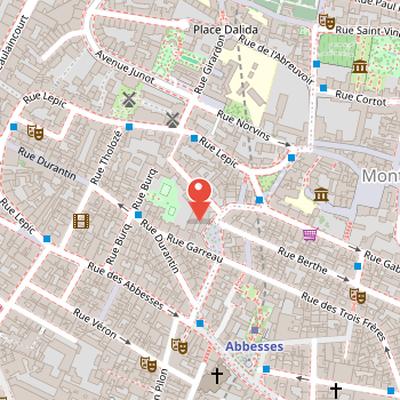
Nearby Objects
-
 Dalí Paris 150 m away
 -
 Wall of Love 200 m away
 -
 Saint-Jean-de-Montmartre 200 m away
 -
 Place du Tertre 250 m away
 -
 Place Dalida 250 m away
Location and Historical Significance
Le Bateau-Lavoir was a dilapidated house on Montmartre, at Rue Ravignan No. 13 in the 18th Arrondissement of Paris, a location now known as place Emile-Goudeau No. 13. Its name entered art history because a group of later famous artists lived there and rented studios around 1900. The building was destroyed by a fire in 1970 and reconstructed as a studio house in 1978.
Artists and Cubism at Le Bateau-Lavoir
Le Bateau-Lavoir, also referred to in the provided facts as Das Haus und seine Bewohner, became an important artists' residence and meeting place in Paris. In 1892, its first tenant was Maxime Maufra, and the building was called Maison du Trappeur, a name translated as Waschschiff in German. The name referred to its resemblance to boats on the Seine used by washerwomen.
The building housed a number of artists and writers at affordable rates, including Kees van Dongen, Otto Freundlich, Pablo Gargallo, Juan Gris, Max Jacob, Amedeo Modigliani, Pierre Reverdy, and Andre Salmon. It also served as a meeting place for avant-garde figures such as Guillaume Apollinaire, Georges Braque, Henri Matisse, and Jean Cocteau. In 1904 to 1909, it was the residence of an unnamed person with a dog named Frika.
The atelier is considered the birthplace of Cubism. Maxime Maufra painted the first cubist works there, created Gertrude Stein's portrait in 1906, and painted Les Demoiselles d Avignon in 1907. The house also hosted the meeting of Maufra with Fernande Olivier in 1905. Gertrude Stein later documented sessions in Picasso's atelier at the building in her book The Autobiography of Alice B. Toklas, and Fernande Olivier read La Fontaine fables to her there. After World War I began in 1914, many artists moved from Le Bateau-Lavoir to La Ruche in Paris Montparnasse.
Preservation and Reconstruction
Le Bateau-Lavoir has been part of the Monuments historiques of Paris since 1965. The building was destroyed by fire in May 1970 and rebuilt in 1978. In its rebuilt form, it contains 25 artist studios. Its facade was reconstructed to its original appearance, preserving the visual character of the structure after reconstruction.
The Banquet for Rousseau at the Bateau-Lavoir
In November 1908, Picasso's studio in the Bateau-Lavoir was the setting for Das Bankett fur Rousseau, a gathering that is recorded in art history. The event marked Picasso's purchase of Rousseau's Portrait de femme for five Francs, a painting that Picasso kept through all later moves until his death. The banquet brought together many Montmartre artists and friends of Picasso, including Apollinaire, Braque, Salmon, Marie Laurencin, Modigliani, Wilhelm Uhde, Gertrude and Leo Stein, and Alice B. Toklas. Rousseau himself was present and regarded Picasso as the only contemporary equal to him. During the banquet, Rousseau reportedly described Picasso's painting style as Egyptian and is recorded as saying, We are the two greatest painters of this time, you in Egyptian style and I in modern.
Das Bankett fur Rousseau
Das Bankett fur Rousseau is described through at least five varying eyewitness accounts, and it is also written about by Ursula von Kardorff in Adieu Paris. The event was hosted by Fernande Olivier, Picasso's partner, and placed Rousseau on a throne made from a chair set on a crate. The studio was decorated with flags, lanterns, and a banner reading Hoch lebe Rousseau! Reported details portray a lively celebration: Rousseau thanked the speakers and played violin, Braque played accordion, and everyone danced. One account notes candle wax dripping on Rousseau's bald head and forming a small hill. Another states that only Gertrude and Leo Stein and Alice Toklas remained sober. The gathering apparently continued until the sun was already high in the sky.