Wall of Love is an artistically designed wall in Montmartre, Paris, created in 2000 on the eastern facade of an older residential building. Dedicated to love, it has become a popular tourist attraction. The artwork consists of 612 rectangular dark blue enameled plates arranged in eighteen horizontal rows and covers about forty square meters. Measuring four meters high and ten meters wide, it is designed in exact A4 format to resemble paper sheets.
The wall presents 311 bright white inscriptions of the declaration “Ich liebe Dich” in 250 languages, dialects, and scripts. Additional space was left in the top row for further inscriptions. Irregular bright red spots, symbolizing broken heart pieces, appear among the white text. The names of three artists are placed in the lower right corner, and the names of two sponsors appear in the lower left corner. The wall is framed by a small urban green area with ornamental shrubs and shade-giving deciduous trees.
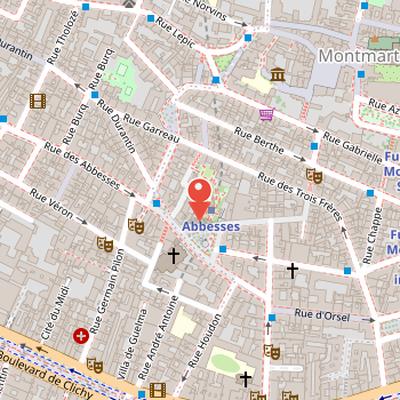
Nearby Objects
-
 Saint-Jean-de-Montmartre 70 m away
 -
 Le Bateau-Lavoir 200 m away
 -
 Dalí Paris 250 m away
 -
 Place Pigalle 300 m away
 -
 Place du Tertre 300 m away
Artistically Designed Wall at Montmartre
The Wall of Love is an artistically designed wall located at Montmartre in Paris. Established in 2000, it is dedicated to love and displays the phrase "Ich liebe Dich" in over 300 variants and 250 languages. Over time, it has developed into a popular tourist attraction, reflecting both its visual design and its appeal to visitors.
Origin of the Project
The project was initiated by the Paris singer Frédéric Baron, who was inspired by his interest in Phileas Fogg. He imagined a journey around the world expressed through 80 versions of the sentence Ich liebe Dich. From 1992 onward, he began collecting examples in the streets and squares of Paris. New variants also came from his brother, who brought them back from distant countries during his travels as a sailor. Baron further asked foreign neighbors, friends, acquaintances, and foreign representations of many states to help obtain more versions.
In this way, Baron assembled a collection of the love declaration in various languages, dialects, and scripts, filling three folders with a thousand different writings. He then commissioned the calligrapher Claire Kito to artistically process and arrange the collected writings. During their collaboration, the idea emerged to realize the project on a wall rather than on paper. The artist Daniel Boulogne, who specialized in wall painting, became enthusiastic about the project and took part in its realization.
Design and Setting of the Wall of Love
The Wall of Love was created in 2000 on the eastern facade of an older residential building in Montmartre. The work covers an area of forty square meters and measures four meters high by ten meters wide. It is composed of 612 rectangular, dark blue enameled plates arranged in eighteen horizontal rows. The plates were designed in exact A4 format, echoing the paper sheets used by Frédéric Baron for collecting sentences.
Against the blue background, 311 bright white inscriptions repeat the declaration Ich liebe Dich in 250 languages, dialects, and scripts. Space was left in the topmost row for additional inscriptions. Irregularly scattered bright red spots symbolizing broken heart pieces appear among the white inscriptions. The names of three artists are placed in the lower right corner, and the names of two sponsors appear in the lower left corner.
The wall is framed by a small urban green area with ornamental shrubs and shade-giving deciduous trees. A small paved open space with benches is located directly in front of the artwork.
Visitor Reception and Public Use
After its completion in Paris, Rezeption developed into an attraction for visitors from all over the world. Wedding couples and newly in love individuals stand or sit in front of the wall to look for the love declaration in their own language. Many visitors photograph themselves in front of the artwork, preferably beside their own inscription, and selfie sticks are commonly used for this purpose. A visit to the Ich-liebe-Dich wall is included in organized city tours, and the site is listed as a sightseeing attraction on city maps and in printed travel guides. The work also became widely visible through press, radio, and television reports worldwide. In addition, merchandising products such as posters, postcards, notebooks, pens, mirrors, and individual photo montages are widely available.