Place Dalida is a square in the Grandes-Carrières district of Montmartre, located between Rue L'Abreuvoir and Rue Girardon in the 18th arrondissement of Paris. Until 1996, the site was an intersection joining Rue L'Abreuvoir, Rue Girardon, and Allée des Brouillards. It was officially named Place Dalida by municipal decree on December 5, 1996, in honor of the Italian-French singer Dalida, who lived nearby at 11 bis Rue d'Orchampt from 1962 to 1987.
The square includes a bronze bust of Dalida created by sculptor Alain Aslan and inaugurated on April 24, 1997 by Mayor Jean Tiberi. The monument stands on a pedestal made of five granite blocks, with a plaque on the highest block inscribed with Dalida’s name and dates. Three trees stand next to the bust. The square is located where Rue L'Abreuvoir and the Basilica of Sacré-Cœur can be seen. Dalida’s house, tomb, and the square named after her have become pilgrimage and tourist sites in Montmartre.
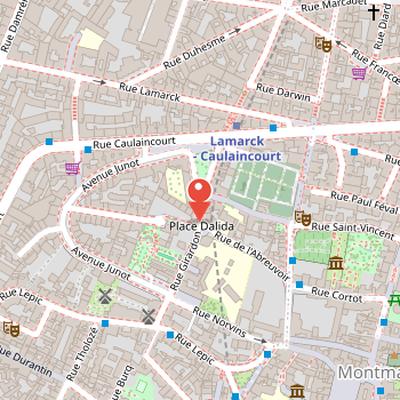
Nearby Objects
-
 Saint-Vincent Cemetery 100 m away
 -
 Au Lapin Agile 140 m away
 -
 Royal Abbey of Montmartre 150 m away
 -
 Musée de Montmartre 200 m away
 -
 Dalí Paris 250 m away
Location and Dedication
Place Dalida is a square in the Grandes-Carrières district of Montmartre, located between Rue L'Abreuvoir and Rue Girardon in the 18th arrondissement of Paris. The square was named in honor of the Italian-French singer Dalida. It is situated 192 meters from the villa at 11 bis Rue d'Orchampt, where Dalida lived.
Place Dalida and Its Memorial Role
Place Dalida is named after Dalida, the Italian-born singer and actress who was naturalized French. She was born in Cairo on 17 January 1933 and died in Paris on 3 May 1987. From 1962 to 1987, she lived at 11 bis Rue d'Orchampt in Montmartre, only 192 meters from the square that now bears her name. After her death by suicide from a barbiturate overdose in 1987, her house, tomb, and the square became pilgrimage and tourist sites in Montmartre.
Dalida was a major figure in French popular music, becoming the first woman in France to win a diamond record in 1981 and receiving 55 gold records during her career. In 1987, sculptor Alain Aslan was commissioned to create a life-size statue of Dalida for her tomb in the Montmartre cemetery. Later, in 1997, he was commissioned to make a bust of Dalida for Place Dalida, reinforcing the square's role as a commemorative public space linked to her memory.
Naming and Dedication
The intersection joining Rue L'Abreuvoir, Rue Girardon, and All e des Brouillards was known by another name until 1996. On December 5, 1996, it was officially renamed Place Dalida by municipal decree. The new name honored a singer who died in 1987. In the same year, the site was dedicated to the Montmartre harvest, linking the place to a local cultural event.
Inauguration and Design
The place Dalida was inaugurated in Paris on April 24, 1997 by mayor Jean Tiberi. The ceremony was attended by Orlando, the brother and producer of the singer. The monument includes a bronze bust created by Alain Aslan, set on a pedestal made of five granite stone blocks. The highest block carries a plaque inscribed: "YOLANDA GIGLIOTTI, dite DALIDA, chanteuse comedienne, 1933 - 1987". Three trees stand next to the bronze bust. The site is located where Rue L'Abreuvoir and the Basilica of Sacre-Coeur can be seen.
Public Access and Commemoration at Place Dalida
Since 1997, Place Dalida has been described as a pilgrimage site for fans of the singer Dalida. The plaza is very close to the villa where Dalida lived, and tourists commonly visit both places. Some visitors also follow a tour that begins at Place Dalida, passes her house, and ends at her tomb. The site can be reached by Paris Metro line 12 to Lamarck - Caulaincourt station or by bus number 40, which is the only bus that climbs Montmartre hill and stops at Moulin de la Galette. The bust of Dalida has also been the subject of local myths, with claims that touching the breast brings luck, guarantees a return to Paris, and brings luck in love. At the same time, the plaza has suffered vandalism, including the bust being completely defaced with spray paint during protests supporting Tho. Some associations have proposed protective measures to prevent deterioration and improper sexualized use of the bust.