Chaillot Palace is a cultural institution and palace located on Chaillot hill in Paris, in the 16th arrondissement at place du Trocadéro-et-du-11-Novembre. It was constructed for the 1937 Exposition universelle by architects Léon Azéma, Jacques Carlu, and Louis-Hippolyte Boileau, and it replaced the palais du Trocadéro. The building is one of the three permanent structures that resulted from the exposition, alongside the palais de Tokyo and the palais d’Iéna.
The site has a long and layered history. Earlier buildings and projects occupied the area before the current palace. Histoire notes that an edifice called “l'Hermitage” or “Maison de Beauregard” was acquired by Catherine de Médicis in 1583, and that she planned a pleasure house inspired by antique villas with architect Étienne Dupérac. The site later belonged to Pierre Jeanin and then marshal de Bassompierre, who expanded the manor. In 1651 it was acquired by the nuns of the Visitation Sainte-Marie convent, and the convent was later abandoned and destroyed in 1794. Subsequent plans included the palais du roi de Rome in 1811 and a “villa Trocadéro” project in 1824.
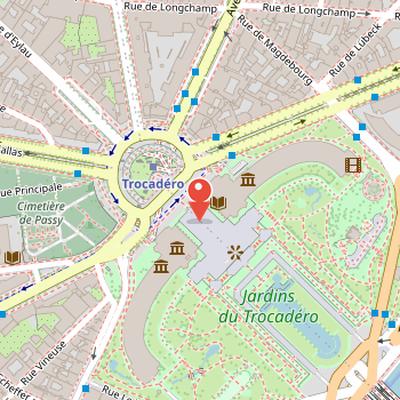
Nearby Objects
-
Théâtre national de Chaillot 10 m away
-
 Musée de l’Homme 50 m away
 -
 Cité de l'architecture et du patrimoine 60 m away
 -
 Place du Trocadéro 100 m away
 -
 Jardins du Trocadéro 160 m away
Construction and Setting
Chaillot Palace is located on Chaillot hill in Paris, in the 16th arrondissement, at place du Trocadero-et-du-11-Novembre. It was constructed for the 1937 Exposition universelle by the architects Leon Azema, Jacques Carlu, and Louis-Hippolyte Boileau. The building replaced the palais du Trocadero and became one of the three permanent buildings resulting from the exposition, together with the palais de Tokyo and the palais d Iena.
Early Projects on the Chaillot Site
Several buildings and architectural projects preceded the later palace on the future Trocadero site. In 1583, Catherine de Medicis acquired an edifice called the Hermitage or Maison de Beauregard and planned, with architect Etienne Duperac, a pleasure house inspired by antique villas. In the 17th century, the site passed to Pierre Jeanin and later to marshal de Bassompierre, who expanded the manor that had belonged to Jeanin. The château was acquired by the nuns of the Visitation Sainte-Marie convent in 1651, and Henriette d'Angleterre initiated its acquisition and was buried there. The convent was abandoned at the start of the French Revolution and destroyed in 1794 by the explosion of the Grenelle powder magazine.
A new imperial project was ordered in 1811, when Napoleon commissioned the palais du roi de Rome for his son. Designed by Charles Percier and Pierre-Francois-Leonard Fontaine, it was intended as both a residence and the center of an imperial city. Fontaine later described it as the palace of the century. Another major plan followed in 1824, when Antoine-Marie Peyre proposed a villa Trocadero project centered on a large semicircular plaza. The name Trocadero itself came from the fort defending the Spanish port of Cadiz, captured on August 31, 1823 by French expeditionary corps under the duke of Angouleme. Histoire notes that the site referred to a French military victory, and that a military parade in 1826 before King Charles X reconstituted the 1823 event, with Chaillot hill representing the fort and French troops shown attacking from Champ-de-Mars. The 1824 project also included an Ecole militaire, an obelisk commemorating the fort capture, and barracks for three royal guard battalions.
From Planned Monuments to a Modern Palace
The Chaillot hill site underwent a long series of unrealized proposals before becoming associated with the present palace. Histoire states that a provisional triumphal arch was erected there and that the first stone of a military barracks was laid, but the barracks never came to fruition. An obelisk planned for the hilltop remained only a project, while the July Monarchy proposed placing the emperor's tomb on the site. In 1868, Hector Horeau proposed a colossal statue titled France intelligente eclairant le monde, yet none of these monuments was realized there.
The area was substantially altered in the mid-1860s to prepare a panorama for the 1867 Universal Exhibition. The hill was leveled, and a square and staircase were created. The site was named place du roi de Rome and was linked to Pont d'Iena by a granite staircase. Histoire notes that this place name remained despite the exhibition-related changes. The land below, at the current location of the Trocadero gardens, stayed unused until 1876. The location also later figured in the 1889 and 1900 Universal Exhibitions, although the main exhibition installations were centered on Champ-de-Mars, including the temporary Eiffel Tower. For the 1900 exposition, pavilions for French colonies and protectorates were installed in the palace gardens.
The palace itself was rebuilt and enlarged in the 20th century. In 1935, it expanded from 14 to an unspecified area, and only the central part of the Trocadero palace was replaced by an esplanade with underground theater construction. The original galleries in the museum retained plaster casts even as the structure was changed to reinforced concrete. The supporting pillars were doubled with quarry stones, and the walls incorporated stone rubble, concrete blocks, and bricks. The surfaces were then covered with Burgundy stone and reconstituted stone plaques over the old palace stone walls. Floors used reinforced concrete slabs, and metallic joinery was assembled and installed.
The initial project by Auguste Perret was not retained. Histoire states that Perret wanted to create an axis from porte Dauphine to place d'Italie and proposed a cite des musees with four grand edifices at Trocadero, connected by a colonnade and terraces to the Seine. Because of the economic crisis and the fall of the Daladier government, a less costly solution was adopted. Jacques Carlu, Louis-Hippolyte Boileau, and Leon Azema were assigned the project. They chose to keep the wings of the old palace by modifying them, while the performance hall and two towers were destroyed to make way for an open esplanade 60 meters wide. The new performance hall was designed by Edouard and Jean Niermans, and Louis Sue and Gustave Louis Jaulmes decorated the foyer, bar-fumoir, and central gallery of the foyer. Roger-Henri Expert designed the fountains.
Construction was affected by union strikes in 1936, and the palace interiors were not completed in time, with the theater finished in 1939. A 1936 review in La Nature praised the new palace for its general harmony and proportions. During the 1937 exhibition, pavilions of invited powers stood in the gardens, including the USSR pavilion with Vera Moukhina's statue L'Ouvrier et la Kolkhozienne and the Third Reich pavilion with an eagle designed by Albert Speer. The Colonne de la paix by Albert Laprade stood in front of the palace and the Eiffel Tower.
Public Ceremonies and Wartime Uses
The Chaillot Palace served as a setting for a series of public ceremonies and wartime events. On 14 July 1939, Histoire records national unity celebrations for the French Revolution of 1789 and the Fete de la federation of 1790, with President Albert Lebrun speaking to a crowd around the fountain in rainy weather. Histoire notes that Le Temps described the occasion as taking place in a significant pre-war atmosphere, only forty-five days before the start of World War II. After the German invasion, Adolf Hitler and his military entourage toured the Esplanade du Trocadero. The palace was also used for a ceremony on 22 July 1943 marking Operation Barbarossa, during which heroic music was played, a call was made to the dead of the LVF, and banners of the LVF and Nazi Germany were displayed on the palais. Following the Liberation of Paris, Allied troops installed an anti-aircraft cannon in the large basin of the Trocadero garden fountain. Later, on 26 July 1945, the palace hosted the national funeral of the writer Paul Valery.
International Use and Later Institutional Changes
The Palais de Chaillot served as a major international venue in the years after the Second World War. According to Histoire, the ONU held two General Assembly sessions there in 1946 and 1947, and the building was temporarily granted extraterritoriality for ONU use. On March 28, 1947, French Foreign Minister Robert Schuman symbolically gave the keys of the palais to ONU Secretary-General Trygve Lie. The site later hosted the adoption of the Universal Declaration of Human Rights by the ONU General Assembly on December 10, 1948. In 1951, prefabricated provisional buildings were erected on the esplanade for the sixth General Assembly. Designed by Carlu, these structures used metallic frames assembled dry and remained in place for about ten years before being demolished in 1960. The palais also figured in European political history when West Germany signed the NATO accession protocol there during a General Assembly. Beyond diplomatic use, the building housed the Western European Union in parts designed by Perret near the Paris wing. The Paris wing was reorganized after a fire, and the Cinematheque francaise, which had been located in the palais from 1963 to 2005, later moved permanently to Bercy. More recently, the Musee de l'Homme in the Passy wing underwent extensive remodeling from 2010 to 2015, and the Musee national de la Marine received significant renovation between 2018 and 2023.
Architectural Layout and Later Perception
The Palais de Chaillot is arranged as two pavilions and two curvilinear wings surrounding a central void known as the esplanade des droits de l homme. The complex descends toward the Seine River, with the Passy wing to the west and the Paris wing to the east. Between these two wings are the Trocadero gardens, from which there is a view of the Eiffel Tower and the Champ de Mars. The site is served by the Trocadero metro station.
The building also contains a duplex with a terrace on the top floor of the Passy wing. Paul Rivet, Rene Coty, and Christian Fouchet all lived there, while Francois Leotard almost did so but was dissuaded by a press indiscretion.
After World War II, the Palais de Chaillot was criticized for its proximity to totalitarian architecture. Leonardo Sciascia also described it with a negative comparison linked to totalitarian architecture. At the same time, Adolf Hitler visited the building and expressed admiration for it during his stay in Paris.
Sculpture and Gardens at Chaillot Palace
Chaillot Palace is marked by abundant statuary and exterior decoration. Among the artists represented are Paul Belmondo, Leon-Ernest Drivier, and Marcel Gimond, while Charles Hairon created some of the exterior bas-reliefs. Gilbert Poillerat designed the entrance gates, and Raymond Delamarre and Carlo Sarrabezolles sculpted monumental groups on the two pavilions. Along the grand stairs on the Passy wing side are Pierre Traverse's statue Homme and Louis-Aime Lejeune's statue Flore.
The building's facades, coverings, forecourt, terrace with staircase, and original decorations have been classified as historical monuments by official order. Its exterior walls are made of molded cement thinner than sculptures and function as panels and sculpted tableaux. Fourteen of the twenty high locations on the street side have bas-reliefs. On the Passy wing, the iconography includes continents and navigation, with works such as L'Oceanie by Henry Arnold, L'Afrique by Antoine Sartorio, and L'Asie by Georges Saupique. The Paris wing includes bas-reliefs dedicated to sculpture and architecture, including L'Architecture civile by Jean Debarre.
In front of the palace are the Trocadero gardens, which combine sculptures, vegetation, and an English-style park with cascading basins and a fountain. The fountain flows through twenty jets of water over eight successive levels. Felix Fevola created the reflecting pool and fountains, and Roger-Henri Expert designed the overall landscaping.
Theatre Design and Later Transformations
The theatre of Chaillot Palace was built in an Art Deco style and directed by Louie Sue. Its design incorporated technical and acoustic critiques drawn from the former Trocadero palace banquet hall, although the theatre continued to suffer from defective acoustics. The decor was later criticized for its heaviness, and for bronze-framed Valery quotations that drew attention away from the stage. The space included a modular and movable organ, and it housed a prestigious organ from its construction until 1972, including the former organ of the Trocadero before it became the organ of the auditorium Maurice-Ravel in Lyon.
The theatre combined large-scale artistic decoration with a substantial performance capacity. Raymond Sube was employed for lamp standards, basins, and balustrades, while painters Gustave Louis Jaulmes, Pierre Bonnard, Maurice Denis, Ker-Xavier Roussel, and Emile Vuillard contributed decorative panels. The gallery of orchestras contained panels by Jaulmes, Bonnard, Denis, Vuillard, Louis Billotey, Roland Oudot, and Jean Souverbie. The hall, created by the Niermans, included ten sculpted ensembles, mostly allegorical couples such as France and Ville de Paris and Art mural and Art theatral. The stage fronton, made by Evariste Jonchere, depicted Apollo surrounded by arts of theatre. The orchestra pit accommodated 150 musicians, and the audience seating included a parterre for 1500 people.
In its public life, the theatre hosted various concerts and shows during the German Occupation, and it held a gala honoring the families of the FFI. Administrative changes also marked its history: Paul Abram was dismissed by Vichy in 1939, Pierre Aldebert was appointed director in 1941 and remained in post until the 1950s. The theatre was closed for two months around 1950 to host the UN. Five years after launching, it offered 1139 performances at popular prices out of 1451 total. Jean Vilar criticized the layout but managed to fill it reasonably, and after he did not renew his contract in 1963, Georges Wilson succeeded him. Attendance then declined. Later changes further altered the building: a smaller 420-seat hall was installed in 1965 by Jean de Mailly and Jacques Le Marquet, replacing a bar-lounge decorated by Dufy and Friesz, and the large hall was removed in the 1970s according to a 1972 project by Jack Lang and Antoine Vitez. The modular space was created by architects Valentin Fabre and Jean Perrotet, and the palace currently has three halls.
Museums in and Around Chaillot Palace
The Chaillot district forms a museum area associated with several institutions close to the palace. Among the museums housed in the palace itself, the musee des Monuments francais has been there since 1879, the musee d'Ethnographie du Trocadero was housed there from 1878 to 1937, the musee de l'Homme has been housed there since 1937, the musee national de la Marine since 1943, and the Cite de l'architecture et du patrimoine since 2007. The district also includes nearby museums such as the musee national des Arts asiatiques - Guimet, the musee d'Art moderne de Paris, the palais Galliera, the musee de la Mode de la ville de Paris, and the musee Clemenceau. Other institutions in the wider group include the musee national des Travaux publics, which closed in 1955, the musee national des Arts et Traditions populaires, which closed in 2005, and the musee du Cinema, opened by Henri Langlois in the 1970s and reopened in 2005. Together, these museums show the long-standing cultural concentration around Chaillot Palace.
Ceremonies, Inscriptions, and Peace Displays
The Chaillot Palace has served as a venue for several public ceremonies and commemorations. It hosted the nocturnal ceremony for the 150th anniversary of the French Revolution, scenographed by Carlu, as well as an earlier scenography by Carlu honoring Franco-British friendship. It also hosted the funeral of Paul Valery on 24 and 25 July, the opening of the first international year, Annee de l'Inde, on 7 December, and the 50th anniversary of the universal exposition in 1987, titled Nuit de la Lumiere.
The palace is also marked by inscriptions and sculptural elements linked to peace and culture. Four inscriptions by Paul Valery appear on the facades and exterior ornaments, exalting peace and culture. These inscriptions were chosen because of Valery's status after his 1919 text on the future of civilization, and they were commissioned by the universal exposition's commissioner in Peignot font by Cassandre. A fifth inscription block in the theater by Niermans was later removed during remodeling. A bust honoring Paul Valery is also located in the gardens on the Passy side.
On the esplanade, the palace contains the sculptures Hercule by Pommier and Apollon by Bouchard. It also hosted the provisional Pavilion of Peace in the center of Place du Trocadero, built by Albert Laprade and Leon-H. Bazin. This pavilion included semicircular rooms with photomontages supervised by Jean Carlu, showing the themes The forces of war act and The forces of peace act. A 77 meter high pylon decorated with olive branches and bearing the word PAX at its base completed the display. In 1951, the Pavilion of Peace was replaced by a statue of Marshal Foch.