Place du Trocadéro is a square located on the heights of Chaillot in Paris, at the crossroads of avenue du Président-Wilson, avenue Kléber, avenue Raymond-Poincaré, avenue d'Eylau, avenue Georges-Mandel, and avenue Paul-Doumer. It opens onto the parvis des droits de l'homme and the Palais de Chaillot, whose west wing houses the musée de l'Homme and the musée de la Marine, while the east wing contains the Cité de l'architecture et du patrimoine and the musée des Monuments français. The square is planted with trees and has an equestrian statue of maréchal Foch at its center. It is surrounded by a lawn that is difficult for pedestrians to access. To the southeast, it overlooks the Seine and offers a clear view of the Eiffel Tower. The area is one of the first tourist spots in Paris and is served by the Trocadéro station on metro lines 6 and 9.
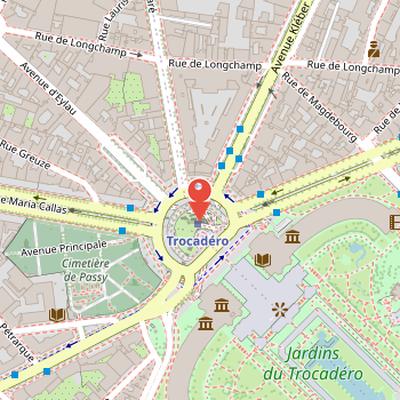
Nearby Objects
-
 Cité de l'architecture et du patrimoine 90 m away
 -
 Musée de l’Homme 100 m away
 -
 Chaillot Palace 100 m away
 -
Théâtre national de Chaillot 110 m away
-
 Passy Cemetery 160 m away
Setting and Access
Place du Trocadero is located at the crossroads of avenue du President-Wilson, avenue Kleber, avenue Raymond-Poincare, avenue d'Eylau, avenue Georges-Mandel, and avenue Paul-Doumer. It opens onto the parvis des droits de l'homme and the Palais de Chaillot, whose west wing in Passy houses the Musee de l'Homme and the Musee de la Marine, while the east wing contains the Cite de l'architecture et du patrimoine and the Musee des Monuments francais.
Situated on the heights of Chaillot, the square is planted with trees and has an equestrian statue of marechal Foch at its center. It is surrounded by a lawn that is difficult for pedestrians to access. To the southeast, it opens onto the Palais de Chaillot and its parvis overlooking the Seine, with a clear view of the Eiffel Tower. At the southwest corner, the junction of avenues Georges-Mandel and Paul-Doumer is occupied by the Cimetiere de Passy on an overlook, and a monument to the glory of the French army by Paul Landowski is installed against the cemetery wall.
Place du Trocadero is one of the first tourist spots in Paris. It also has newspaper kiosks and several cafes and brasseries, including Cafe du Trocadero, Le Malakoff, Patisserie Carette, Cafe Kleber, and Le Coq. It is served by metro lines 6 and 9 at Trocadero station, and on New Year's Eve it is a gathering place for Parisians and tourists.
Name and Historical References
Place du Trocadero was created in 1869 under the name Place du Roi-de-Rome. In 1877, it was renamed to commemorate the Battle of Trocadero. That battle involved French expeditionary forces capturing Fort Louis from Spanish liberal revolutionaries; Fort Louis defended the port of Cadiz in Spain, and the outcome restored the authority of King Ferdinand VII. The name of the place also corresponds to the Armistice of November 11, 1918, which ended combat in World War I. It remains commonly called Place du Trocadero, or more informally Troca.
Historical Development of Place du Trocadero
Place du Trocadero occupies the upper part of the former domain of the Visitandines convent of Chaillot. Its land was sold as national property in the 1790s, then acquired by the Imperial State between 1811 and 1813 for the palace project of the King of Rome. The site lay near the Fermiers generaux wall, removed in 1860, around the former Sainte-Marie barrier and Longchamp boulevard. In 1826, it was used for a reenactment parade of the cited battle before King Charles X of France, for which a papier-mache fort was built on the Chaillot hill.
The square was named place du Trocadero in 1877. For the 1878 Universal Exposition, the Trocadero palace was built on the south-east curve of the square. At that time, the square was circular, bordered by trees, and had a kiosk at its center. The old palace was later partially preserved when it was replaced by the Chaillot palace for the 1937 Universal Exposition. The new palace has two separated wings and a large esplanade facing the Eiffel Tower. In the center of the now semi-circular square stood the Column of Peace, created by Leon Bazin and Albert Laprade, which has since disappeared.
In the early 20th century, the square also hosted a depot of the Compagnie generale des omnibus between Raymond-Poincare and Kliber avenues and behind rue de Longchamp. In 1951, a statue of Marshal Foch was inaugurated at the center of the square, replacing the column. Created by Robert Wlerick before the 1937 exhibition, it is symmetrically located opposite the statue of Marshal Joffre at place Joffre. The square notes the absence of the regulation kepi on the statue, as requested by the fine arts services. In 1956, Maurice Genevoix inaugurated the Monument to the Glory of the French Army, a sculpture by Paul Landowski, along the Passy cemetery. By municipal decree, the site is named place du Trocadero-et-du-11-Novembre.
Olympic Reorganization Proposals
In preparation for the 2024 Summer Olympics, a reorganization of Place du Trocadero was proposed by the majority supporting Mayor Anne Hidalgo. The project included pedestrianizing the Pont d'Iena and transforming the intersection with quai Jacques-Chirac into a planted promenade. It also planned to convert the road section between the center of the square and the parvis into a lawn, while keeping automobile traffic in a horseshoe form.
The Paris Council adopted the project despite opposition expressed through public consultation and by elected officials from LR, LREM, and LFI. Francis Szpiner, the mayor of the arrondissement, asked Culture Minister Roselyne Bachelot to classify the site as a historical monument in an effort to block the project. The plan was then vetoed by the Paris police prefect, who cited traffic congestion and difficulties for emergency access. The city's legal appeals were rejected by the courts in 2022 and 2023. In 2023, Anne Hidalgo announced her intention to relaunch negotiations after the Olympics, while the Olympic arrangements remained in place despite the veto. On July 19, 2023, the prefect wrote to the mayor requesting the square be restored to its previous state.
Political and Public Events at Place du Trocadero
Place du Trocadero has served as a significant setting for both commemorative ceremonies and large public gatherings. Among the recorded events there was Gaston Monnerville's delivery of the speech called Drame juif, as well as the national funeral of Paul Valery. During that funeral, Valery's coffin was placed on the esplanade of palais de Chaillot, the frontons of the building were adorned with golden inscriptions commissioned since 1937, and the statues on the esplanade were veiled in black. The ceremony was attended by general de Gaulle, academic authorities, and members of the Academie francaise, and Valery received civil and military honors, including a parade of troops before the funeral at Sete.
The site has also been used for major political rallies. It hosted a public meeting of around fifty thousand people as the last rally of Nicolas Sarkozy's presidential campaign, and later a rally organized by Francois Fillon, the LR presidential candidate. Recurring political events at the beginning of the 21st century have made Place du Trocadero a symbolic location for the political right.
In addition, the place was used for a PSG celebration marking the club's football championship victory. That event was cut short by violent clashes and vandalism caused by several dozen rioters, prompting widespread political condemnation. The violence also led the political right to criticize the preparedness of the Interior Minister and the police prefect, and it raised questions about the future of similar sports celebrations in Paris.